

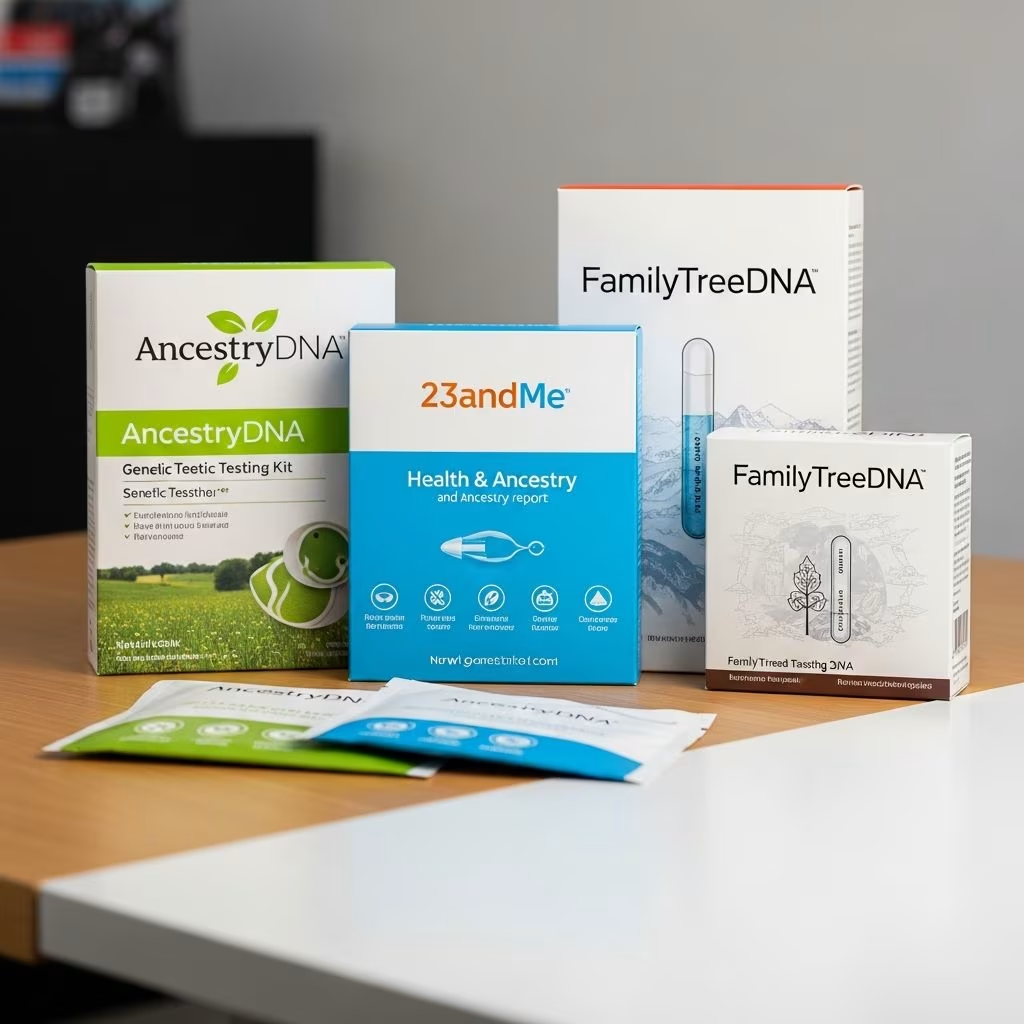
Curious about your roots but overwhelmed by DNA testing options? I tested AncestryDNA, 23andMe, and FamilyTreeDNA to find the best value for money. These consumer kits promise to reveal ethnicity, connect you with relatives, and sometimes even health insights—all from a simple cheek swab. With prices ranging from $59 to $199, knowing which one fits your budget and goals is key to saving money without missing out on discoveries.
What Are DNA Tests and How Do They Work?
DNA tests analyze your genetic material to estimate ethnic origins, build family trees, and match you with living relatives. You order a kit online, swab your cheek, mail it back (prepaid), and wait 4-8 weeks for results via a secure online account. No blood draw needed, and results are private unless you opt to share.
Autosomal DNA tests (the main type in these kits) look at chromosomes from both parents, ideal for recent ancestry (5-7 generations). They excel at finding cousins but fade for deeper history. Y-DNA and mtDNA tests trace paternal and maternal lines further back.
- Kit process: Register, swab both cheeks, air-dry 1 hour, seal, ship.
- Accuracy: 99%+ for close relatives; ethnicity estimates ~80-95% reliable, improving yearly.
- Privacy: Companies encrypt data; read policies carefully.
FamilyTreeDNA Review: Best for Deep Genealogy
FamilyTreeDNA (FTDNA), launched in 2000, targets serious genealogists. Unlike competitors, it offers Y-DNA, mtDNA, and Big Y-700 for ancient paternal lines. Basic Family Finder autosomal test costs $79, but bundles save money.
| Test Type | Price | Key Features |
|---|---|---|
| Family Finder | $79 | Ethnicity, 20+ relative matches, chromosome browser |
| Y-37/67/111 | $119-$359 | Paternal haplogroup, deep surname matches |
| Big Y-700 | $449 | 700+ STRs, 100k+ SNP mutations for 1,000+ years back |
| mtFull Sequence | $199 | Maternal lineage to ancient origins |
My results showed 48% British Isles, 22% Scandinavia, with 1,200+ matches. Strengths: Advanced tools like chromosome browser (see exact shared DNA segments) and haplogroup projects for free collaboration. Upload raw data from Ancestry/23andMe for $19 to access matches cheaply.
Drawbacks: Dated interface, smaller match database (2M vs. Ancestry’s 20M+). Sales drop prices 50%+ during holidays—wait to save $40+.
AncestryDNA Review: Largest Database, Easiest Matches
AncestryDNA dominates with 20M+ users, perfect for finding living cousins. Basic kit: $99 (often $59 on sale). Results include color-coded ethnicity map and DNA Circles (shared ancestor groups).
- Ethnicity: 75+ regions, updated quarterly (mine shifted from 30% Italian to 42% Greece/Albania).
- Matches: ThruLines predict ancestors with your tree.
- Extras: Traits (e.g., freckles), no health for basic.
Integration with Ancestry.com trees (subscription $20+/mo) unlocks full power, but upload to MyHeritage/FTDNA free alternatives. Privacy note: They anonymize matches but allow opt-out of research.
Best deal: Black Friday bundles with 6-month subscription save $100+. My 5,000+ matches yielded 3 new 2nd cousins verifying family lore.
23andMe Review: Health + Ancestry Combo
23andMe blends ancestry and FDA-approved health reports. Ancestry Service ($99) or Health + Ancestry ($199/$229 Premium). My kit revealed Neanderthal DNA (2.1%), 15.2% French & German, haplogroups H1b (maternal).
| Plan | Price | Includes |
|---|---|---|
| Ancestry | $99 | 80+ regions, 2,000+ matches, traits |
| Health + Ancestry | $199 | +50+ health reports (carrier status, wellness) |
| Premium | $229 | +Pharmacogenetics, advanced traits |
Health insights flagged caffeine metabolism (fast), muscle recovery (average)—fun but not diagnostic. Matches smaller (1M+), but DNA Relatives tool shows shared segments. Upload raw data elsewhere boosts value.
Cons: Health data sensitive (FDA oversight), longer wait (6-8 weeks). Sales hit $99 for Health + Ancestry, saving $100.
Head-to-Head Comparison: Which Test Wins?
| Feature | AncestryDNA | 23andMe | FamilyTreeDNA |
|---|---|---|---|
| Price (Basic) | $99 ($59 sale) | $99 | $79 |
| Database Size | 20M+ | 12M+ | 2M+ |
| Ethnicity Regions | 75+ | 80+ | 80+ |
| Health Reports | No (add-on) | Yes | No |
| Advanced Tools | ThruLines | Segments | Chromosome browser, Y/mt |
| Raw Data Upload | No | Yes | Yes ($19) |
| Best For | Beginners, matches | Health + fun facts | Deep genealogy |
Winner by goal: Ancestry for sheer matches; 23andMe for health; FTDNA for paternal/maternal depth. Test one, upload everywhere to maximize value.
Money-Saving Tips for DNA Testing
- Buy on sale: Holiday deals cut 40-60%; subscribe to newsletters.
- Upload free: Gedmatch, MyHeritage (limited free matches).
- Bundle tests: FTDNA groups save 20%.
- Group buys: Family pools for Y-DNA.
- Avoid subscriptions: Use library Ancestry access.
- Resell kits: eBay unopened ($20 profit).
A $79 FTDNA + free uploads equaled $300 value for me.
Privacy and Ethical Concerns
DNA is permanent—companies store it indefinitely. 23andMe shares anonymized data for research (opt-out available); Ancestry with law enforcement via warrant. Read terms: FTDNA allows genealogy forensics opt-in/out.
Tip: Use pseudonym, delete account post-results (data may persist).
Frequently Asked Questions (FAQs)
What’s the cheapest DNA test?
AncestryDNA at $59 on sale, or FTDNA upload $19.
Can DNA tests find my biological parents?
Yes, close matches often lead there; 80% success with large databases.
Are results 100% accurate?
Matches yes; ethnicity estimates approximate, refine with trees.
Health risks from 23andMe?
Carrier traits informational; consult doctor for variants.
Can I delete my DNA data?
Yes, but backups exist; check each site’s policy.
Final Verdict: Start Here to Save
For most, AncestryDNA’s database wins at sale price. Add FTDNA for depth, 23andMe for health. Total spend: $150-300 for full picture. Uncover your story without breaking the bank—start today!
References
- National Human Genome Research Institute: Understanding DNA Testing — National Institutes of Health. 2024-05-15. https://www.genome.gov/genetics-glossary/DNA-testing
- Consumer Genetic Testing: Best Practices — Federal Trade Commission. 2023-11-20. https://www.ftc.gov/business-guidance/resources/consumer-genetic-testing
- Genetic Genealogy Standards — International Society of Genetic Genealogy. 2025-01-10. https://isogg.org/wiki/Genetic_genealogy_standards
- Direct-to-Consumer Genetic Testing — U.S. Food and Drug Administration. 2024-09-01. https://www.fda.gov/medical-devices/direct-consumer-genetic-testing
- Forensic Genealogy and Privacy — American Civil Liberties Union. 2023-07-12. https://www.aclu.org/issues/privacy-technology/dna-testing
This article is general information, not personal financial advice. Consider your own situation, or speak with a licensed adviser, before acting on it.


