

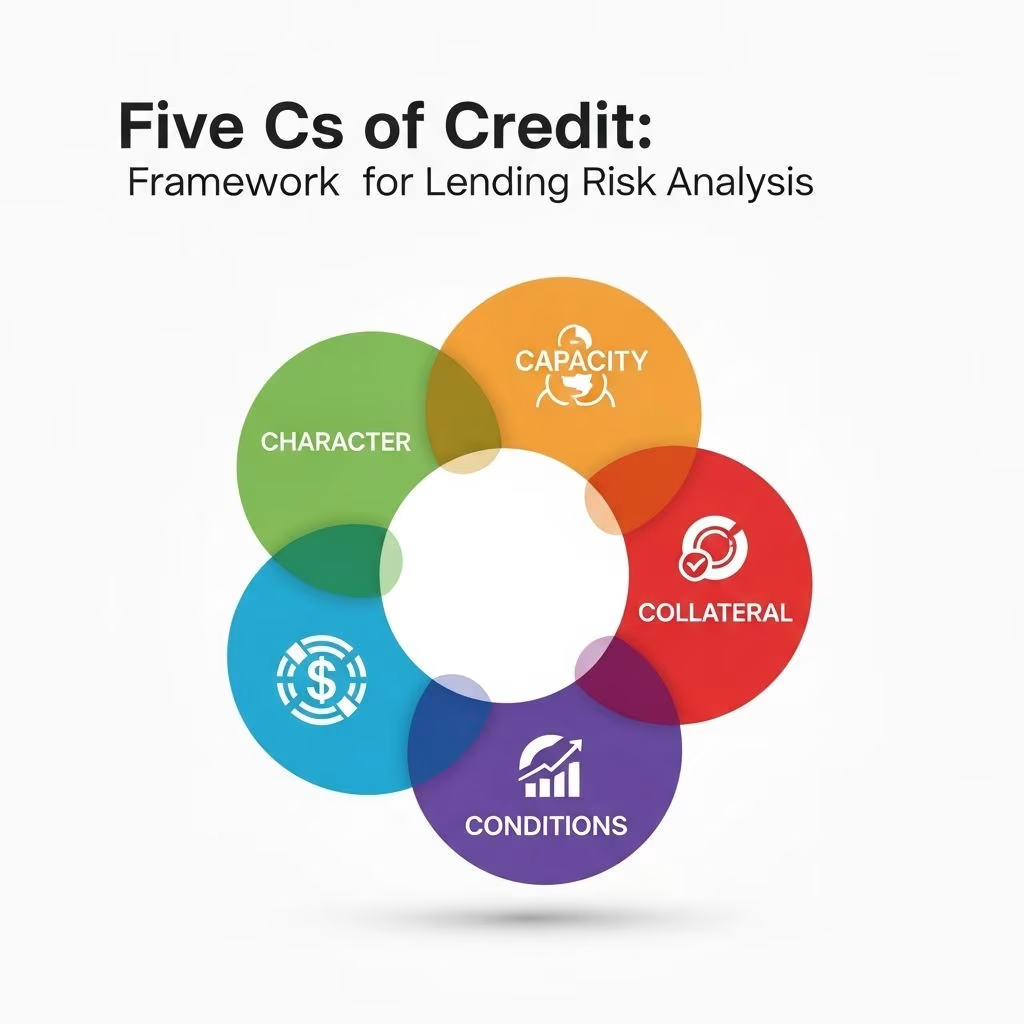
Five Cs of Credit: A Comprehensive Guide to Lending Risk Analysis
The Five Cs of Credit represent a fundamental framework that financial institutions, banks, and lending organizations use to evaluate the creditworthiness of potential borrowers. This systematic approach helps lenders minimize risk and make informed decisions about loan approvals, interest rates, and repayment terms. By analyzing Character, Capacity, Capital, Collateral, and Conditions, lenders can develop a comprehensive understanding of a borrower’s ability and willingness to repay borrowed funds.
Credit risk—the possibility that a borrower may fail to meet their repayment obligations—is a critical concern for all lending institutions. The 5 Cs framework provides a structured methodology to assess this risk through both qualitative and quantitative metrics. Understanding each component helps borrowers strengthen their loan applications and enables lenders to price credit appropriately and structure lending agreements that protect their interests while serving borrower needs.
What Are the Five Cs of Credit?
The Five Cs of Credit is a risk assessment system designed to evaluate the overall strength of a loan application. Each of the five components addresses a different aspect of the borrower’s financial profile and circumstances:
- Character: The borrower’s creditworthiness, integrity, and historical payment performance
- Capacity: The borrower’s ability to generate sufficient income to meet debt obligations
- Capital: The borrower’s financial position, including savings, assets, and net worth
- Collateral: Assets that can be pledged to secure the loan
- Conditions: External economic factors and specific circumstances surrounding the loan request
Each lender weights these five components differently based on the borrower type, loan size, and specific circumstances. While some lenders may emphasize character and payment history, others may prioritize capital and collateral. This flexibility allows the framework to apply across various lending scenarios, from personal mortgages to commercial business loans.
Character: Assessing Borrower Integrity and Payment History
Character represents the borrower’s commitment to honor their financial obligations and their historical track record of managing credit responsibly. This component addresses the fundamental question every lender asks: Will this borrower make their payments on time, even if unforeseen circumstances arise?
Lenders evaluate character through several key indicators:
- Credit Score (FICO): A numerical representation of credit history, typically ranging from 300 to 850
- Credit History: The borrower’s record of past loan payments, credit card usage, and debt management
- Payment Timeliness: Whether the borrower has consistently paid bills on or before the due date
- Default History: Any instances of loan default or bankruptcy proceedings
- Late Payment Records: The frequency and severity of late or missed payments
For corporate borrowers, character assessment becomes more complex. Lenders examine the management team’s reputation, the company’s track record in honoring commitments, and the ownership structure. A strong management team with a history of successful ventures presents lower credit risk than an inexperienced team entering the market for the first time.
The significance of character cannot be overstated. A borrower with an excellent payment history and high credit score demonstrates reliability and responsibility. Conversely, a pattern of late payments, defaults, or bankruptcy raises serious concerns about whether the borrower will prioritize the new loan obligation. Lenders recognize that character serves as a proxy for future behavior—if a borrower has managed credit responsibly in the past, they are more likely to continue doing so.
Capacity: Evaluating the Ability to Repay Debt
Capacity measures the borrower’s ability to generate sufficient income and cash flow to meet all debt obligations, including the new loan payment. Unlike character, which relies on historical behavior, capacity focuses on current financial strength and future earning potential. This component is more quantitative and objective than character assessment.
Lenders evaluate capacity through various financial metrics and ratios:
- Debt-to-Income Ratio: Total monthly debt payments divided by gross monthly income
- Debt Service Coverage Ratio: Net operating income divided by total debt obligations
- Income Stability: Whether income is consistent, growing, or subject to volatility
- Employment History: Length of employment and job stability in the current position
- Industry Conditions: Whether the borrower’s industry is stable or experiencing decline
For personal borrowers, a lender examines employment history, income level, and existing debt obligations. A borrower with stable employment and low existing debt has higher capacity than someone with irregular income or significant existing obligations. If the debt-to-income ratio is already high, adding a new loan payment may strain the borrower’s finances to unsustainable levels.
For business borrowers, capacity analysis becomes more sophisticated. Lenders examine cash flow statements, income statements, and balance sheets to understand the company’s ability to service debt. A company with strong, consistent cash flows and reasonable leverage is viewed as having high capacity. Conversely, a business with declining revenues or already excessive debt may lack sufficient capacity to take on additional borrowing.
Capital: Assessing Financial Position and Asset Base
Capital encompasses the borrower’s overall financial position, including liquid assets, savings, investments, and net worth. Capital demonstrates the borrower’s financial cushion and willingness to invest their own resources into their endeavors. When borrowers have significant capital invested in a project or business, they have greater incentive to ensure success and meet their obligations.
Lenders consider capital from multiple perspectives:
- Down Payment Size: The percentage of the purchase price the borrower contributes from their own funds
- Savings and Reserves: Emergency funds available to cover loan payments if income temporarily declines
- Investment Assets: Stocks, bonds, and other liquid securities that could be liquidated if needed
- Net Worth: Total assets minus total liabilities, reflecting overall financial strength
- Equity Position: For business loans, the owner’s equity stake versus debt financing
A larger capital contribution by the borrower significantly reduces lender risk. For example, a homebuyer making a 20% down payment demonstrates greater financial responsibility and skin-in-the-game than someone making a minimal down payment. The larger initial investment means the borrower has more to lose if they default, creating a powerful incentive to maintain payments.
Similarly, in commercial lending, a company with strong equity financing and low debt levels presents lower risk than an over-leveraged enterprise. A lender observes that a well-capitalized company has greater financial flexibility to weather economic downturns and unexpected challenges.
Collateral: Securing the Loan with Pledged Assets
Collateral refers to assets that the borrower pledges as security for the loan. In the event of default, the lender has a legal right to seize and sell the collateral to recover the loan proceeds. Collateral-backed loans, known as secured loans, provide lenders with additional protection and reduce risk significantly.
Collateral assessment involves evaluating:
- Asset Quality: The condition and marketability of the pledged assets
- Liquidity: How quickly the asset could be sold to generate cash
- Loan-to-Value Ratio: The loan amount relative to the collateral’s market value
- Market Demand: Whether the asset would find ready buyers if liquidation becomes necessary
- Depreciation Risk: Whether the asset’s value might decline over the loan term
Common forms of collateral include real estate (homes, commercial property, land), vehicles, equipment, inventory, accounts receivable, and investment securities. Real estate typically serves as collateral for mortgages, while vehicles secure auto loans. Business loans might be secured by equipment, inventory, or personal guarantees from company owners.
The presence of quality collateral can enable a lender to extend more favorable terms, including lower interest rates and higher loan amounts. A lender willing to extend credit with minimal collateral requirements typically expects compensating factors elsewhere—such as excellent character and capacity indicators. Conversely, weak character or capacity signals may require substantial collateral to offset the risk.
Conditions: Understanding Economic and Contextual Factors
Conditions encompass the broader economic environment and specific circumstances surrounding the loan request. External factors beyond the borrower’s control can significantly impact their ability to repay, making conditions an important consideration in credit risk assessment.
Macroeconomic conditions that lenders consider include:
- Economic Growth Rate: Whether the economy is expanding or contracting
- Unemployment Levels: Rising unemployment increases default risk across borrower populations
- Interest Rate Environment: Higher interest rates increase borrowing costs and may affect repayment ability
- Industry Trends: Whether the borrower’s industry is growing or declining
- Inflation Rates: Which affects purchasing power and business costs
Specific conditions related to the loan itself include the loan purpose, requested amount, and repayment timeline. A borrower seeking funds to start a business in a high-risk industry during uncertain economic times presents greater conditions risk than someone refinancing an existing mortgage with predictable payments. The end use of funds matters significantly—lending for equipment purchases backed by expected revenue generation is different from lending for consumer consumption.
A borrower’s industry can create substantial conditions risk. For example, during energy price declines, oil and gas companies face challenging conditions regardless of individual character, capacity, or capital strength. Technology companies experience different cyclical conditions than utilities. Lenders must understand how macroeconomic and industry-specific conditions could impair a borrower’s repayment ability.
How Lenders Apply the Five Cs Framework
Lenders use the Five Cs framework as a comprehensive risk assessment tool that informs multiple lending decisions. Rather than relying on a single factor, sophisticated lenders evaluate all five components holistically to develop a complete credit profile.
The framework typically influences:
- Loan Approval Decisions: Whether to approve or deny the loan application
- Interest Rate Pricing: Higher-risk borrowers pay higher interest rates
- Loan Terms: Repayment period, covenants, and other conditions
- Loan Amount: The maximum amount the lender is willing to advance
- Required Down Payment: The percentage of funds the borrower must contribute
- Collateral Requirements: What assets must secure the loan
Strengths Offsetting Weaknesses
The Five Cs framework recognizes that strength in one area can compensate for weakness in another. For instance, a borrower with an excellent credit score and strong payment history (strong character) might secure a loan despite lower current income levels (weaker capacity) or minimal down payment (weaker capital). Similarly, a company with substantial liquid collateral may qualify for favorable terms despite operating in a cyclical industry, because the collateral provides strong loss mitigation if default occurs.
This flexibility makes the framework adaptable to diverse lending situations and borrower profiles. A startup founder with limited track record but strong capital investment and excellent collateral might qualify for business financing. A long-term employee with modest income but substantial home equity might qualify for a personal loan despite lower debt service capacity.
Comparison Table: The Five Cs at a Glance
| Credit Factor | Definition | Assessment Type | Key Metrics |
|---|---|---|---|
| Character | Borrower’s integrity and payment history | Qualitative/Historical | Credit score, payment history, defaults |
| Capacity | Ability to generate income for repayment | Quantitative/Current | Debt-to-income ratio, cash flow, employment |
| Capital | Borrower’s financial position and reserves | Quantitative/Balance Sheet | Net worth, assets, down payment, savings |
| Collateral | Assets securing the loan | Quantitative/Asset-Based | LTV ratio, asset quality, liquidity |
| Conditions | Economic and contextual factors | Qualitative/External | Economic outlook, industry trends, loan purpose |
The Five Cs in Different Lending Scenarios
Personal Mortgage Lending
In residential mortgage lending, the Five Cs framework emphasizes character and capacity heavily. Lenders examine credit scores and payment history (character) alongside employment and income stability (capacity). Capital considerations include down payment size and savings, while collateral is the home itself. Conditions assess local real estate market conditions and economic outlook affecting property values.
Auto Lending
Auto lenders focus on character through credit scores and capacity through debt-to-income ratios. The vehicle itself serves as collateral, with loan-to-value ratios typically around 80-100%. Capital requirements depend on vehicle type and borrower profile. Conditions include used versus new vehicle conditions and market depreciation expectations.
Business Lending
Commercial lending emphasizes all five components equally. Character includes management team reputation and business track record. Capacity involves analyzing business cash flows, revenue trends, and debt service coverage. Capital considers owner’s equity investment. Collateral might include business assets, equipment, or personal guarantees. Conditions assess industry cycles and economic environment affecting business operations.
Frequently Asked Questions About the Five Cs of Credit
What is the most important of the Five Cs of Credit?
Different lenders weight the Five Cs differently, but character is often considered foundational. A borrower with excellent character and payment history demonstrates reliability regardless of other factors. However, strong capacity and capital can compensate for moderate character concerns. The relative importance depends on the loan type and borrower circumstances.
Can a borrower with weak collateral still obtain a loan?
Yes, a borrower with strong character, capacity, and capital can qualify for unsecured lending despite lacking collateral. Unsecured personal loans and credit cards operate without collateral backing. However, unsecured lending typically carries higher interest rates to compensate for increased lender risk.
How do lenders verify the information borrowers provide about the Five Cs?
Lenders use credit bureaus for credit history and FICO scores, employment verification services for income and employment status, appraisers for asset and collateral valuation, financial statement analysis for business loans, and public records for legal issues like bankruptcies or liens. Third-party verification ensures accuracy and reduces fraud risk.
Does improving one C of Credit automatically improve approval chances?
Improving any of the Five Cs strengthens the overall loan application, but the degree of impact varies by lender priorities and loan type. Improving capital by saving for a larger down payment helps significantly. Improving character through paying down debt and maintaining perfect payment records takes time but demonstrates commitment. Lenders evaluate the complete profile rather than isolated factors.
How do economic conditions affect the Five Cs framework?
Economic downturns directly impact conditions risk and indirectly affect all other factors. During recessions, lenders may tighten requirements despite strong individual borrower profiles. Industry-specific recessions particularly affect business lending. Lenders may require stronger character, capacity, or capital compensating factors when conditions deteriorate.
Are the Five Cs used equally for all loan types?
No, lenders weight the Five Cs differently depending on loan type. Mortgage lenders emphasize collateral and capacity. Credit card companies emphasize character and capacity. Business lenders typically weight all five equally. The loan size, term, and borrower type influence which factors receive greatest emphasis in the evaluation process.
References
- 5 Cs of Credit | Lending Risk Analysis Framework — Wall Street Prep. 2025. https://www.wallstreetprep.com/knowledge/5-cs-of-credit/
- 5 Cs of Credit – Overview, Credit Risk, Framework — Corporate Finance Institute. 2025. https://corporatefinanceinstitute.com/resources/commercial-lending/5-cs-of-credit/
- Five C’s to Understanding Small Business Credit — ESL. 2025. https://www.esl.org/resources-tools/business-support/borrowing-for-your-business/five-c-s-of-credit
This article is general information, not personal financial advice. Consider your own situation, or speak with a licensed adviser, before acting on it.


