

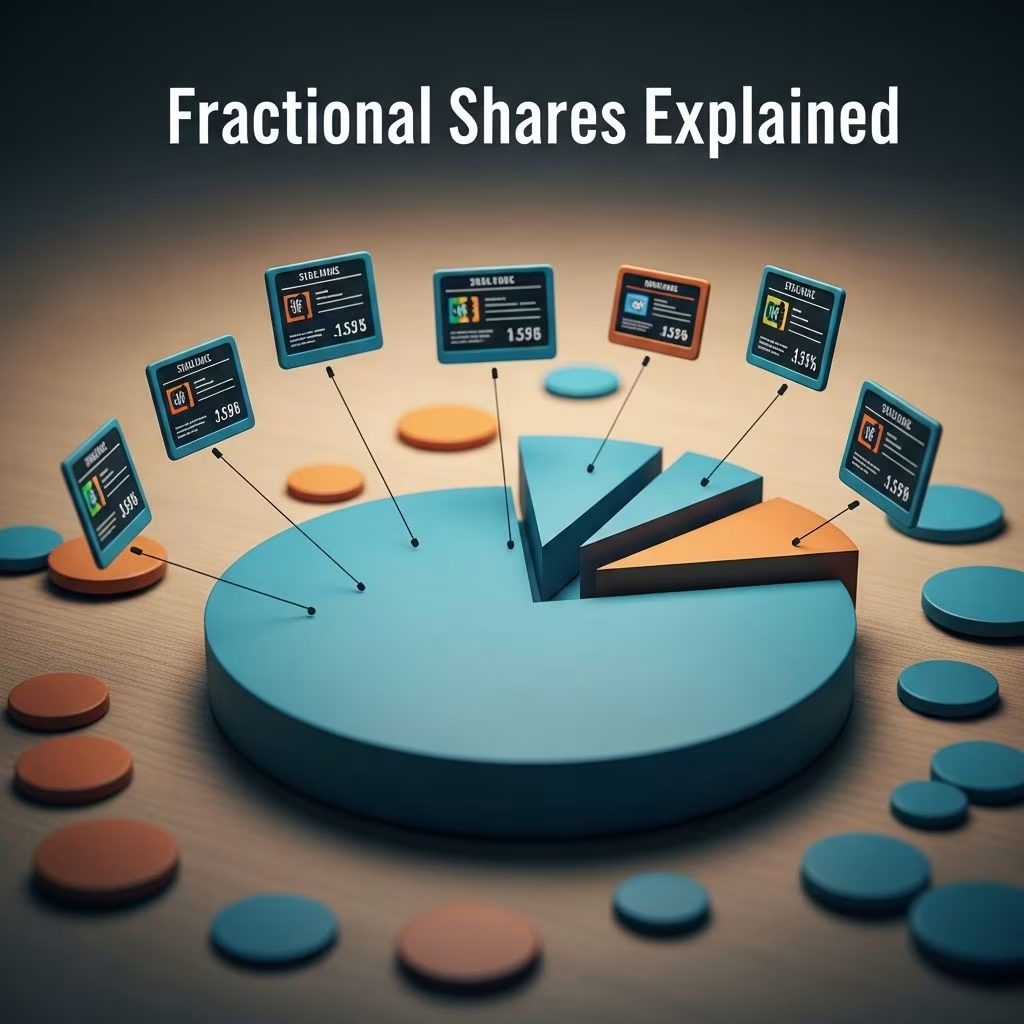
Fractional shares enable investors to purchase portions of a single stock or exchange-traded fund (ETF) rather than requiring a full share, making high-priced securities accessible to those with smaller budgets. This approach democratizes investing by allowing precise dollar-amount investments, proportional ownership, and proportional returns including dividends.
Understanding the Fundamentals of Partial Stock Ownership
At its core, a fractional share represents ownership of less than one complete unit of a company’s equity or an ETF. For instance, if a stock trades at $1,000 and an investor allocates $250, they acquire 0.25 shares. This ownership entitles them to a corresponding fraction of any dividends, capital gains, or corporate actions like stock splits.
Brokerages facilitate this by aggregating orders or using internal mechanisms to divide shares. Unlike whole shares traded on exchanges, fractions often settle through the firm’s dividend reinvestment plans (DRIPs) or direct slicing of holdings. This innovation stems from advancements in trading technology, enabling retail investors to mirror professional strategies without large capital outlays.
Why Fractional Shares Matter in Modern Portfolios
Traditional investing demands buying whole shares, often leaving surplus cash uninvested if prices exceed available funds. Fractional shares eliminate this inefficiency, allowing every dollar to work immediately. They particularly benefit newcomers or those building diversified portfolios amid volatile markets where blue-chip stocks like tech giants command premiums.
- Lower Entry Barriers: Invest in pricier assets without waiting to accumulate full-share costs.
- Precision Allocation: Target exact investment amounts, ideal for thematic strategies like sustainable energy or AI sectors.
- Enhanced Diversification: Spread capital across more holdings, reducing single-stock risk exposure.
Financial regulators note that this model empowers broader participation, though availability varies by brokerage.
Mechanics: How to Buy and Trade Fractions
Trading fractional shares typically occurs via dollar-based orders. Specify a cash amount, and the platform calculates the equivalent fraction at the prevailing price. For example, a $500 order for a $2,000 stock yields 0.25 shares.
Key operational aspects include:
| Aspect | Description | Example |
|---|---|---|
| Order Types | Dollar or share quantity; some platforms restrict to regular hours | $100 in XYZ at $1,000/share = 0.1 shares |
| Eligible Assets | Often limited to S&P 500 stocks, ETFs; check firm lists | Apple, Vanguard ETFs |
| Trading Windows | May exclude after-hours; mobile/app only in some cases | 9:30 AM – 4 PM ET |
Selling mirrors buying: liquidate fractions for cash, with proceeds proportional to market value. Platforms like Fidelity and Schwab pioneered “stock slices,” bundling fractions seamlessly into accounts.
Financial Rewards: Dividends and Growth Potential
Fractional owners receive pro-rata dividends. Owning 0.5 shares of a stock paying $2 per share yields $1. ETFs distribute collected dividends similarly, often quarterly, with options for cash payout or reinvestment.
Capital appreciation works identically: if the underlying value rises 20%, so does the fraction’s worth. Profits realize upon sale, taxed as ordinary capital gains based on holding period. This parity ensures fractions perform like wholes, minus minor brokerage fees.
Strategic Applications for Investors
Building Diversified Holdings
Fractional shares shine in diversification. Allocate $1,000 across 10 high-flyers ($100 each) versus concentrating in one or two affordable stocks. This mirrors index fund benefits but with stock-picking flexibility.
Custom Portfolio Balancing
Rebalance precisely: adjust to 5% tech exposure by buying exact fractions, avoiding whole-share rounding errors. Thematic investing—e.g., green tech—becomes feasible with modest sums.
Long-Term Compounding
Reinvest fractional dividends to acquire more fractions, accelerating growth via automation. Vanguard highlights this for ETF slices, compounding returns over decades.
Potential Drawbacks and Risk Considerations
Despite advantages, limitations persist. Not all brokerages offer fractions across all securities; some cap at U.S. large-caps. Trading restrictions—like no shorting or options on fractions—limit advanced tactics.
- Liquidity Issues: Fractions may trade slower or at wider spreads.
- Fee Structures: Rare commissions, but spreads or minimums apply.
- Corporate Actions: Splits adjust fractions proportionally, but rights offerings might not.
Market risks remain: fractions amplify losses if values drop. The SEC advises thorough research, as fractions don’t mitigate volatility.
Choosing the Right Brokerage Platform
Evaluate platforms by eligible assets, fees, and interfaces. Leaders include:
| Platform | Key Features | Minimum Investment |
|---|---|---|
| Fidelity | Dollar-based for stocks/ETFs, no fees | $1 |
| Schwab | Stock Slices for S&P 500, 24/7 trades | $5 |
| Vanguard | ETF focus, dividend reinvestment | $1 |
| TD Direct | High-priced stock access | Varies |
Select based on your assets and frequency; test demos for usability.
Frequently Asked Questions
Can I trade fractional shares anytime?
Most platforms limit to standard market hours, though some like Schwab offer extended windows. Confirm with your broker.
Do fractional shares qualify for dividends?
Yes, proportionally. A 0.75 share gets 75% of the per-share payout.
Are there taxes on fractional dividends?
Dividends are taxable income; sales trigger capital gains tax. Track via 1099 forms.
Can I use fractions in retirement accounts?
Often yes, in IRAs or 401(k)s supporting them, enhancing tax-advantaged growth.
What’s the minimum for fractional investing?
Typically $1-$5, varying by firm and asset.
Future Outlook for Fractional Trading
As fintech evolves, expect wider adoption, including international stocks and crypto fractions. Regulatory clarity from bodies like the SEC will standardize practices, potentially integrating with robo-advisors for automated slicing.
Investors should view fractions as tools, not shortcuts. Pair with education and risk assessment for sustainable strategies. Always diversify and align with long-term goals amid economic shifts.
References
- What are Fractional Shares? | TD Direct Investing — TD. 2023. https://www.td.com/ca/en/investing/direct-investing/articles/fractional-shares
- Fractional Share Investing – Buying a Slice Instead of the Whole Share — SEC Office of Investor Education and Advocacy. 2023-10-12. https://www.investor.gov/introduction-investing/general-resources/news-alerts/alerts-bulletins/investor-bulletins/fractional-share-investing-buying-slice-instead-whole-share
- What are fractional shares? Pros and Cons, Examples — Trading 212. 2024. https://www.trading212.com/learn/investing-101/fractional-shares
- What are fractional shares and how do they work? A complete guide — Saxo. 2024. https://www.home.saxo/en-sg/learn/guides/equities/what-are-fractional-shares-and-how-do-they-work-a-complete-guide
- Fractional shares | Dollar-based investing | Fidelity — Fidelity. 2024. https://www.fidelity.com/learning-center/trading-investing/fractional-shares
- Fractional Shares | Invest in Stock Slices – Charles Schwab — Charles Schwab. 2024. https://www.schwab.com/fractional-shares-stock-slices
- Dollar-based Trading-Fractional Shares — Vanguard. 2024. https://investor.vanguard.com/investor-resources-education/article/what-is-dollar-based-investing
This article is general information, not personal financial advice. Consider your own situation, or speak with a licensed adviser, before acting on it.


