

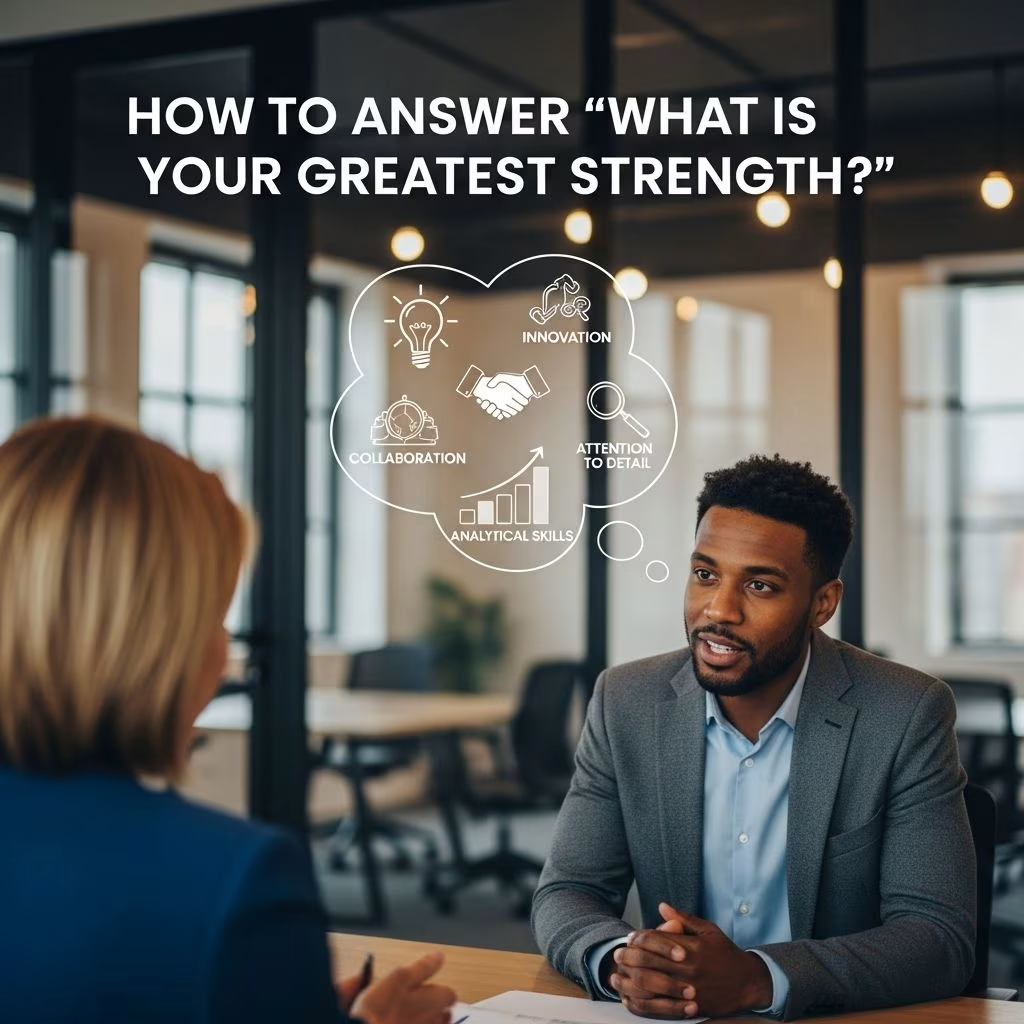
How to Answer ‘What Is Your Greatest Strength?’ With Examples
One of the most common questions you’ll encounter in job interviews is, “What is your greatest strength?” While it might seem straightforward, this question is actually an opportunity to showcase your most valuable skills, abilities, and qualifications in a way that resonates with hiring managers. The key is not just to identify a strength, but to present it strategically in the context of the position you’re pursuing.
This question gives you a chance to highlight what makes you unique and how you can contribute to the organization. Rather than simply listing qualities, the most effective approach involves selecting a strength that aligns with the job requirements and backing it up with a concrete example that demonstrates its impact.
Choose Your Strength Strategically
The first step in crafting a compelling answer is to think carefully about which strength to highlight. You shouldn’t just pick any skill you’re good at; instead, consider which strengths will position you as the most qualified candidate for the specific role and make you a valuable addition to the company culture.
Before your interview, review the job description thoroughly. Look for keywords and required skills that the employer emphasizes. Then identify which of your genuine strengths best match those requirements. This strategic alignment demonstrates that you understand the role and have the qualities the organization is seeking.
When selecting your strength, consider the following approach: identify two or three strengths that genuinely apply to the position, then choose the one that’s most relevant and that you can illustrate with a compelling story or example.
Use the STAR Method to Back Up Your Answer
Saying “I’m a great communicator” carries far less weight than actually demonstrating your communication skills through a concrete example. This is where the STAR technique becomes invaluable. STAR stands for Situation, Task, Action, and Result, and it helps you structure your answer to prove that you can do what you claim you can do.
Here’s how the STAR method works: First, describe the Situation and Task you were facing. Then, explain the Action you took to address the challenge. Finally, highlight the Result of your efforts. This framework keeps your answer focused and prevents you from rambling or making claims you can’t substantiate.
A strong STAR example for a strength answer sounds like this: “My greatest strength is my ability to take initiative and improve team processes. During my last internship, I was helping to manage several social media accounts. I noticed that the team wasn’t always on the same page about our messaging strategy. So I took the initiative to send out a weekly email to keep everyone informed and to solicit feedback. This weekly update ended up being so helpful that it was later incorporated into a full-time staff member’s responsibilities.” This example clearly shows the situation, the action taken, and the measurable impact.
Categories of Strengths to Consider
When brainstorming which strength to highlight, it helps to think about different categories of strengths that are relevant in most professional environments. Here are the main categories:
Communication Strengths
If your role involves interacting with colleagues, clients, or customers, communication skills are vital. Communication strengths include:
- Building strong relationships
- Communicating clearly in writing
- De-escalating conflict situations
- Giving constructive feedback
- Handling difficult conversations
- Listening actively to others
- Making conversation with new people
- Negotiating effectively
- Providing excellent customer service
- Speaking or writing persuasively
- Presenting to groups of people
- Telling compelling stories
Management Strengths
Even if you’re not applying for a formal management position, demonstrating leadership qualities can set you apart. Management strengths include:
- Being aware of disabilities and accessibility needs
- Recognizing diversity and inclusion
- Creating clear roadmaps and vision
- Delegating effectively
- Focusing on process improvements
- Focusing on achieving results
- Handling team conflicts
- Identifying employee strengths and weaknesses
- Managing projects successfully
- Motivating employees
- Mentoring and developing others
- Setting realistic deadlines
- Establishing achievable goals
Teamwork Strengths
Before selecting a teamwork strength, consider how you’ll likely be working with teams in the specific role. Teamwork strengths include:
- Accepting and incorporating feedback
- Being dependable and reliable
- Going above and beyond to help others
- Communicating effectively across departments
- Demonstrating high emotional intelligence
- Noticing when colleagues need assistance
- Responding quickly to changes
- Taking charge when the situation calls for it
Work Style Strengths
These strengths reflect how you approach tasks and get work done. They’re excellent for demonstrating how well you’d integrate with an existing team. Work style strengths include:
- Being adaptable to new situations
- Being proactive and forward-thinking
- Collaborating with others effectively
- Finding creative solutions to problems
- Paying attention to small details
- Thinking about the bigger picture
- Multitasking when needed
- Prioritizing effectively
- Switching between tasks quickly
- Self-motivating without external pressure
- Performing well under pressure
Real Examples of Strong Strength Answers
Example: Identifying Patterns
“I’d say that one of my greatest strengths is identifying patterns in data and processes. For example, as a junior operations analyst, I noticed that at a company my team was consulting for, mistakes tended to happen in clusters, but not always on the same days of the week or ahead of deadlines. After examining the company’s meeting schedule, I realized that all of the error clusters happened on days where there was a staff meeting from 3 to 4 p.m. I hypothesized that after these meetings, people were either rushing to finish by 5 p.m. or not fully focusing after a late-afternoon meeting. Once I pointed this out, the company implemented a policy where all larger meetings had to be over by 3 p.m., and these spikes in mistakes disappeared, leading to a 15% decrease in refunds.”
Example: Building Relationships
“My greatest strength is probably my ability to build strong relationships with clients. I genuinely enjoy meeting and getting to know new people, so I always approach each new account as an opportunity to make a lasting work connection. By asking thoughtful questions and really listening to their answers, I’m usually able to build strong rapport quickly. I credit these relationships with my 90% renewal rate. I’ve even had contacts from clients move to different companies and then specifically request to work with me again.”
Example: Empathy and User Perspective
“I think that one of my biggest strengths is being able to anticipate questions and issues that users will have with new products or features. I’m good at putting myself in the shoes of different types of users and flagging potential questions or concerns that the product team may not have considered. Sometimes they’re able to address these issues before launch, but even if they can’t, the marketing team can be proactive about addressing customer concerns.”
Example: Emotional Intelligence
“I’m skilled at reading people and recognizing when they need help or support. In a senior business class, we had a group project where each person needed to give a five-minute presentation segment in front of a large group. From our first meeting, I could tell that one student was particularly uncomfortable with public speaking. When it came time to divide our sections, I directed the conversation so that he could choose the topic he was most comfortable presenting about. This allowed him to deliver his best work and boosted the overall quality of our presentation.”
Example: Empathy in Customer Service
“My greatest strength is empathy. When I’m dealing with customer complaints, I’m able to genuinely put myself in their shoes and understand how an issue is affecting them on a personal level. This approach has resulted in my department maintaining the highest complaint resolution numbers for the past three quarters.”
Example: Flexibility and Adaptability
“I believe that my greatest strength is flexibility and adaptability. I’m one of those rare people who genuinely enjoys change and thrives in dynamic environments, which is why I’m particularly interested in startups like your company. You’re never in the same role for long, regardless of job title. In my current position, I’ve successfully learned social media management, design work, and several project management systems. I genuinely love the opportunity to keep expanding my skill set.”
Example: Resilience
“My greatest strength is resilience. I bounce back from challenges and always emerge with new insights about my work, my team, and myself. My last employer underwent a major restructuring where I worked on three different teams in just six months. At one point, I was briefly assigned to assist the software development team, and that experience helped me discover where I truly wanted to build my career. Since then, I’ve spent considerable time taking relevant classes, pursuing independent study, and earning industry certifications to solidify my expertise.”
Common Strengths to Highlight
If you’re still deciding which strength to emphasize, here’s a comprehensive list of professional strengths that resonate well in most interview settings:
- Attention to detail
- Collaboration skills
- Communication abilities
- Creativity and innovation
- Discipline and focus
- Emotional intelligence
- Empathy and understanding
- Entrepreneurial mindset
- Flexibility and adaptability
- Patience with complex processes
- Problem-solving capability
- Resilience under pressure
- Strong teamwork skills
- Time management expertise
- Outstanding work ethic
Mistakes to Avoid When Answering This Question
Making Statements Without Offering Proof
One of the biggest mistakes candidates make is stating a strength without backing it up with concrete evidence. Simply saying “I’m a great leader” or “I’m incredibly organized” without providing an example feels hollow and unsubstantiated. Always use the STAR technique to demonstrate that you can actually do what you claim. This approach also prevents you from making promises your skill set can’t deliver on.
Rambling or Going Off Track
Another common pitfall is providing a long-winded answer that loses focus or goes in multiple directions. Keep your response concise and directly relevant to the question and the position. If you notice yourself speaking quickly or straying from your main point, take a breath and refocus. Remember that quality matters more than quantity. A tight, well-structured two-minute answer is far more impressive than a rambling five-minute monologue.
Key Takeaways for Your Interview
When preparing to answer this question, remember these essential points: First, think strategically about which strength will best position you for the specific role. Second, always back up your strength with a concrete, measurable example using the STAR method. Third, keep your answer focused and concise, avoiding unnecessary details or tangents. Finally, choose a strength that’s genuine and that you can speak about authentically, as interviewers can usually tell when candidates are being inauthentic.
Frequently Asked Questions
Q: Should I mention multiple strengths or just one?
A: While it’s fine to briefly mention that you have multiple strengths, focus primarily on one or two that are most relevant to the position. Providing a detailed example for one strength is more impactful than briefly listing several.
Q: What if my greatest strength seems too common or generic?
A: Every strength becomes unique when you support it with a specific, personal example. Even if communication or teamwork seem common, your particular story and impact make it distinctive. Focus on what you uniquely bring to the table.
Q: Can I mention a strength that’s directly related to a weakness?
A: Yes, this can work well. For example, you might say you’re detail-oriented but have learned to balance that with big-picture thinking. However, make sure the strength is genuine and that you focus more on the positive aspect than the limitation.
Q: How long should my answer be?
A: Aim for 60 to 90 seconds. This gives you enough time to state your strength, provide context with the STAR method, and deliver a measurable result without rambling.
Q: Should I tailor my answer for each company or position?
A: Absolutely. While you can have a general framework prepared, you should adjust your answer to align with the specific job description and company culture. This shows that you’ve researched the position and understand what they’re looking for.
References
- 3 Smart Strategies for Answering “What’s Your Greatest Strength?” — The Muse. Accessed November 2025. https://www.themuse.com/advice/3-smart-strategies-for-answering-whats-your-greatest-strength
- How To Answer “What Is Your Greatest Strength?” [With Examples] — CareerCloud. Accessed November 2025. https://careercloud.com/what-is-your-greatest-strength/
- The Fine Line Between My Greatest Strength and Weakness — Real Life Coaching. Accessed November 2025. https://reallifee.com/wp/the-fine-line-between-my-greatest-strength-and-weakness
This article is general information, not personal financial advice. Consider your own situation, or speak with a licensed adviser, before acting on it.


