

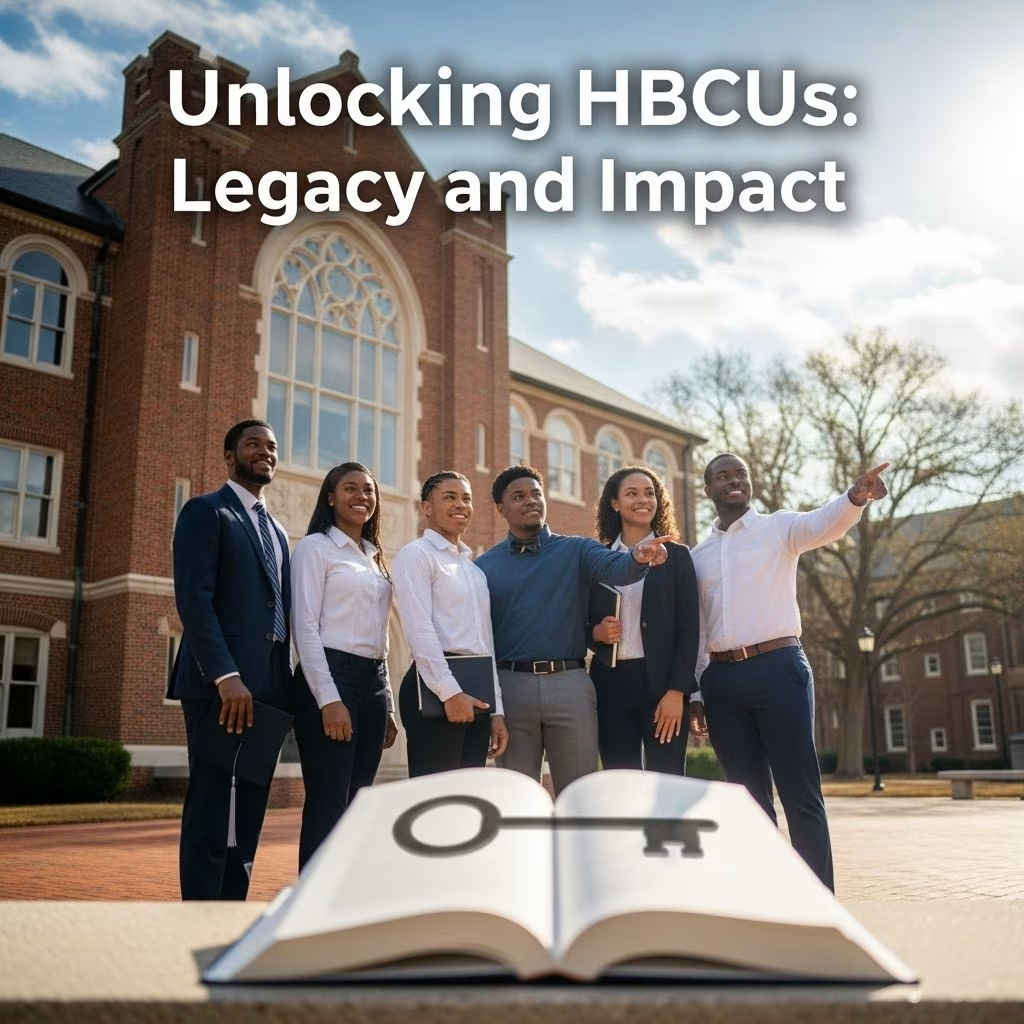
Historically Black Colleges and Universities (HBCUs) represent pillars of resilience and excellence in American higher education, established primarily before 1964 to educate Black Americans when mainstream institutions barred their entry. Defined by the Higher Education Act of 1965, these accredited schools maintain a principal mission of serving Black students while welcoming diverse populations today.
Roots in a Divided Nation
The story of HBCUs begins amid profound racial barriers in the 19th century. Before the Civil War, enslaved and free Black individuals faced legal prohibitions against education in many areas, leaving no formal higher learning options. The earliest institutions emerged in the North through philanthropy and religious dedication. Cheyney University of Pennsylvania, originally the Institute for Colored Youth founded in 1837 by Quaker Richard Humphreys, stands as the oldest, focusing on vocational skills like agriculture to empower Black communities.
Post-Civil War Reconstruction (1865-1877) accelerated HBCU growth, fueled by federal support from the Freedmen’s Bureau and missionary groups such as the American Missionary Association. Atlanta University (now Clark Atlanta University), established in 1865, became the South’s first HBCU, pioneering graduate and bachelor’s degrees for Black students. Shaw University followed that same year in North Carolina, marking rapid expansion as Black churches rallied to build educational strongholds.
- Pre-Civil War pioneers: Cheyney (1837), Lincoln University (1854), Wilberforce University (1856).
- Reconstruction boom: Over a dozen founded between 1865-1877, often by Protestant denominations.
- Land-grant catalysts: Second Morrill Act of 1890 mandated separate colleges for Black students in segregated states.
Pioneering Institutions That Shaped Generations
HBCUs vary from public land-grant universities to private liberal arts colleges, concentrated in the South but spanning the nation. Howard University in Washington, D.C., founded in 1867, exemplifies comprehensive scope with law, medicine, and arts programs. Morehouse College (1867) and Spelman College (1881), both in Atlanta, form part of a historic cluster fostering intellectual and social leadership.
Public HBCUs like Alabama A&M (1875) and Tennessee State (1912) benefited from Morrill Act funding, emphasizing agriculture, engineering, and teacher training—fields critical for Black economic mobility. Today, over 100 HBCUs persist, enrolling about 300,000 students, with Black enrollment hovering around 90% at many.
| Institution | Founded | Key Focus | Notable Feature |
|---|---|---|---|
| Cheyney University | 1837 | Vocational/Teacher Ed | Oldest HBCU |
| Clark Atlanta Univ. | 1865 | Liberal Arts/Grad | First South HBCU degrees |
| Howard University | 1867 | Law, Medicine, Arts | Comprehensive research |
| Morehouse College | 1867 | Liberal Arts (Men) | Civil rights leaders |
| Spelman College | 1881 | Liberal Arts (Women) | STEM excellence |
Overcoming Adversity: The Civil Rights Struggle
Jim Crow laws entrenched segregation, confining Black students to HBCUs while Northern schools imposed quotas. Yet these institutions thrived, producing teachers, ministers, and professionals who built the Black middle class. Debates raged early on; at the 1847 National Convention of Colored People, figures like Frederick Douglass opposed separate colleges, fearing perpetuation of isolation, but advocates like Alexander Crummell prevailed, emphasizing necessity amid discrimination.
The 1950s-1960s desegregation era challenged HBCUs as federal rulings like Brown v. Board (1954) opened doors elsewhere. Enrollment dipped temporarily, but HBCUs adapted, enhancing curricula and research. A 1991 U.S. Department of Education report underscores their role as primary postsecondary providers for Black Americans pre-desegregation.
Illustrious Alumni and Transformative Contributions
HBCUs have launched countless trailblazers. Morehouse alumni include Dr. Martin Luther King Jr., whose education there honed his civil rights vision. Howard produced Thurgood Marshall, first Black Supreme Court Justice, who argued Brown v. Board. Spelman graduate Marian Wright Edelman founded the Children’s Defense Fund.
- Government Leaders: Kamala Harris (Howard, attended), Jesse Jackson (A&T State).
- Entertainment Icons: Oprah Winfrey (TSU, attended), Spike Lee (Morehouse).
- Business Pioneers: Kenneth Chenault (Bowdoin, but HBCU influence via network), Ursula Burns (Rochester, HBCU legacy).
- Science & Tech: George Washington Carver (Iowa State, Tuskegee collaborator).
These graduates underscore HBCUs’ outsized impact: despite comprising 3% of U.S. colleges, they yield 25% of Black STEM doctorates and 50% of Black lawyers.
Academic Excellence and Unique Campus Culture
HBCUs excel in nurturing environments where students receive personalized attention—average class sizes often under 20. They boast high retention via mentorship and family-like communities. Strengths span STEM (e.g., NC A&T’s engineering), business (Howard’s MBA), and health professions.
Campus life pulses with traditions like homecoming celebrations, marching bands, and Greek organizations, fostering lifelong networks. Research output surges, with federal grants rising post-1980s White House Initiatives.
Modern Challenges and Bright Horizons
Funding gaps plague HBCUs; average endowments lag peers ($15M vs. $200M+). Underfunding stems from historical exclusion from state allocations. Yet initiatives like the Biden-era investments (2021-2026) inject billions for infrastructure and scholarships.
Diversification grows: non-Black enrollment up 20% since 2000, enriching dialogues. Virtual programs expand access. Future focus: closing attainment gaps, boosting PhD production.
Why Choose an HBCU Today?
For students seeking cultural affirmation, rigorous academics, and networks yielding high ROI—HBCU grads often outpace others in salaries post-grad. They embody upward mobility, from Reconstruction to now.
Frequently Asked Questions
What qualifies as an HBCU?
An institution established before 1964, accredited, with a historical mission to educate Black Americans.
Are HBCUs only for Black students?
No, they welcome all, with growing diverse enrollment while prioritizing Black success.
How many HBCUs exist?
Approximately 105, mostly in the South.
Do HBCUs offer strong career outcomes?
Yes, producing disproportionate Black professionals in law, medicine, and STEM.
What support exists for HBCUs?
Federal programs, White House Initiative, and private philanthropy bolster them.
References
- 5 Things To Know: HBCU Edition — National Museum of African American History and Culture. 2023. https://nmaahc.si.edu/explore/stories/5-things-know-hbcu-edition
- Historically black colleges and universities — Wikipedia (sourced from primary acts). 2024-02-01. https://en.wikipedia.org/wiki/Historically-black-colleges_and_universities
- Historically Black Colleges and Universities (HBCU) — Britannica. 2024. https://www.britannica.com/topic/historically-black-colleges-and-universities
- HBCUs: The history and importance of historically black colleges and universities — Cheyney University. 2023. https://cheyney.edu/news/hbcus-the-history-and-importance-of-historically-black-colleges-and-universities/
- History of the HBCU (Historically Black Colleges and Universities) — U.S. Department of Education, Office for Civil Rights. 1991-03. https://libguides.vsu.edu/c.php?g=1086243&p=7920113
- One Hundred and Five Historically Black Colleges and Universities — White House Initiative on HBCUs, U.S. Dept. of Education. 2024. https://sites.ed.gov/whhbcu/one-hundred-and-five-historically-black-colleges-and-universities/
- Historically Black Colleges and Universities – HBCUs — Association of Governing Boards (AGB). 2023. https://agb.org/knowledge-center/institutions/historically-black-colleges-universities/
This article is general information, not personal financial advice. Consider your own situation, or speak with a licensed adviser, before acting on it.


