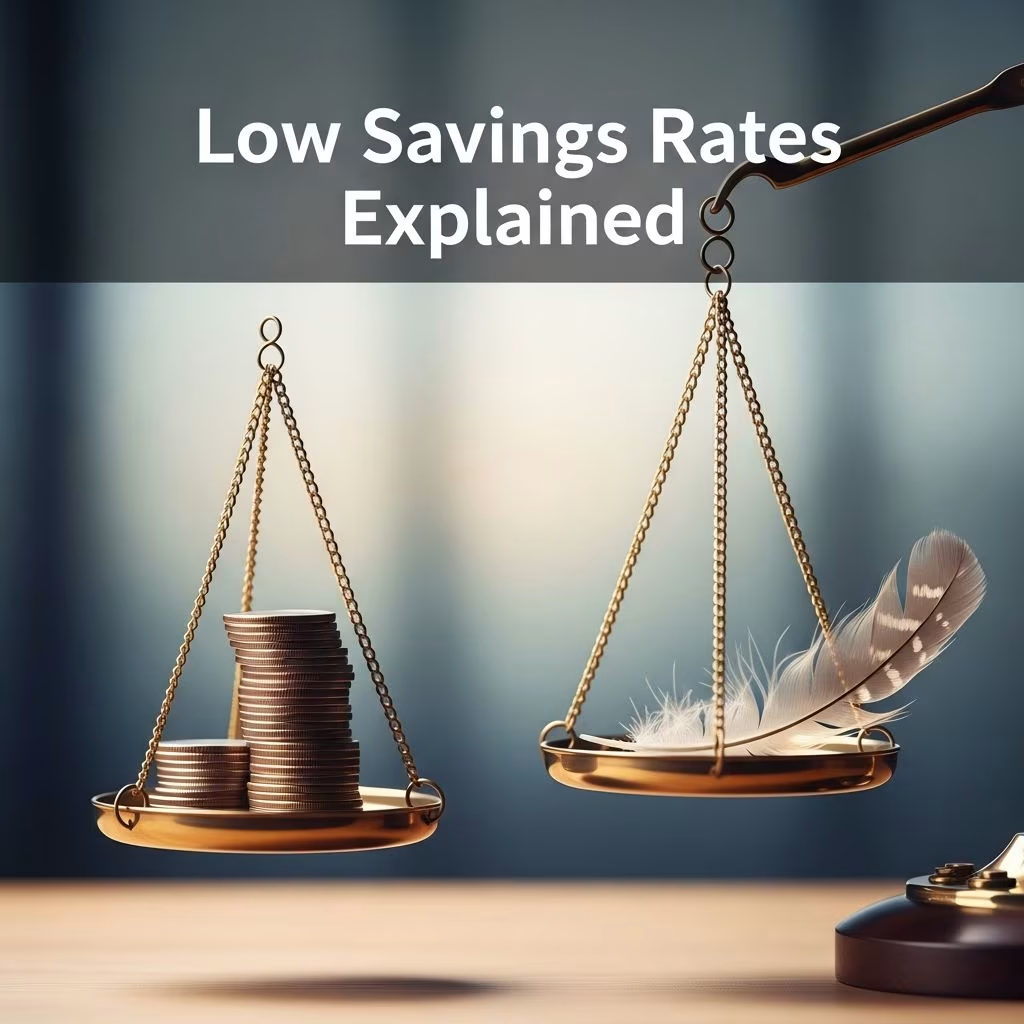
Traditional savings accounts often provide minimal interest rates, typically around 0.39% APY nationally, far below what high-yield options offer today. This disparity stems from economic policies, bank strategies, and consumer habits, leaving many savers with stagnant returns.
The Economic Forces Shaping Savings Yields
Savings account interest rates are closely tied to broader economic conditions, particularly the Federal Reserve’s federal funds rate, which influences what banks pay on deposits. When the Fed lowers this benchmark to stimulate borrowing and spending, banks adjust downward, resulting in lower APYs for savers. As of early 2026, despite some volatility, average rates linger near historic lows for conventional accounts.
Inflation plays a countervailing role: even if nominal rates rise slightly, real returns—after adjusting for price increases—can remain negative. For instance, with inflation hovering, a 0.39% APY means your purchasing power erodes over time. Banks prioritize lending profitability over depositor yields, especially when loan demand is soft.
How Banks Determine Your Account’s Interest Rate
Banks calculate APY based on the funds they have available versus lending opportunities. Large national banks hold vast deposit bases, reducing their need to compete aggressively on rates. They fund loans through low-cost deposits, passing little benefit to customers. Community banks or online-only institutions, with leaner operations, offer higher rates to attract funds—up to 5.00% APY in March 2026.
- Operational Costs: Brick-and-mortar banks incur expenses for branches and staff, subsidizing low rates.
- Deposit Volume: Excess deposits mean less incentive to pay more.
- Competition: Online banks bypass physical overhead, enabling competitive yields.
Comparing Average vs. High-Yield Savings Accounts
The national average savings rate stands at 0.39% APY per FDIC data, while top high-yield accounts reach 5.00% APY—over 12 times higher. This table highlights key differences:
| Account Type | Average APY (2026) | Min. Balance | Fees | Access |
|---|---|---|---|---|
| Traditional Bank | 0.39% | $0 | Possible monthly | In-person/online |
| High-Yield Online | Up to 5.00% | $0-$10,000 | $0 | Online only |
High-yield accounts from providers like Bask Bank offer up to 4.00% with conditions, such as maintaining $10,000 average balance for a boost, while Barclays provides 3.85% with no minimum.
Strategies to Maximize Your Savings Returns
To escape low rates, consider these actionable steps:
- Switch to Online Banks: Institutions like Axos Bank (4.21% APY) or Vio Bank (4.03%) deliver superior yields without fees.
- Monitor Promotions: Bask Bank’s 0.25% APY boost for new accounts through June 2026 rewards qualifying balances.
- Laddering Approach: Divide funds across multiple accounts with varying terms to capture rising rates.
- Automate Transfers: Set recurring deposits to hit minimums for bonus rates, like Varo’s 5% on up to $5,000.
Always verify FDIC insurance for balances up to $250,000 per depositor per bank.
Current Top High-Yield Savings Options in 2026
As of March 2026, standout accounts include:
- Bask Bank: Up to 4.00% APY (3.75% base + 0.25% boost) for new accounts with $10,000 average balance; no fees.
- Barclays: 3.85% APY on balances over $250,000, 3.70% below; $0 minimum deposit.
- Axos Bank: 4.21% APY, seven times the national average; low minimums.
- CIT Bank: 4.10% APY with $100 minimum; estimated $1,025 earnings on $25,000.
- Peak Bank & Vio Bank: 4.02%-4.03% APY, $100 minimum deposit.
These rates fluctuate; check provider sites for updates.
The Role of Inflation and Fed Policy in Your Returns
Federal Reserve decisions directly impact savings yields. Rate cuts to combat slowdowns suppress APYs, while hikes boost them. In 2026, with top rates at 5.00%, savers in high-yield accounts outpace inflation better than those in averages. Understand the fed funds rate as the baseline—banks add a margin for profit.
Real yield calculation: APY minus inflation rate. At 5% APY and 3% inflation, you net 2% growth in purchasing power.
Common Pitfalls Keeping Savers Stuck with Low Rates
Many overlook these traps:
- Inertia: Sticking with a big bank’s 0.39% rate due to familiarity.
- Hidden Fees: Monthly charges that erode tiny interest.
- Low Balances: Missing tiered rate boosts, like Barclays’ higher yield over $250,000.
- Ignoring Online Options: Fearing tech, missing 10x better returns.
Long-Term Impact of Low vs. High Rates
On $10,000 over five years at 0.39% APY: ~$196 interest. At 4.50% APY: ~$2,384—over 12 times more. Compounding amplifies this: high-yield accounts turn savings into meaningful wealth builders.
FAQs
Why is my savings account rate so low?
Large banks pay minimal APYs (0.39% average) to fund operations cheaply, unlike competitive online banks offering up to 5.00%.
Are high-yield savings accounts safe?
Yes, if FDIC-insured, protecting up to $250,000 per depositor. Verify via fdic.gov.
How often do savings rates change?
Rates adjust with Fed policy and competition; top yields hit 5.00% in March 2026 but can shift monthly.
What’s the minimum for high-yield accounts?
Many require $0-$100, like Vio Bank’s 4.03%; some boosts need $10,000.
Can I lose money in a savings account?
No principal risk with FDIC coverage, but inflation can diminish real value if rates are low.
Steps to Switch to a Better Savings Account
- Research FDIC-insured high-yield options via comparison sites.
- Compare APYs, fees, and minimums using tools like the table above.
- Open online—takes minutes; transfer funds via ACH.
- Close old account after confirming balance transfer.
- Set alerts for rate changes.
Transitioning unlocks returns like 4.21% APY immediately.
References
- The top high-yield savings rates: Up to 5.00% on March 27, 2026 — Fortune. 2026-03-27. https://fortune.com/article/best-savings-account-rates-3-27-2026/
- The top high-yield savings rates: Up to 5.00% on March 25, 2026 — Fortune. 2026-03-25. https://fortune.com/article/best-savings-account-rates-3-25-2026/
- Best High-Yield Savings Accounts Of March 2026 – Up to 4.21% — Bankrate. 2026-03. https://www.bankrate.com/banking/savings/best-high-yield-interests-savings-accounts/
- Best High-Yield Savings Accounts for March 2026 – NerdWallet — NerdWallet. 2026-03. https://www.nerdwallet.com/banking/best/high-yield-online-savings-accounts
This article is general information, not personal financial advice. Consider your own situation, or speak with a licensed adviser, before acting on it.