

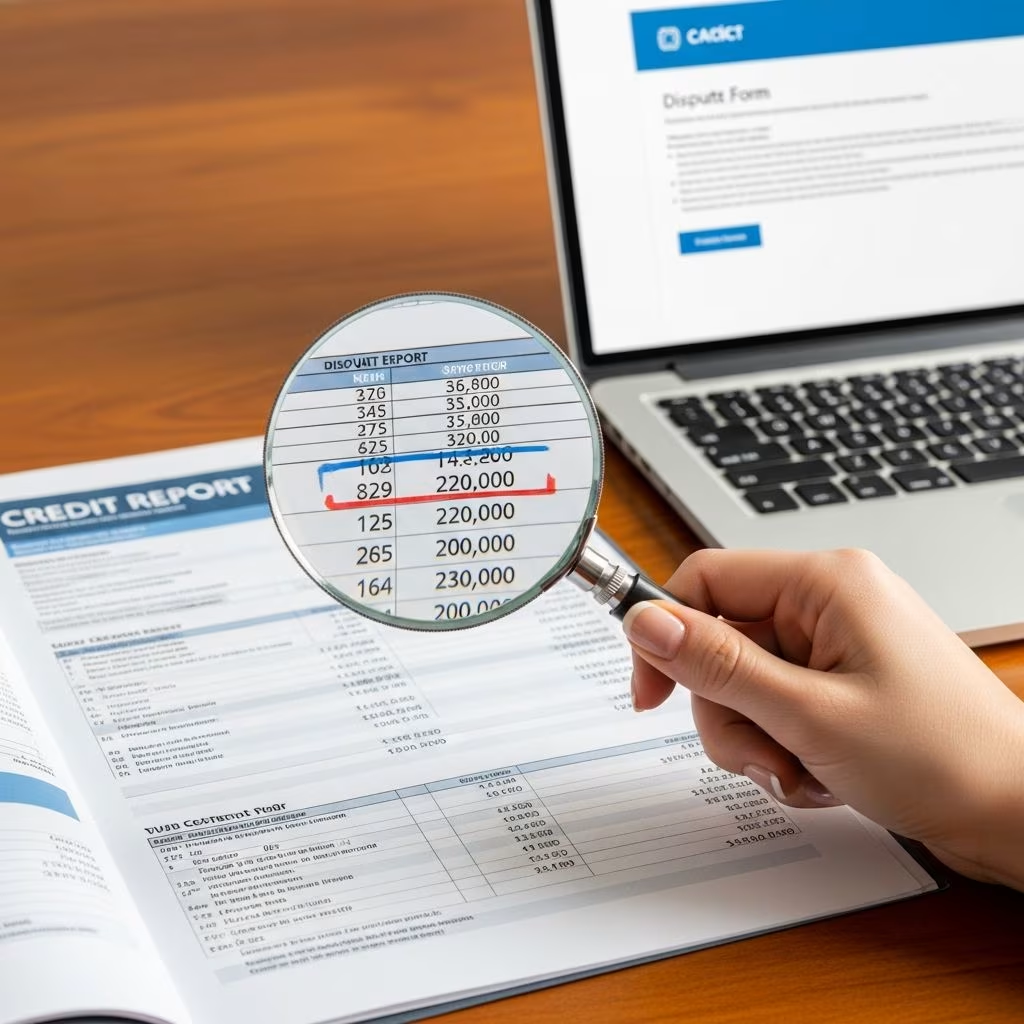
Errors on your credit report can significantly lower your credit score, affecting loan approvals, interest rates, and even job opportunities. Fortunately, federal law gives you the right to dispute inaccuracies for free, and credit bureaus must investigate within 30 days. This comprehensive guide walks you through every step, from spotting mistakes to following up on responses, ensuring you reclaim your financial accuracy.
Why Check Your Credit Report Regularly
Your credit report, maintained by the three major bureaus—Equifax, Experian, and TransUnion—compiles data from lenders, banks, and public records. Inaccuracies arise from data entry errors, identity theft, or outdated information. The Fair Credit Reporting Act (FCRA) mandates that negative items like late payments be removed after seven years, and bankruptcies after 10 years. Regular checks, available weekly for free at AnnualCreditReport.com, prevent long-term damage.
Common pitfalls include merged files from similar names or addresses, leading to incorrect accounts listed as yours. By reviewing annually or after major life events like divorce or address changes, you stay proactive.
Common Errors to Look For
Not all discrepancies warrant a dispute, but those impacting your score do. Prioritize these high-impact errors:
- Wrong account status: Late payments reported despite on-time payments.
- Outdated negative information: Derogatory marks beyond the seven-year limit.
- Incorrect personal info: Ex-spouse on accounts post-divorce or unfamiliar addresses.
- Fraudulent accounts: Unrecognized loans or credit cards signaling identity theft.
- Inaccurate balances or limits: Overstated debts or understated credit limits, skewing utilization ratios.
Less critical but still disputable: duplicate accounts or misspelled names. Always highlight errors on a printed report copy for your records.
Step 1: Gather Supporting Documentation
Before disputing, compile ironclad proof to streamline the investigation. Credit bureaus verify claims quickly with clear evidence.
| Error Type | Required Documents |
|---|---|
| Late payment dispute | Credit card/loan statements, bank records showing timely payments |
| Identity theft/fraud | FTC Identity Theft Report, police report, birth/death certificates |
| Divorce-related | Divorce decree, account closure proof |
| General identification | Gov’t ID (driver’s license/passport), SSN, utility bill, past addresses (2 years) |
Keep originals safe; send photocopies only. Organize with a cover letter explaining each item’s relevance.
Step 2: File the Dispute with Credit Bureaus
Notify all three bureaus, as they may hold different data. Options include online (fastest), mail, or phone (limited).
Equifax
- Online: Equifax dispute portal
- Mail: P.O. Box 740256, Atlanta, GA 30374-0256
- Phone: 866-349-5191
Experian
- Online: Experian dispute form
- Mail: P.O. Box 4500, Allen, TX 75013
- Phone: 866-200-6020
TransUnion
- Online: TransUnion dispute center
- Mail: P.O. Box 2000, Chester, PA 19016
- Phone: 800-916-8800
Use FTC sample letters for structure: state your info, describe errors, attach proof, request removal. Online portals guide you through highlighting specific items. Disputes are free and don’t harm your score during investigation.
Step 3: Notify the Data Furnisher
Simultaneously contact the creditor or lender (“furnisher”) reporting the error. This prompts them to correct data at the source.
- Find their address on your credit report or their website.
- Send a certified letter with the same documentation.
- Under FCRA, they must investigate within 30 days and report results to you, including account details, investigation confirmation, and corrections if applicable.
Furnishers must notify bureaus of disputes, adding a note to your report. If they verify inaccuracy, they update all bureaus.
Step 4: Monitor the Investigation
Bureaus have 30 days (45 if via AnnualCreditReport.com) to investigate, contacting furnishers for verification. They must respond in writing, often with an updated report if changes occur.
- If upheld: Error removed; request free updated report. Ask for notifications to recent inquirers (6 months general, 2 years employment).
- If denied: Review their evidence. Escalate to CFPB with your proof; track via their portal.
Track via certified mail receipts and save all correspondence. Persistence resolves most issues.
What Happens After a Successful Dispute
Corrections reflect immediately, potentially boosting your score by removing negative weights. Monitor all three reports post-resolution. True negatives remain: 7 years for most, 10 for bankruptcy.
Pro tip: Add a 100-word statement of dispute to your report if unresolved, visible to lenders.
Preventing Future Errors
Freeze your credit to block fraud, enable alerts, and review reports quarterly. Use apps for real-time monitoring.
Frequently Asked Questions (FAQs)
Q: How long does a credit dispute take?
A: Bureaus must respond within 30 days, extendable to 45 in some cases.
Q: Does disputing hurt my credit score?
A: No, the process doesn’t affect your score; only corrections do positively.
Q: Can I dispute by phone only?
A: Phone starts the process but requires follow-up documentation; online/mail preferred.
Q: What if the furnisher doesn’t respond properly?
A: File a CFPB complaint; they require clear statements on investigations and results.
Q: How often can I get free credit reports?
A: Weekly from AnnualCreditReport.com, authorized by federal law.
Conclusion: Take Control Today
Disputing errors empowers you to fix your financial profile swiftly. Act promptly—small efforts yield big score improvements and better opportunities.
References
- How to Dispute Credit Report Errors — NerdWallet. 2023-10-15. https://www.nerdwallet.com/finance/learn/dispute-credit-report
- Navigating the Credit Dispute Process: A Step-by-Step Guide — Orea Teai. 2024-05-20. https://www.oreateai.com/blog/navigating-the-credit-dispute-process-a-stepbystep-guide/f55df9a3fd686af7da64d93b1406b893
- How to Dispute Mistakes On Your Credit Report — Wise Bread. 2015-08-12. https://www.wisebread.com/how-to-dispute-mistakes-on-your-credit-report
- Credit disputes: getting a clear statement of results from your furnisher — Consumer Financial Protection Bureau. 2022-11-10. https://www.consumerfinance.gov/about-us/blog/credit-disputes-getting-a-clear-statement-of-results-from-your-furnisher/
This article is general information, not personal financial advice. Consider your own situation, or speak with a licensed adviser, before acting on it.


