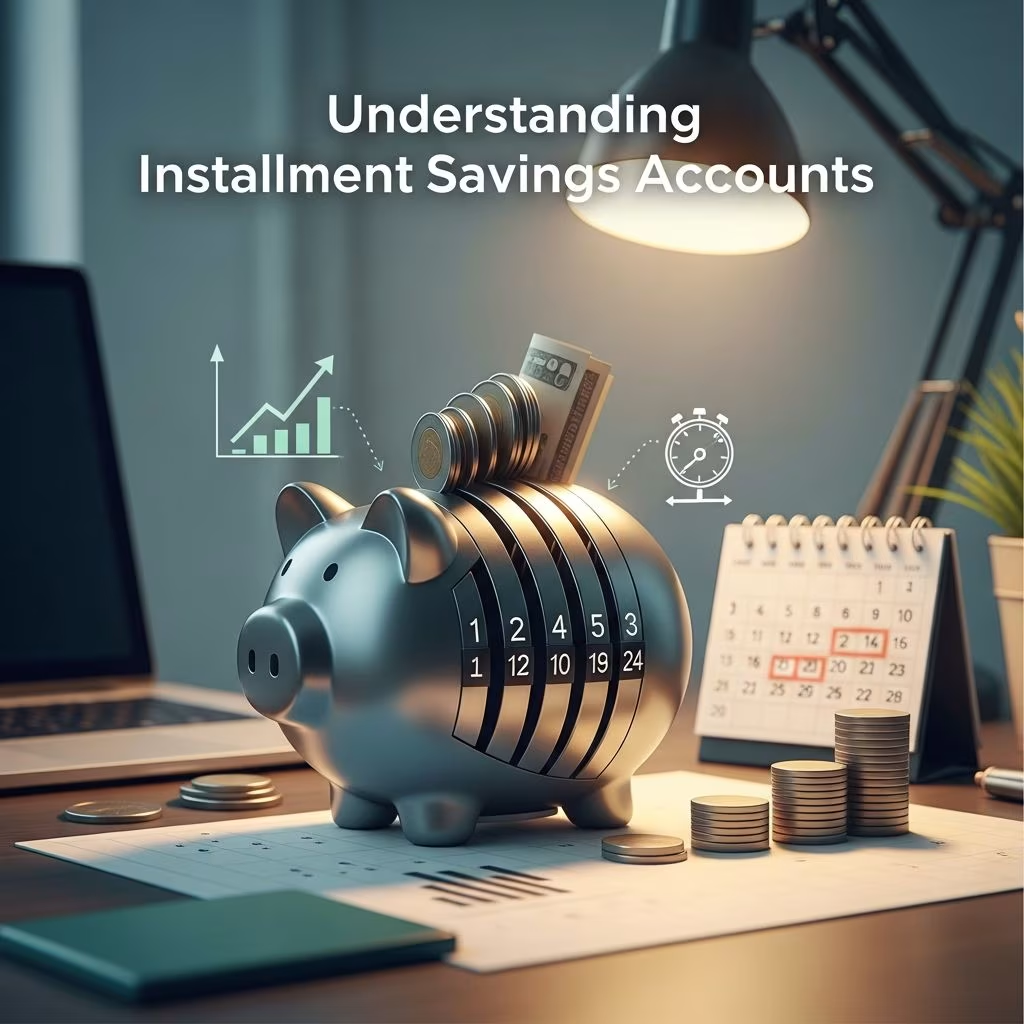
Installment savings accounts are deposit accounts that let you build a lump sum by making fixed monthly deposits over a set term, typically with a fixed interest rate and a clearly defined maturity date. At maturity, you receive the total of your installments plus the interest earned.
Instead of depositing a large amount all at once, as with a certificate of deposit (CD), you commit to a series of regular monthly contributions that gradually grow your balance. This structure can make disciplined saving easier for people who do not have a large upfront sum.
How Installment Savings Accounts Work
While specific features vary by bank or credit union, installment savings accounts generally follow a similar structure.
Core Features
- Contract or goal amount: You choose a target balance (for example, $5,000 or $10,000) to reach by the end of the term.
- Fixed monthly payment: The bank calculates a required monthly deposit based on your goal amount, term length, and interest rate.
- Fixed term length: Terms often range from 1 to 5 years, with some banks offering flexible options such as 6 months to several years.
- Automatic transfers: Monthly payments are commonly transferred automatically from a linked checking or savings account.
- Fixed interest rate / APY: The interest rate is typically locked in at opening and stays the same for the entire term.
- Maturity value: At the end of the term, you receive the total of all deposits plus the interest earned, which should be close to or equal to the agreed contract/goal amount if payments are made as scheduled.
Step-by-Step Example
Consider a simplified example based on common structures used by banks:
- You choose a goal amount of $6,000 over a 3-year term.
- The bank sets your monthly deposit at about $160–$170, depending on the fixed interest rate.
- Each month, that amount is automatically transferred from your checking account to your installment savings account.
- Interest accrues on the balance as it grows; some banks compound interest daily and credit it quarterly and at maturity.
- At maturity, you receive the total deposits plus interest, which should be close to or slightly above your $6,000 goal.
Interest and Compounding
Depending on the institution, interest may be:
- Compounded daily and credited quarterly and at maturity, using a daily balance method.
- Paid only if the account is held to maturity; some products do not pay contracted interest if you withdraw early.
Because deposits are made over time rather than upfront, the effective return can differ from an equivalent CD, even if the stated annual percentage yield (APY) looks similar. Early in the term, a smaller balance is earning interest; the balance grows gradually as you make installment payments.
Installment Savings vs. Certificates of Deposit (CDs)
Installment savings accounts share some traits with CDs: both have fixed terms, often fixed rates, and discourage early withdrawals. However, they differ in how and when you fund them.
| Feature | Installment Savings Account | Certificate of Deposit (CD) |
|---|---|---|
| Funding method | Series of fixed monthly deposits over the term. | Single lump-sum deposit at the beginning of the term. |
| When interest starts on full balance | Balance grows over time; interest initially applies to smaller amounts. | Full deposit earns interest from day one. |
| Typical savers | People who cannot or prefer not to deposit a large sum upfront, and want help building savings steadily. | People who already have a lump sum and want to lock in a rate. |
| Access to funds | Often limited; early withdrawals may reduce or forfeit interest. | Penalties apply for early withdrawal; principal usually protected. |
| Rate type | Frequently fixed for the term. | Typically fixed, though some CDs may have step-up or variable structures. |
| Best use case | Scheduling savings for a predictable future goal, like tuition or a major purchase. | Maximizing interest on a lump sum while limiting spending access. |
Which Earns More Interest?
Even when the advertised APY on an installment savings account appears higher than a comparable CD, the dollar amount of interest earned may be lower for the installment savings account.
- With a CD, the entire deposit (for example, $10,000) earns interest for the full term.
- With an installment savings account, only the small initial deposits earn interest early on; the balance reaches the goal amount only near the end of the term.
This difference in timing means that the CD may generate more total interest, even if the installment savings APY is nominally higher.
Installment Savings vs. Regular Savings Accounts
Installment savings accounts also differ from traditional savings accounts.
- Regular savings: Flexible deposits and withdrawals, variable interest rates, and typically lower yields than CDs; funds are accessible for everyday needs.
- Installment savings: Fixed monthly deposits, limited or penalized access during the term, often higher rates than standard savings accounts, and more structured saving toward a specific goal.
In essence, regular savings accounts prioritize liquidity, whereas installment savings accounts prioritize disciplined, goal-driven accumulation.
Benefits of Installment Savings Accounts
Installment savings can be especially useful for people who need structure and predictability in their savings habits.
Encourages a Savings Habit
- Fixed monthly contributions help build a regular savings routine.
- Automatic transfers reduce the chance of forgetting a payment and remove the need for repeated decisions about saving.
- The requirement to maintain the account to get the full interest can motivate you to keep saving until maturity.
Helps Reach Specific Financial Goals
Installment savings accounts are often marketed as “goal-based” products, suitable for:
- Short- or medium-term goals (for example, 1–5 years).
- Planned expenses such as tuition, insurance premiums, a vehicle purchase, or a vacation.
- Business cash needs with known timelines, using business-oriented installment products.
By choosing a term that matches your timeline and a goal amount that matches your budget, you create a structured path to a future lump sum.
Low Initial and Monthly Requirements
- Minimum opening and monthly deposits can be relatively low, making installment savings accessible for first-time savers.
- Spreading contributions over time reduces the immediate burden on your budget compared with funding a large CD upfront.
Predictability and Rate Security
- A fixed interest rate lets you estimate how much you will have at maturity, assuming you follow the payment schedule.
- Knowing the monthly amount and target date simplifies planning for major expenditures.
Drawbacks and Risks
While installment savings accounts can be valuable tools, they are not ideal for every situation.
Potentially Lower Total Interest Than CDs
Because the balance grows gradually, the total interest you earn may be less than on a CD funded with a lump sum, even if the installment account’s APY is higher.
Limited Liquidity and Early Withdrawal Issues
- Some accounts do not pay the full advertised interest if you withdraw funds before maturity.
- Others may restrict withdrawals or impose penalties, similar to or stricter than CD early-withdrawal rules.
- If you anticipate needing frequent or unpredictable access to your money, a regular savings or money market account might be more appropriate.
Payment Commitment
- You must make each monthly deposit on time; missing payments can affect your ability to reach the goal amount and may impact eligibility for the contracted interest.
- This commitment can strain your budget if your income is unstable or if unexpected expenses arise.
Rate Risk Relative to Market Conditions
- If market interest rates rise significantly after you open an installment savings account with a fixed rate, you may be locked into a lower rate until maturity.
- Conversely, if rates fall, your fixed rate can be an advantage.
Who Should Consider an Installment Savings Account?
Installment savings accounts tend to suit savers who value structure and goal orientation over liquidity.
Good Candidates
- First-time savers: Individuals who are just starting to build financial habits and benefit from a formal schedule.
- People without a large lump sum: Savers who cannot deposit a substantial amount at once but can manage consistent smaller payments.
- Goal-focused planners: Anyone with a clearly defined future expense (tuition, down payment, equipment, or a planned trip) and a known time horizon.
- Busy individuals: Those who appreciate automatic transfers and a “set it and let it grow” approach.
Who Might Prefer Other Options
- Savers who already have a significant lump sum and want to maximize interest immediately may benefit more from CDs or high-yield savings accounts.
- People who need frequent access to their funds are generally better served by liquid savings or money market accounts.
- Those with highly variable income might find fixed monthly commitments difficult to maintain.
How to Choose an Installment Savings Account
If you decide an installment savings account fits your goals, compare offerings among reputable banks and credit unions.
Key Factors to Compare
- Term length: Choose a term that aligns with your goal timeline (for example, 1, 2, 3, 4, or 5 years).
- Interest rate / APY: Look for competitive fixed rates, but remember that the effective return also depends on how quickly your balance grows.
- Minimum and maximum goal amounts: Many banks set minimum contract amounts (for example, $500 to $1,000) and maximums (as high as $100,000).
- Funding method: Confirm whether monthly deposits must be automatic from a linked account, and whether additional deposits are allowed.
- Early withdrawal rules: Understand whether you lose interest or incur penalties if you need funds before maturity.
- Deposit insurance: Verify that the institution is covered by applicable deposit insurance schemes (such as FDIC insurance in the United States or comparable coverage in other jurisdictions).
Practical Tips
- Set a realistic monthly deposit amount based on your budget rather than simply the maximum goal you could theoretically reach.
- Link the account to a checking account you actively use to ensure monthly transfers have sufficient funds.
- Review your account statements periodically to confirm payments are processing correctly and interest is accruing as expected.
Frequently Asked Questions (FAQs)
Q: Is an installment savings account the same as a CD?
A: No. A CD requires a one-time lump-sum deposit that earns interest for the entire term, while an installment savings account is funded through fixed monthly deposits that build up over time. Both usually have fixed terms and penalize early withdrawals, but they serve different types of savers.
Q: Can I withdraw money from an installment savings account before it matures?
A: Early withdrawal rules vary. Some accounts allow withdrawals but may reduce or eliminate the interest you earn if you do not maintain the account to maturity. Others may impose fees or restrictions. Always review the specific terms before opening the account.
Q: Do installment savings accounts pay more interest than regular savings?
A: Many installment savings accounts offer higher interest rates than standard savings accounts, but the total interest you earn also depends on how long your money remains on deposit and how quickly the balance grows. Regular savings accounts may have lower yields but provide easier access to your funds.
Q: What happens if I miss a monthly payment?
A: Missing a payment can affect your progress toward your goal and potentially impact the interest you earn, depending on the institution’s policies. Some banks may allow you to catch up, while others may reduce benefits if the schedule is not maintained. Check the account agreement for details.
Q: Are installment savings accounts safe?
A: When held at insured banks or credit unions, installment savings accounts are typically covered by deposit insurance up to applicable limits. This makes them a relatively low-risk option for short- and medium-term goals compared with market-based investments, though you remain exposed to interest-rate and liquidity trade-offs.
References
- Installment Savings — Federal Deposit Insurance Corporation (FDIC). 2013-05-16. https://www.fdic.gov/system/files/2024-07/2013-05-16-presentation-ng.pdf
- CDs Vs. Installment Savings Accounts — MyBankTracker. 2010-08-03 (accessed 2026). https://www.mybanktracker.com/cd/faq/differences-cds-vs-installment-savings-accounts-2528
- Open a Personal Installment Savings Account — Bank of Hope. 2024 (accessed 2026). https://www.bankofhope.com/personal-banking/personal-installment-savings
- Installment Saving Account — Sharons Credit Union. 2023 (accessed 2026). https://www.sharons.ca/personal/accounts/savings-accounts/installment-savings
- What is The Difference Between a Certificate of Deposit and Savings Accounts? — F&M Bank. 2023-05-15. https://www.myfmbank.com/blog/post/what-is-the-difference-between-a-certificate-of-deposit-and-savings-accounts
- Goal Setter (Installment Savings) — Hana Bank USA. 2024 (accessed 2026). https://www.hanabank.us/personal/accounts/goal-setter
This article is general information, not personal financial advice. Consider your own situation, or speak with a licensed adviser, before acting on it.