

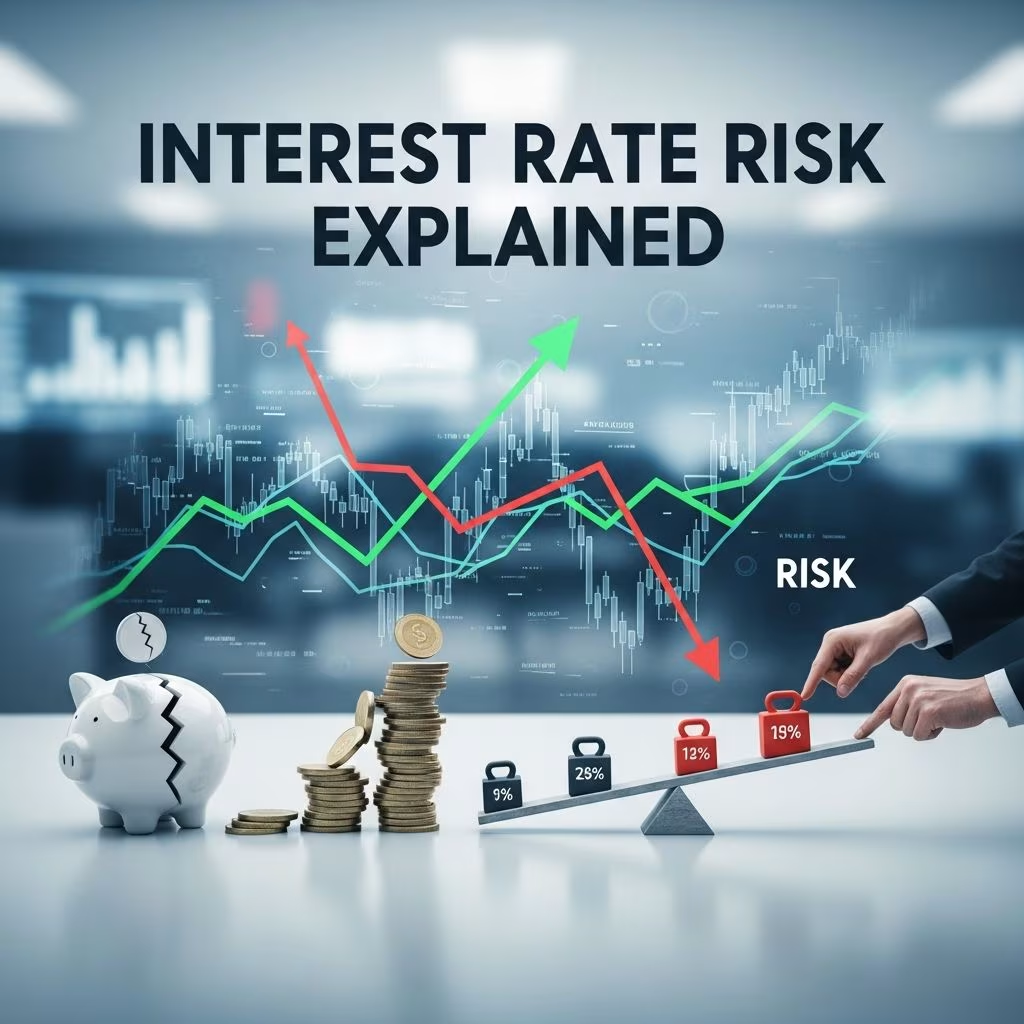
Interest rate risk arises from changes in market interest rates that can reduce the value of investments or increase borrowing costs. This risk primarily impacts fixed-income securities like bonds, where rising rates lead to falling prices due to their inverse relationship.
Understanding the Fundamentals of Interest Rate Risk
At its core, interest rate risk represents the potential for financial losses when market rates shift unexpectedly. For investors holding bonds, an increase in prevailing rates makes existing bonds with lower yields less appealing, prompting a drop in their market value. Lenders and borrowers face similar challenges, as variable-rate loans can become more expensive or less profitable.
This risk is inherent in banking and investment activities. Financial institutions must balance it to maintain profitability, while individual investors need awareness to safeguard portfolios. The Federal Reserve defines it as exposure to adverse rate movements affecting earnings and capital.
Key Types of Interest Rate Risk
Interest rate risk manifests in several forms, each with unique implications for portfolios and operations. Recognizing these helps in targeted mitigation.
- Price Risk: Occurs when rising rates decrease bond values. Longer-maturity bonds experience greater price volatility due to extended exposure.
- Reinvestment Risk: Involves reinvesting coupon payments or principal at lower rates than originally earned, eroding expected returns.
- Basis Risk: Emerges from mismatches between rates on related instruments, such as borrowing at one benchmark while investing at another.
- Yield Curve Risk: Stems from shifts in the yield curve’s shape, affecting short- versus long-term rates differently.
- Volatility Risk: Arises from unpredictable rate swings, complicating forecasts for debt servicing or asset valuation.
Why Bond Prices Move Inversely with Rates
Bonds promise fixed interest payments based on their coupon rate. When market rates rise, new bonds offer higher coupons, making older ones less desirable. Investors sell existing bonds, driving prices down to yield equivalently.
Consider a bond with a 3% coupon issued at par value. If rates climb to 5%, its price must fall so its yield matches the market. Duration measures this sensitivity: higher duration means greater risk.
| Bond Maturity | Duration (Years) | Price Sensitivity to 1% Rate Increase |
|---|---|---|
| Short-term (2 years) | ~1.9 | -1.9% price drop |
| Medium-term (10 years) | ~8.7 | -8.7% price drop |
| Long-term (30 years) | ~19.5 | -19.5% price drop |
This table illustrates how maturity amplifies risk; data derived from standard bond pricing models.
Factors Driving Interest Rate Changes
Multiple economic forces influence rates, amplifying interest rate risk.
- Central bank policies set benchmark rates to control inflation and growth.
- Inflation expectations push rates higher to preserve purchasing power.
- Credit supply-demand dynamics shift yields based on investor demand.
- Economic cycles: expansions often raise rates, recessions lower them.
- Geopolitical tensions introduce volatility through uncertainty.
The Office of the Comptroller of the Currency (OCC) notes these expose bank balance sheets to rate movements.
Impacts on Investors, Borrowers, and Institutions
For Bond Investors
Fixed-income portfolios suffer most. A portfolio heavy in long-term bonds could lose significant value in a rising rate environment, as seen in past Federal Reserve tightening cycles.
For Borrowers
Variable-rate loans become costlier when rates rise, straining budgets for mortgages, auto loans, or corporate debt.
For Financial Institutions
Banks face earnings compression if assets reprice slower than liabilities. The FDIC highlights risks to capital from mismatched maturities.
Strategies to Manage and Mitigate Risk
Proactive measures can reduce exposure without eliminating returns.
- Laddering: Spread maturities across short, medium, and long terms to balance reinvestment and price risks.
- Duration Matching: Align portfolio duration with investment horizon to neutralize rate shifts.
- Hedging with Derivatives: Use interest rate swaps, futures, or options to offset potential losses.
- Diversification: Mix fixed-income with equities or inflation-protected securities.
- Shorten Maturities: Favor shorter-term bonds for lower sensitivity.
Institutions employ advanced models like gap analysis or economic value of equity simulations per Federal Reserve guidelines.
Real-World Examples of Interest Rate Risk
In 2022, aggressive Fed rate hikes caused bond indices to decline over 13%, hitting long-duration funds hardest. Investors in 30-year Treasuries saw prices drop sharply as yields surged from 1.5% to over 4%.
Conversely, falling rates in 2020 boosted bond prices but introduced reinvestment risk as coupons rolled into lower-yield instruments.
Tools for Measuring Interest Rate Risk
Key metrics include:
- Duration: Weighted average time to receive cash flows; approximates price change per rate shift.
- Convexity: Measures duration’s rate sensitivity for more precise forecasting.
- Key Rate Duration: Assesses exposure to specific maturity segments.
These help quantify risk, enabling informed adjustments.
Interest Rate Risk in Today’s Economy
As of 2026, persistent inflation concerns and policy normalization keep rates volatile. Borrowers locking in fixed rates hedge against hikes, while investors shorten durations amid uncertainty.
Common Myths About Interest Rate Risk
- Myth: Only affects bonds. Fact: Impacts loans, savings, and derivatives too.
- Myth: Short-term bonds are risk-free. Fact: They carry reinvestment risk.
- Myth: Rates always rise long-term. Fact: Cycles include declines.
Frequently Asked Questions (FAQs)
What is interest rate risk in simple terms?
It’s the risk that changing interest rates will lower investment values or raise borrowing costs.
Who is most exposed to this risk?
Bondholders with long maturities, variable-rate borrowers, and banks with rate-sensitive balance sheets.
How can I protect my bond portfolio?
Use laddering, diversify, or hedge with derivatives.
Does it affect stock investments?
Indirectly, via higher discount rates reducing valuations, but less than fixed-income.
What role does duration play?
Higher duration means greater price volatility from rate changes.
Building a Resilient Financial Plan
Integrate interest rate risk assessment into overall strategy. Regularly review duration, stress-test portfolios against rate scenarios, and stay informed on central bank signals. This approach ensures stability amid fluctuations.
For personalized advice, consult financial professionals attuned to current market dynamics.
References
- Interest Rate Risk – Definition, How to Mitigate the Risk — Corporate Finance Institute. 2023. https://corporatefinanceinstitute.com/resources/career-map/sell-side/risk-management/interest-rate-risk/
- What is Interest Rate Risk? — GTreasury. 2024. https://www.gtreasury.com/posts/what-is-interest-rate-risk
- Interest rate risk — Robeco USA. 2023. https://www.robeco.com/en-us/glossary/fixed-income/interest-rate-risk
- Interest Rate Risk | Definition + Example — Wall Street Prep. 2023. https://www.wallstreetprep.com/knowledge/interest-rate-risk/
- Interest-Rate Risk Management Section 3010.1 — Federal Reserve. 1998 (authoritative standard). https://www.federalreserve.gov/boarddocs/supmanual/trading/3000p2.pdf
- Interest Rate Risk — FDIC.gov. 2024. https://www.fdic.gov/capital-markets/interest-rate-risk
- Interest Rate Risk — OCC.gov. 2024. https://www.occ.treas.gov/topics/supervision-and-examination/capital-markets/balance-sheet-management/interest-rate-risk/index-interest-rate-risk.html
This article is general information, not personal financial advice. Consider your own situation, or speak with a licensed adviser, before acting on it.


