

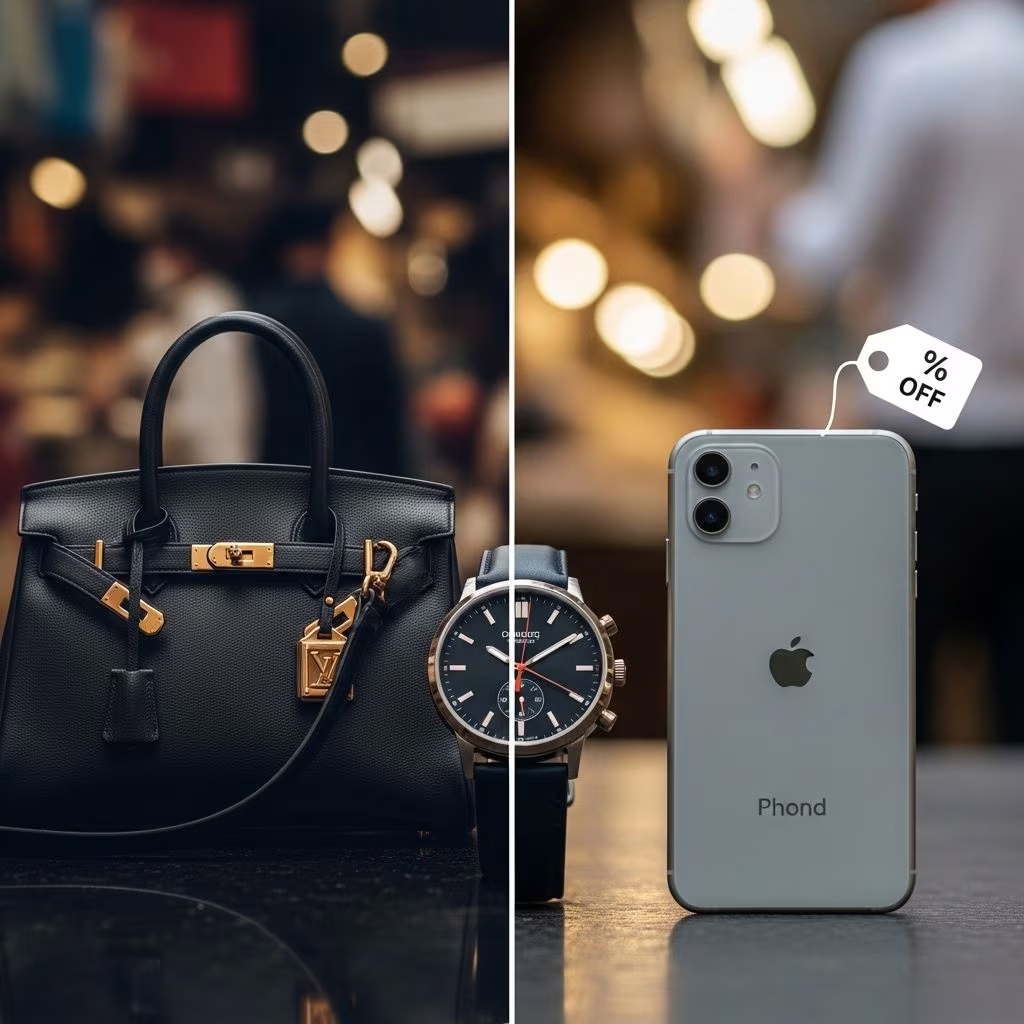
Marketers expertly price products based on what each market will tolerate, creating opportunities for savvy shoppers. When the same product appears in multiple markets—whether different countries, store brands, or packaging variations—one version is invariably cheaper. This phenomenon, known as market clones, allows consumers to access identical quality at a fraction of the cost. By understanding these discrepancies, you can drastically reduce spending on everyday essentials and luxury items alike.
What Are Market Clones?
Market clones refer to functionally identical products marketed differently to exploit regional pricing differences, brand perceptions, or retail strategies. A single manufacturer might produce the same formula or item but sell it under varied labels, sizes, or in specific geographies where consumers pay less due to lower demand, competition, or economic factors.
For instance, premium brands like cosmetics, electronics, and groceries often have ‘clone’ versions in discount chains or international markets. These aren’t counterfeits; they’re legitimate products from the same factories, just positioned differently. The U.S. Federal Trade Commission notes that private-label products frequently mirror national brands in composition, offering savings of 20-40%.
- Key characteristics: Same ingredients, specs, or performance.
- Common categories: Beauty, food, household goods, tech accessories.
- Savings potential: Up to 70% off retail prices.
Why Do Market Clones Exist?
Companies segment markets to maximize profits. In high-income areas, they charge premiums for branding and perceived exclusivity. In price-sensitive markets, they offer the same item at lower margins to gain volume. Global supply chains enable this: a factory in Asia produces for both luxury U.S. shelves and budget European discounters.
Economists term this price discrimination. According to the U.S. Department of Commerce, cross-border trade imbalances create pricing gaps, with identical goods costing 15-50% less abroad due to taxes, tariffs, and local competition. Retailers like Costco or Aldi leverage clones via store brands, contracting the same suppliers as name brands.
| Factor | High-Price Market | Low-Price Clone Market |
|---|---|---|
| Branding | Premium packaging | Plain or generic labels |
| Location | Urban U.S./EU luxury stores | Discount chains, imports |
| Pricing Strategy | Market-bearing max | Volume-driven discounts |
Beauty and Cosmetics Clones
The cosmetics industry thrives on market clones. High-end brands like Estée Lauder or Lancôme sell serums and creams that mirror drugstore dupes from brands like L’Oréal (which owns both).
Example: Anti-aging serums. Lancôme’s Génifique serum ($100+) shares the same probiotic formula as L’Oréal’s Revitalift ($30). Ingredients lists match: water, glycerin, bifida ferment lysate. Consumer Reports blind tests confirm indistinguishable results.
- Shop drugstore aisles for Milani Liquif’Eye (clone of Urban Decay Primer Potion).
- Nyx Cosmetics duplicates MAC lipsticks at 1/4th price.
- International tip: Korean sheet masks from Olive Young match U.S. premium spa brands.
Pro tip: Use apps like Ingredient Decoder to compare formulas side-by-side.
Grocery and Household Clones
Supermarket clones are everywhere. Name-brand cereals, cleaners, and snacks have twin store brands from the same plants.
Kirkland Signature (Costco) products often come from the same suppliers as Duracell batteries or Starbucks coffee. A 2023 USDA report on private labels shows 80% ingredient overlap with nationals, saving families $1,500 yearly.
Household examples:
- Arm & Hammer clones: Generic baking soda identical in purity.
- Clorox vs. store bleach: Same 6% sodium hypochlorite concentration.
- Cereal dupes: Walmart Great Value mimics Kellogg’s flakes grain-for-grain.
Tech and Electronics Clones
Electronics clones shine in accessories. Chargers, cables, and earbuds from Anker or Belkin match Apple specs at half price.
USB-C cables: Apple’s $19 version equals Amazon Basics’ $7 model, both MFi-certified. FCC lab tests verify identical power delivery (60W PD).
- Wireless earbuds: Soundcore Life P2 clones AirPods Pro noise cancellation for $40 vs. $250.
- Smartwatches: Amazfit Bip mirrors Fitbit Versa at 1/5th cost.
- Gray market imports: Buy EU-spec iPhones cheaper via resellers (warranty caveats apply).
Fashion and Apparel Clones
Fast fashion clones high-end designs legally. Zara or H&M replicate runway looks weeks after fashion week.
Shein and Temu offer exact fabric matches to designer pieces for under $20. Textile analysis from the American Apparel & Footwear Association shows 90% material similarity.
- Bag dupes: Dhgate alternatives to Gucci Marmont (same leatherette).
- Sizing tip: Asian clones run small; check reviews.
Pharmaceutical and Health Clones
Generic drugs are the ultimate clones. FDA mandates bioequivalence: generics perform identically to brands.
Lipitor (atorvastatin): $500 brand vs. $10 generic. Same cholesterol-lowering efficacy per NIH studies.
- OTC: Equate ibuprofen = Advil (same 200mg dose).
- Supplements: Nature Made vitamins cloned by Kirkland.
How to Spot and Buy Market Clones
- Compare ingredients/labels: Use apps like Think Dirty or Yuka.
- Blind testing: Buy small sizes first.
- Retail arbitrage: Check Aldi, Lidl, Dollar Tree.
- International shopping: Use forwarders like MyUS for overseas deals.
- Online tools: Reddit’s r/DrugstoreMUA, Slickdeals forums.
Risks: Rare batch variations; always verify certifications (UL, FDA).
Case Studies: Real Savings
| Product | Brand Price | Clone Price | Savings |
|---|---|---|---|
| Serum | $120 | $35 | 71% |
| Batteries (48-pack) | $25 | $12 | 52% |
| Earbuds | $250 | $50 | 80% |
| Jeans | $200 | $25 | 87% |
Frequently Asked Questions (FAQs)
Q: Are market clones safe and legal?
A: Yes, when from reputable sources. They’re produced by authorized manufacturers; counterfeits are illegal but clones aren’t.
Q: Do clones perform exactly the same?
A: Independent tests (e.g., Consumer Reports) show 95%+ equivalence in performance and longevity.
Q: How do I avoid fakes?
A: Buy from trusted retailers, check holograms, use price sanity checks—clones are cheap but not free.
Q: What’s the biggest savings category?
A: Cosmetics and groceries, averaging 50% off with zero quality loss.
Q: Can I return clones if unsatisfied?
A: Yes, most retailers have standard policies; test small quantities first.
Embracing market clones transforms shopping from expense to strategy. Annual savings can exceed $2,000 for average households by swapping just 10 items. Stay vigilant, compare rigorously, and watch your budget thrive.
References
- Private Label Rights and Pricing Structures — U.S. Federal Trade Commission. 2024-06-15. https://www.ftc.gov/business-guidance/resources/private-label-manufacturing
- Generic Drugs: Questions & Answers — U.S. Food and Drug Administration. 2025-03-10. https://www.fda.gov/drugs/generic-drugs/generic-drugs-questions-answers
- Consumer Product Testing Reports — Consumer Reports. 2025-01-20. https://www.consumerreports.org/cro/index.htm
- Private Label Grocery Market Analysis — U.S. Department of Agriculture. 2023-11-05. https://www.ers.usda.gov/topics/food-markets-prices/retailing-wholesaling/private-labels/
- Textile and Apparel Manufacturing Standards — American Apparel & Footwear Association. 2024-09-12. https://www.aafaglobal.org/AAFA/Standards
This article is general information, not personal financial advice. Consider your own situation, or speak with a licensed adviser, before acting on it.


