

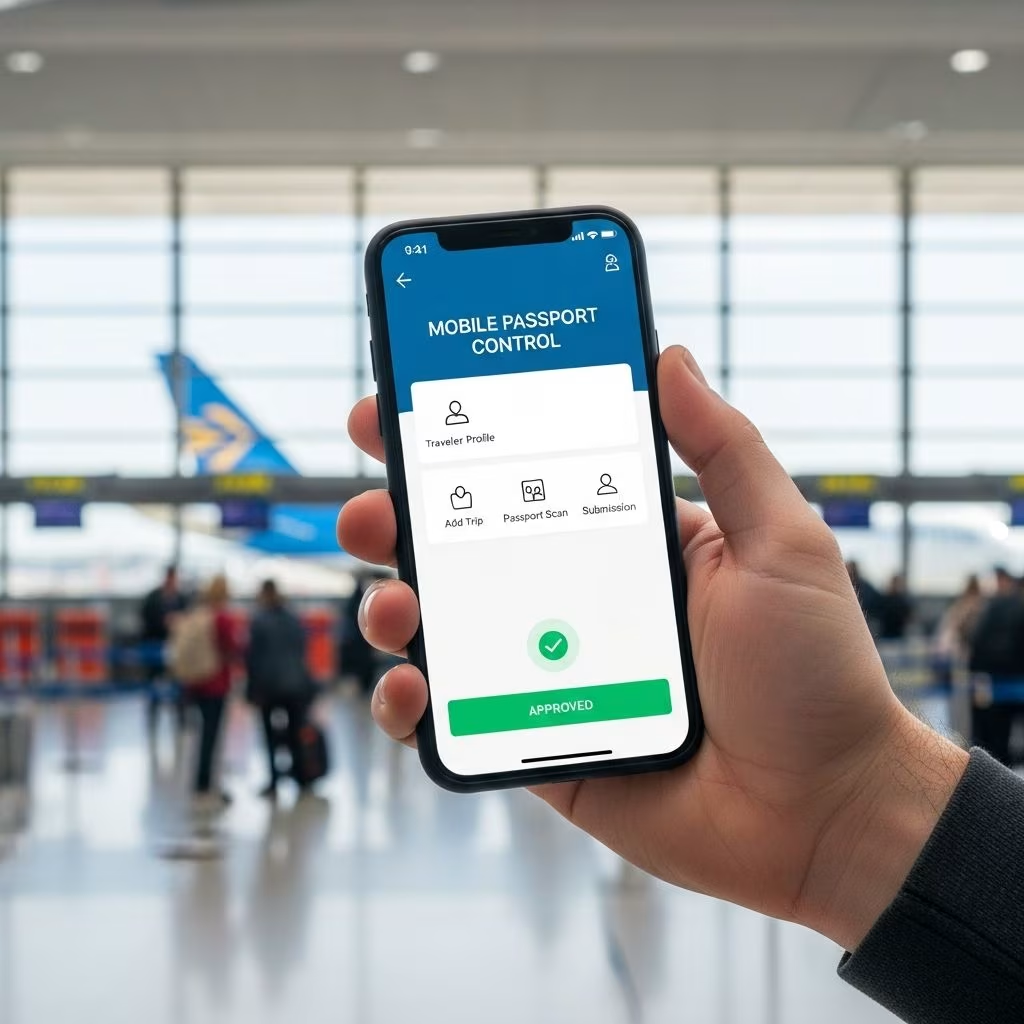
The Mobile Passport Control (MPC) program, operated by U.S. Customs and Border Protection (CBP), revolutionizes the re-entry process for international travelers arriving in the United States. This free mobile application enables users to submit passport details, selfies, and customs declarations digitally before reaching inspection lines, leading to shorter queues and smoother processing at participating ports.
Why Choose Mobile Passport Control for Your Next Trip
In an era of crowded airports and lengthy immigration waits, MPC stands out by digitizing paperwork traditionally done on paper forms or kiosks. Eligible travelers can bypass standard lines for dedicated MPC lanes, often halving wait times during peak hours. Unlike paid programs requiring background checks, MPC demands no pre-approval, making it instantly accessible upon download.
Key advantages include support for group submissions up to 12 people from the same household, ideal for families or tour groups. It integrates seamlessly with existing travel routines—no need to alter flight plans or apply months in advance. Data from user reports and CBP indicate consistent reductions in processing time, especially at busy hubs like those in New York, Los Angeles, and Miami.
Eligibility Criteria: Who Can Use the CBP MPC App
MPC is available to U.S. citizens, lawful permanent residents, and Canadian visitors with B1/B2 visas. Travelers must arrive via air or sea at one of over 30 designated airports or four cruise ports. Children under 18 included in a parent’s submission do not need separate profiles if traveling together.
Note that MPC does not cover visa-required nationalities beyond Canadians or those using ESTA under the Visa Waiver Program; these travelers must use standard procedures. Always verify your port of entry supports MPC via the app or CBP website before relying on it.
Step-by-Step Guide to Setting Up the App
- Download the Official App: Search for “Mobile Passport Control” or “CBP MPC” in the Apple App Store or Google Play. Only the CBP-authorized version, updated as of February 2022, is valid; third-party apps are no longer supported.
- Create a Primary Profile: Launch the app and establish your main account by entering biographic details. Opt to save passport scans for future use or reset per trip for privacy.
- Add Travelers: For groups, input details for up to 11 additional members. Scan passports or enter manually; ensure all are from the same household.
- Pre-Fill Travel Info: Select your entry mode (air/sea), port (e.g., JFK, LAX), and flight details when available.
Submitting Your Digital Declaration on Arrival Day
Timing is crucial: submit your MPC packet 4 hours before or after landing, ideally while still airborne if Wi-Fi allows. Capture a clear selfie matching your passport photo, then answer customs questions on goods, agriculture items, and trip purpose. The app generates a QR-coded receipt valid for 4 hours.
Upon deplaning, proceed directly to the MPC-labeled lane. Present your passport and phone to the CBP officer, who scans the QR code to verify identities via facial recognition. For groups, one representative’s photo pulls up all profiles.
| Step | Action | Time Required |
|---|---|---|
| 1. Selfie & Questions | Take photo, answer declarations | 2-3 minutes |
| 2. Generate Receipt | Submit for QR code | 30 seconds |
| 3. MPC Lane | Present docs to officer | 1-5 minutes |
Supported Locations: Airports and Ports Accepting MPC
As of recent updates, MPC operates at 31 U.S. airports including major ones like Atlanta (ATL), Chicago O’Hare (ORD), Dallas/Fort Worth (DFW), and international preclearance sites such as Dublin Airport. Cruise ports include Port Everglades and San Juan. Check the app for real-time availability, as expansion continues.
- Preclearance Benefits: Locations like Dublin allow submission before U.S. arrival, minimizing stateside delays.
- Peak Usage Tips: Major hubs see highest adoption; smaller airports may have shorter standard lines anyway.
MPC vs. Global Entry: A Side-by-Side Comparison
While both expedite entry, MPC suits casual travelers, whereas Global Entry targets frequent ones. MPC is free and immediate; Global Entry costs $120 (as of 2024 updates), requires interviews, and offers kiosk access without apps.
| Feature | Mobile Passport Control | Global Entry |
|---|---|---|
| Cost | Free | $120 (5 years) |
| Approval Time | Instant | Weeks to months |
| Group Size | Up to 12 | Individual (add kids) |
| Speed Gain | Moderate (dedicated lane) | High (kiosks) |
| Eligibility | U.S./Canadian citizens | Broader, with vetting |
Many use MPC as a Global Entry bridge during application waits.
Pro Tips for Seamless MPC Experience
- Device Prep: Ensure your phone is charged; offline mode submits upon connection.
- Photo Quality: Use good lighting for selfies to match passport biometrics accurately.
- Family Coordination: Pre-save profiles to avoid last-minute data entry with jet-lagged kids.
- Fallback Plan: If MPC lines are long, join the shortest standard queue—no penalty.
- Privacy Settings: Delete data post-use if concerned about storage.
Frequently Asked Questions (FAQs)
Is the MPC app truly free?
Yes, the official CBP MPC app costs nothing to download or use, with no hidden fees.
Can I use MPC with a newborn or infant?
Infants can be added to a parent’s submission without separate selfies if under 2, but verify at the port.
What if my port doesn’t have MPC lanes?
Use regular lines; the app won’t generate a receipt for non-participating locations.
Does MPC work for land borders?
Currently limited to air and sea; no land port support.
How secure is my data in the app?
CBP employs encryption and federal security standards; data is not retained beyond processing.
Common Pitfalls and How to Avoid Them
Avoid submitting expired QR codes by regenerating if delayed. Don’t forget physical passports—they’re mandatory alongside the app. For international flights with connections, submit upon final U.S. arrival. Technical glitches are rare but restart the app or device if encountered.
Families should designate one device per group to streamline; multiple phones work but sync profiles first. During high-traffic events like holidays, arrive early to test submission.
The Future of MPC and Travel Tech Integration
CBP continues expanding MPC, with potential biometric enhancements and more ports. Integration with airline apps or facial boarding tech could further minimize physical interactions. Travelers benefit from evolving tools reducing border friction, aligning with post-pandemic efficiency demands.
As adoption grows, MPC reinforces U.S. leadership in digital border management, benefiting millions annually without compromising security.
References
- Mobile Passport Control | Princeton Travel & Expense — Princeton University. 2023. https://travel.princeton.edu/faculty-staff/travel-expense-mobile-apps/mobile-passport-control
- Streamlining Your Journey: The Benefits of Mobile Passport Control — OreAte AI. 2024-02-01. https://www.oreateai.com/blog/streamlining-your-journey-the-benefits-of-mobile-passport-control/4fbb36fbee28b692b388ea74798fe0e3
- Mobile Passport app is now called CBP MPC — The Points Guy. 2023-11-15. https://thepointsguy.com/news/mobile-passport-app-is-now-called-cbp-mpc/
- The Mobile Passport App: Everything You Need to Know — CEI FX. 2024. https://www.ceifx.com/news/the-mobile-passport-app-everything-you-need-to-know
- Mobile Passport Control – App Store — Apple Inc. 2024-01-20. https://apps.apple.com/us/app/mobile-passport-control/id1520656722
This article is general information, not personal financial advice. Consider your own situation, or speak with a licensed adviser, before acting on it.


