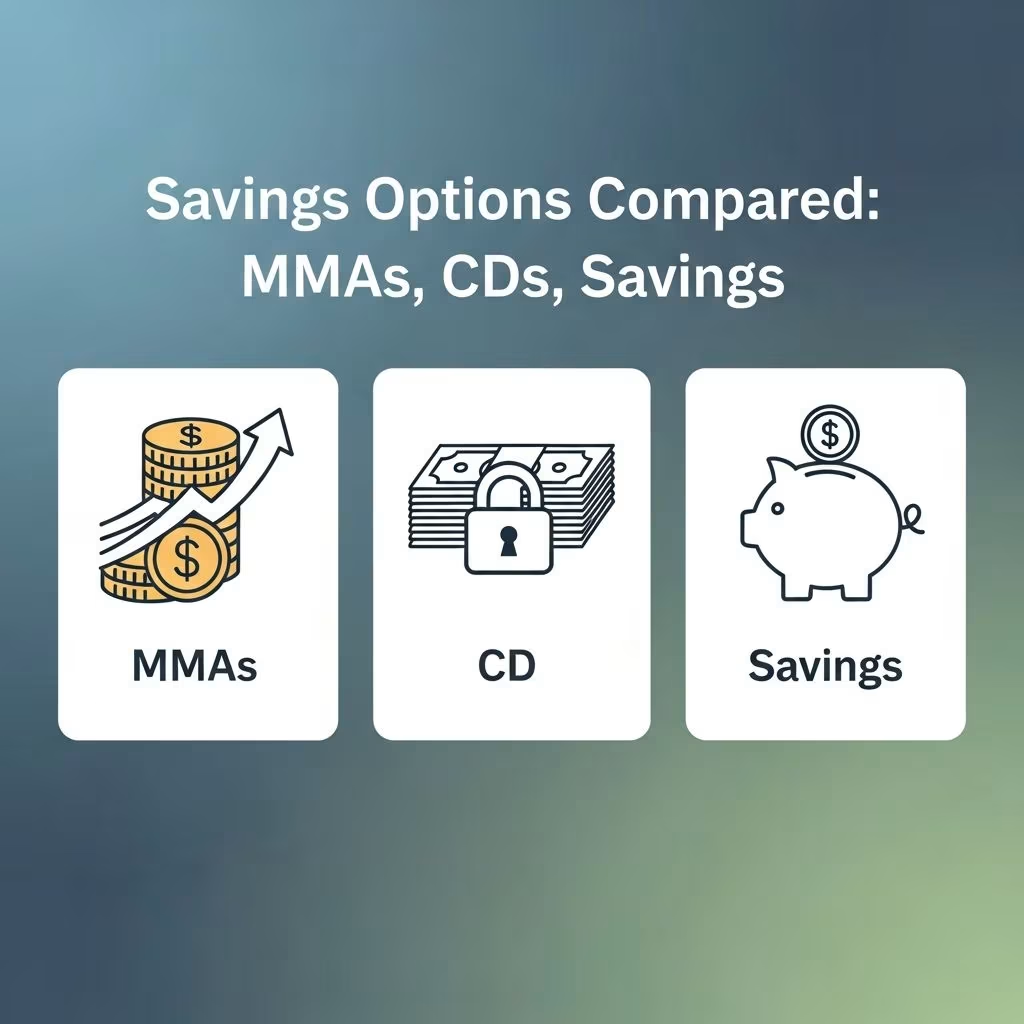
Choosing the right savings vehicle can significantly impact your financial growth and accessibility to funds. Money market accounts (MMAs), certificates of deposit (CDs), and traditional savings accounts each offer unique benefits tailored to different saving needs, from emergency funds to long-term goals.
Understanding the Core Features of Each Account Type
Savings accounts provide basic flexibility for everyday saving. They allow frequent deposits and withdrawals, often with online transfers or ATM access, making them ideal for beginners or those building an emergency fund. Interest rates are typically variable and modest, but FDIC insurance protects deposits up to $250,000 per depositor per bank.
Money market accounts blend savings security with enhanced features like check-writing or debit cards. They generally offer higher variable rates than standard savings, tiered by balance, but may limit monthly transactions (often six or fewer) and require higher minimum balances.
Certificates of deposit lock funds for a fixed term, from months to years, yielding higher fixed rates. Early withdrawals incur penalties, suiting them for money you won’t need soon.
Key Differences in Accessibility and Liquidity
Liquidity defines how easily you access funds without penalties. Savings accounts excel here, with no strict limits federally, though some banks impose them. MMAs offer similar access but with transaction caps and potential fees for excess withdrawals.
- Savings: High liquidity, transfers anytime.
- MMAs: Moderate liquidity, check/debit options, limited withdrawals.
- CDs: Low liquidity, locked until maturity.
CDs demand commitment; penalties can eat into principal. MMAs provide flexibility for short-term needs while earning better than savings.
Interest Rates: Variable vs. Fixed Returns
Rates drive growth. Savings and MMAs feature variable rates that fluctuate with market conditions, often higher for larger balances in MMAs.
CDs guarantee fixed rates for the term, protecting against drops but missing rises. In rising rate environments, variable MMA rates may outperform short-term CDs.
| Account Type | Rate Type | Typical Range (2025-2026) | Best For |
|---|---|---|---|
| Savings | Variable | 0.5%-4% | Flexible access |
| MMA | Variable, Tiered | 1%-5% | Balanced growth/access |
| CD | Fixed | 2%-5.5% (term-dependent) | Locked growth |
Rates vary by institution and economy; shop around for competitive offers.
FDIC Insurance and Safety Considerations
All three are FDIC-insured up to $250,000 per depositor, per ownership category, at insured banks, minimizing risk. This covers principal and interest, providing peace of mind. Credit unions offer equivalent NCUA protection.
Note: Brokerage money market funds differ, with SIPC coverage up to $500,000 but potential principal loss, unlike bank accounts.
Minimum Balances, Fees, and Penalties
Savings accounts often have low or no minimums, with minimal fees if balances stay above thresholds.
MMAs require higher minimums (e.g., $2,500) for optimal rates, possible monthly fees if dropped.
CDs need upfront deposits ($500+), no ongoing fees but early withdrawal penalties (e.g., 90-180 days’ interest).
- No-penalty CDs: Rare options allow early access without charge.
- Bump-up CDs: Adjust rates upward if market rises.
Pros and Cons Breakdown
Savings Accounts
- Pros: Easy access, low barriers, no penalties.
- Cons: Lower rates, potential transaction limits.
Money Market Accounts
- Pros: Higher rates, check/debit access, liquidity.
- Cons: Minimums, transaction limits, variable rates.
Certificates of Deposit
- Pros: Fixed higher rates, predictable growth, no fees if held to term.
- Cons: Illiquidity, penalties, opportunity cost if rates rise.
When to Choose Each Option
Short-term or emergency funds: Savings or MMAs for access without penalty.
Medium-term goals (1-3 years): MMAs or short-term CDs balancing rate and flexibility.
Long-term savings: CDs to lock in rates, especially in uncertain economies.
Laddering CDs—staggering maturities—enhances liquidity while capturing rates.
Strategies to Maximize Your Savings
Combine accounts: Use savings for immediate needs, MMAs for active saving, CDs for committed funds. Monitor rates via FDIC’s RateCap tool or bank comparisons. High-yield online options often beat brick-and-mortar.
In 2026, with potential rate shifts, review annually. Automate transfers to build balances efficiently.
Current Market Insights for 2026
As of early 2026, online banks offer top MMA rates near 5%, CDs up to 5.5% for 1-2 years. Inflation and Fed policy influence variables; fixed CDs hedge declines.
Frequently Asked Questions
What is the main advantage of a CD over an MMA?
CDs provide fixed, often higher rates without fluctuation risks.
Are MMAs better than savings accounts?
Usually, for higher rates and features, if you meet minimums.
Can I lose money in these accounts?
No, with FDIC insurance up to limits; inflation may erode purchasing power.
How do I avoid CD penalties?
Select no-penalty CDs or hold to maturity.
What’s a good MMA minimum balance?
$1,000-$10,000 unlocks best tiers; varies by bank.
Final Thoughts on Building Your Savings Portfolio
Align choices with goals: liquidity for near-term, locks for distant. Diversify across accounts for optimal yield and access. Regularly reassess as rates evolve.
References
- Money Market vs CDs: 10 Reasons to Choose in 2025 — Canal Bank. 2025. https://gocanalbank.com/money-market-vs-cds-10-convincing-reasons-which-one-you-should-choose-in-2025/
- Money Market vs. Certificate of Deposit (CD) — American National Bank. 2024-01-15. https://www.american.bank/news/money-market-vs-certificate-of-deposit/
- Money Market Accounts vs. Savings Accounts vs. CDs — Bankrate. 2025-11-20. https://www.bankrate.com/banking/savings/money-market-vs-savings-accounts-vs-cds/
- Certificates vs. Money Market Accounts — Oxford FCU. 2024. https://www.ofcu.org/certificates-vs-money-market-accounts
- High-yield savings accounts vs. CDs vs. money market funds — Vanguard. 2025. https://investor.vanguard.com/investor-resources-education/article/high-yield-savings-vs-cd-vs-money-market
- Money Market vs CD: How to Decide — Old National Bank. 2024. https://www.oldnational.com/personal/savings/money-market-vs-cd/
This article is general information, not personal financial advice. Consider your own situation, or speak with a licensed adviser, before acting on it.