

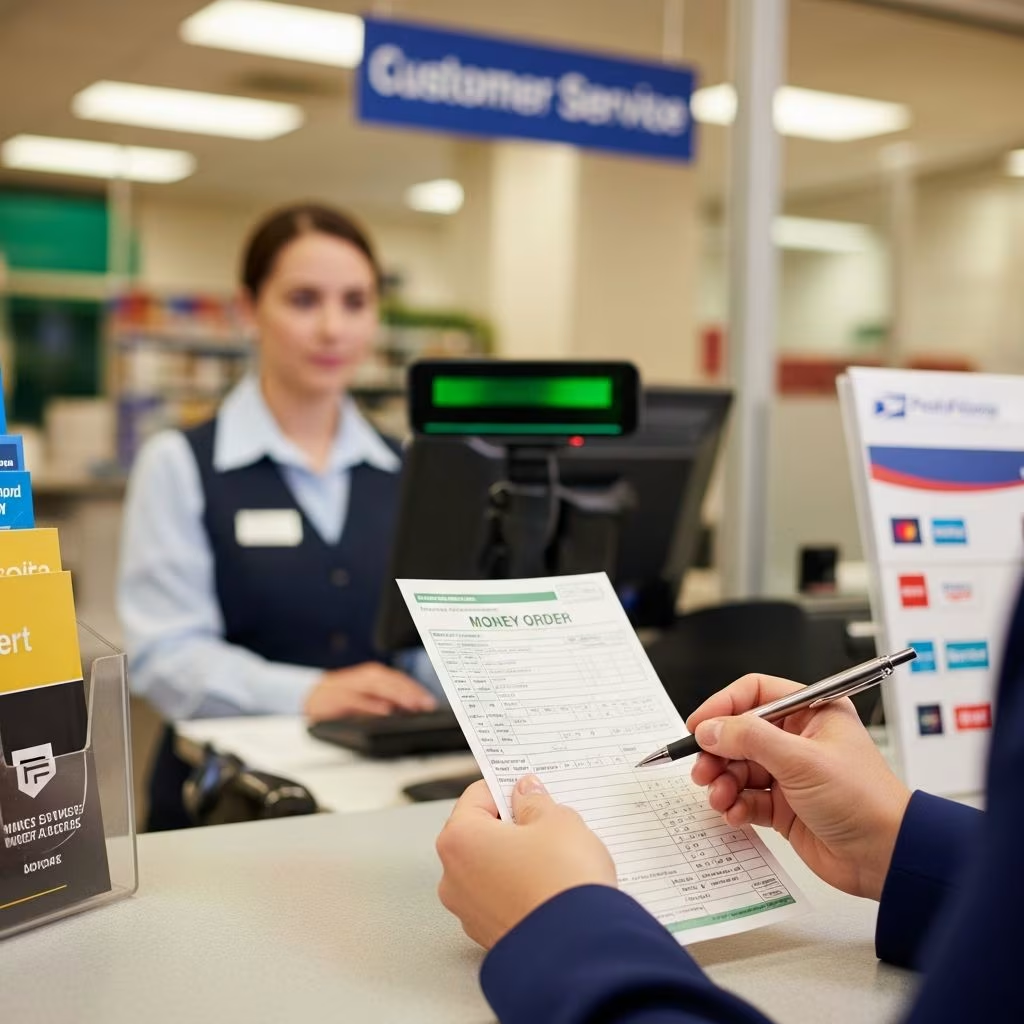
Money orders offer a reliable way to send or receive payments securely, especially when cash or personal checks aren’t ideal. Prepaid and guaranteed, they function like checks but eliminate bounce risks since funds are paid upfront. This guide explores prime locations to obtain them, complete with fees, limits, and practical advice.
Understanding the Basics of Money Orders
A money order is a prepaid negotiable instrument issued by trusted entities, allowing payment of a fixed amount without linking to a personal bank account. Buyers pay the face value plus a small fee, receiving a document the recipient can cash or deposit like a check. This setup ensures security, as the issuer guarantees funds, making it superior to cash for mailed payments or transactions with unbanked parties.
Typically capped at $1,000 per order, they suit rents, utilities, or gifts. For larger sums, multiple orders or alternatives like cashier’s checks work better, as the latter lack strict limits. Issuers print the amount securely, often with a detachable receipt for the buyer’s records.
Top Places to Purchase Money Orders
Several outlets issue money orders, each with unique perks like hours, fees, and limits. Availability depends on location, so verify locally.
United States Postal Service (USPS)
USPS stands out for nationwide access and low fees. Domestic orders cost $2.10 for up to $500 and $2.90 for $501-$1,000; international ones range $10.85-$12.40. Limits match domestic at $1,000. Buy during post office hours, paying cash, debit, or traveler’s checks—no credit cards. They offer refunds if lost, with receipts essential.
- Pros: Ubiquitous, cheap, secure tracking.
- Cons: Limited hours, no evenings/weekends typically.
Banks and Credit Unions
Many banks like Chase, Bank of America, and credit unions sell to account holders. Fees hover at $0-$5, limits $1,000. Require ID and account status; some restrict to customers. Convenient if banking there, but less accessible for non-customers.
- Pros: Integrated with accounts, potential fee waivers.
- Cons: Customer-only policies common.
Convenience Stores and Grocery Chains
Spots like 7-Eleven, Walmart, Kroger, and Rite Aid issue via partners like Western Union or MoneyGram. Fees $0.99-$5.95, limits $500-$1,000. Open late, accept cash/debit. Walmart caps at $1,000 for $0.88 fee up to $500, $1.00 after.
- Pros: Extended hours, easy access.
- Cons: Higher fees, variable availability.
Check-Cashing and Retail Services
Outlets like ACE Cash Express or Western Union locations provide quick issuance. Fees $1-$5, limits standard. Ideal for urgent needs, often 24/7.
Comparing Money Order Providers
Choose based on cost, convenience, and amount. Here’s a breakdown:
| Provider | Fee (Up to $500) | Fee ($501-$1,000) | Max Amount | Payment Methods |
|---|---|---|---|---|
| USPS | $2.10 | $2.90 | $1,000 | Cash, Debit, Traveler’s Checks |
| Walmart | $0.88 | $1.00 | $1,000 | Cash, Debit |
| 7-Eleven | $0.99-$1.49 | $1.49-$2.99 | $1,000 | Cash, Debit |
| Banks | $0-$5 | $0-$5 | $1,000 | Cash (Account Req.) |
Data synthesized from common providers; fees may vary by location.
Step-by-Step Guide to Buying and Using
- Locate a Provider: Use store locators on USPS.com, Walmart.com, or apps.
- Gather Funds and ID: Bring exact cash/debit amount plus fee; photo ID mandatory.
- Fill Out Form: Enter payee name, your address, optional ‘pay to’ details. Avoid leaving blank.
- Sign and Detach Receipt: Sign in purchaser section; keep stub.
- Deliver: Mail or hand to recipient.
Recipients endorse and deposit/cash at banks or issuers.
Fees, Limits, and Hidden Costs
Fees range $0.70-$5 domestically, higher internationally. Limits prevent fraud; exceed by buying multiples. Watch for expiration (none federally, but check issuer). Refunds cost extra, need receipt.
When to Choose Money Orders Over Alternatives
Opt for them sans bank account or for mail security. Compare:
| Option | Security | Cost | Limit | Bank Needed? |
|---|---|---|---|---|
| Money Order | High (Prepaid) | Low ($1-5) | $1,000 | No |
| Personal Check | Medium (Can Bounce) | Free | Account Balance | Yes |
| Cashier’s Check | High | $10-20 | None | Yes |
| Wire Transfer | High | $20-50 | Varies | Yes |
| P2P Apps (Venmo) | Medium | Free/Low | $1,000 Daily | Often |
Money orders excel for unbanked or secure mail.
Safety Tips and Common Pitfalls
Write payee clearly, use permanent ink. Mail via tracked service. Report loss immediately with receipt. Avoid credit cards for purchase—fees only. Scams target sellers; buy from reputable spots.
- Track via serial number.
- Don’t send cash instead.
- Verify recipient details.
International Money Orders
For abroad, USPS issues to select countries, fees $10+. Alternatives like Western Union better for speed. Confirm acceptance.
Frequently Asked Questions
Can I buy a money order with a credit card?
No, most issuers accept only cash, debit, or checks to prevent debt.
How long does it take to cash a money order?
Instant at issuers; 1-2 days via bank deposit.
What if I lose the receipt?
Refunds harder; inquiry fees apply, process 30-60 days.
Are money orders taxable?
No, but track for records.
Can businesses accept money orders?
Yes, widely for rents, deposits.
Modern Alternatives in a Digital Age
Apps like Zelle, PayPal reduce need, but money orders persist for no-fee security. Hybrid use: digital for speed, orders for proof.
In summary, money orders remain vital for secure, accessible payments. With locations from post offices to supermarkets, they’re easy to obtain.
References
- Money Order – Definition, How It Works, Types — Corporate Finance Institute. 2023. https://corporatefinanceinstitute.com/resources/valuation/money-order/
- What is a money order? How it works and when you should use one — Business Insider. 2024-01-15. https://www.businessinsider.com/personal-finance/banking/what-is-a-money-order
- Money order — Wikipedia (citing USPS). 2025-04-01. https://en.wikipedia.org/wiki/Money_order
- money order — Legal Information Institute, Cornell Law School. 2024. https://www.law.cornell.edu/wex/money_order
- What Is a Money Order and How Does It Work? — Experian. 2024-06-20. https://www.experian.com/blogs/ask-experian/what-is-money-order/
- What is a Money Order and How Does It Work? — Capital One. 2025-02-10. https://www.capitalone.com/learn-grow/money-management/what-is-a-money-order/
This article is general information, not personal financial advice. Consider your own situation, or speak with a licensed adviser, before acting on it.


