

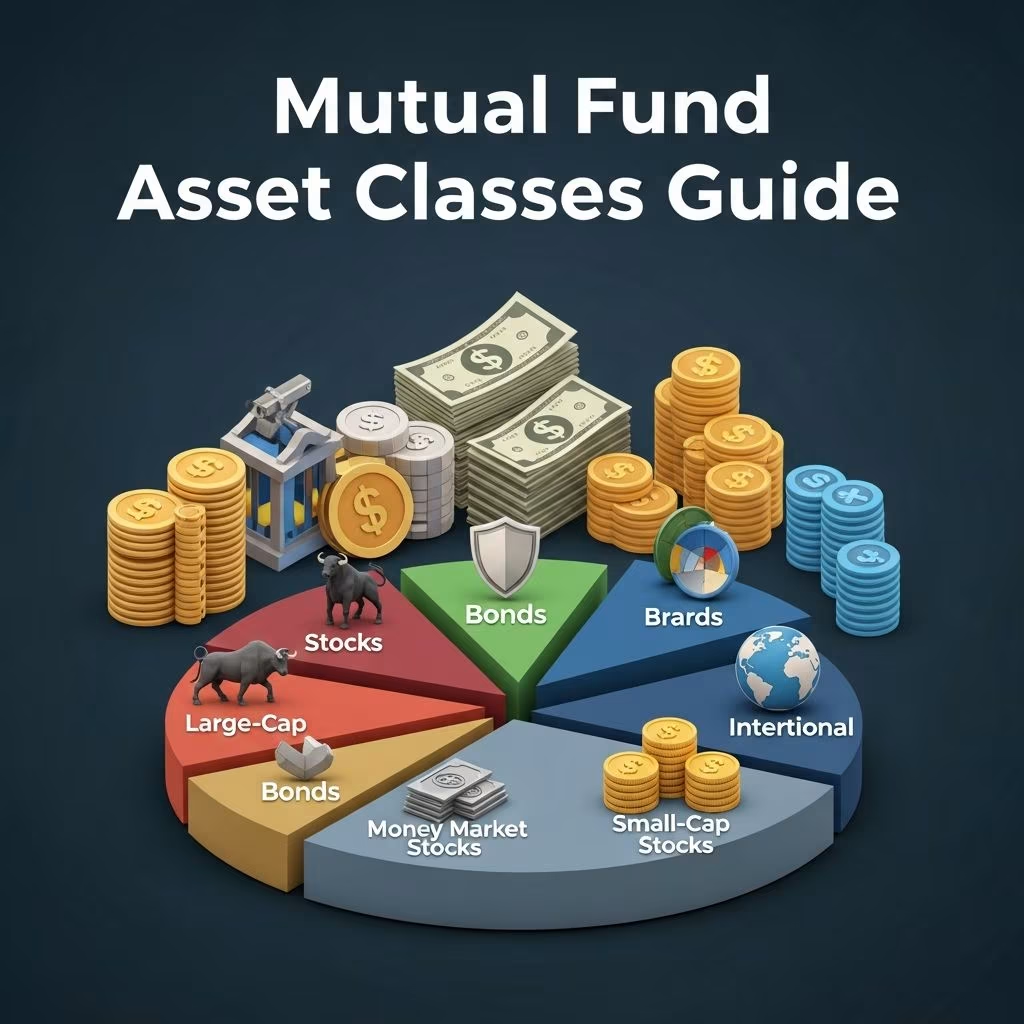
Mutual funds provide investors with access to a wide range of asset classes, each designed to meet different financial objectives such as preserving capital, generating income, or pursuing long-term growth. By understanding these categories, individuals can construct portfolios that align with their risk tolerance, time horizon, and goals. This guide examines the primary types of mutual fund asset classes, their characteristics, benefits, and ideal use cases, helping you make informed decisions.
Understanding the Foundations of Asset Classes in Mutual Funds
Asset classes in mutual funds represent broad groupings of investments that behave differently under various market conditions. Common categories include cash equivalents, fixed income, equities, and specialized sectors. Diversifying across these classes helps mitigate risk because they often respond uniquely to economic shifts—such as interest rate changes or stock market rallies. For instance, while stocks may surge during economic expansions, bonds typically offer stability during downturns.
Investors select funds based on factors like liquidity needs, expected returns, and volatility tolerance. Low-risk options prioritize capital preservation, whereas higher-risk funds aim for substantial appreciation over time. Vanguard’s offerings, known for low costs, exemplify how these classes can be accessed efficiently.
Cash-Like Investments: Money Market Funds for Stability
Money market funds invest in short-term, high-quality debt instruments like government securities and commercial paper. These funds aim to maintain a stable net asset value (NAV), usually $1 per share, making them suitable for emergency savings or short-term goals.
- Low volatility: Minimal price fluctuations compared to stocks or bonds.
- Liquidity: Easy access to funds, often same-day settlements.
- Yield potential: Typically higher than savings accounts but lower than bonds.
Ideal for parking cash during market uncertainty or awaiting opportune investments. However, returns may not outpace inflation over extended periods, limiting long-term growth.
Fixed Income Options: Bond Funds for Steady Income
Bond funds pool investments into government, corporate, or municipal debt securities, providing regular interest payments. They serve as a buffer against stock market volatility while offering yields superior to money market funds.
Key subtypes include:
- Government bonds: Backed by federal entities, lowest risk.
- Corporate bonds: Higher yields from company debt, moderate risk.
- Municipal bonds: Tax-exempt, appealing for high-income investors.
Bond funds moderate portfolio risk, especially when paired with equities. Duration—the sensitivity to interest rate changes—affects performance; shorter durations reduce rate risk.
| Bond Fund Type | Risk Level | Yield Expectation | Best For |
|---|---|---|---|
| Government | Low | Moderate | Capital preservation |
| Corporate | Medium | Higher | Income generation |
| Municipal | Low-Medium | Tax-adjusted high | Tax-sensitive investors |
These funds shine in income-focused portfolios, particularly for retirees seeking predictable cash flows.
Balanced and Multi-Asset Funds: Combining Growth and Income
Balanced funds blend stocks and bonds, typically in a 60/40 ratio, to deliver both growth and income with moderated risk. They automatically rebalance to maintain targets, simplifying management.
- Target-date funds: Shift conservatively toward bonds as retirement nears.
- LifeStrategy funds: Fixed allocations like 80% stocks/20% bonds for growth-oriented investors.
- Income-focused balanced: Emphasize dividends and coupons for steady payouts.
These ‘all-in-one’ solutions suit busy investors, reducing the need for manual adjustments. Growth portfolios lean heavily on stocks, balanced ones split evenly, and income models favor fixed income.
Equity Funds: Stock Funds for Long-Term Growth
Stock funds invest in company shares, offering the highest growth potential but with elevated volatility. They thrive over long horizons, historically outpacing other classes despite periodic downturns.
Variations include:
- Index funds: Track benchmarks like the S&P 500 for broad exposure.
- Active funds: Managers select stocks to outperform markets.
- Growth vs. value: Growth targets high-potential firms; value seeks undervalued ones.
Pairing stock funds with bonds diversifies risk. Investors with 10+ year horizons benefit most, as short-term losses often recover.
Global Exposure: International Funds for Broader Diversification
International funds target stocks and bonds from developed (e.g., Europe, Japan) and emerging markets (e.g., China, India). They reduce reliance on U.S. performance, capturing global growth opportunities.
- Developed markets: Stable economies with mature companies.
- Emerging markets: Higher growth potential, increased volatility.
- Global funds: Blend U.S. and foreign holdings.
Currency fluctuations add complexity, but these funds enhance diversification. Limit to 20-30% of portfolios for balance.
Targeted Investments: Sector and Specialty Funds
Sector funds concentrate on industries like technology, healthcare, energy, or real estate. Specialty options include precious metals or ESG-focused funds aligning with environmental, social, and governance values.
Pros and cons:
- High conviction: Capitalize on sector booms.
- Elevated risk: Vulnerable to industry slumps.
- ESG appeal: Invest ethically without sacrificing returns.
Use sparingly as portfolio satellites, not cores. ESG funds have grown popular, integrating sustainability with profitability.
Share Classes: Tailoring Costs and Access
Vanguard offers Investor, Admiral, and Institutional shares with identical holdings but varying minimums and fees. Admiral shares lower expense ratios (avg. 0.14%) for $3,000+ investments, while Institutional suits large investors ($5M min).
| Share Class | Min. Investment | Avg. Expense Ratio |
|---|---|---|
| Investor | $3,000 | 0.29% |
| Admiral | $3,000-$100,000 | 0.14% |
| Institutional | $5M | 0.08% |
Lower fees compound savings over time.
Building Your Portfolio: Allocation Strategies
Effective asset allocation drives returns and controls risk. Income portfolios favor bonds/dividends; balanced split equities/fixed income; growth emphasizes stocks.
- Assess risk tolerance: Conservative? More bonds. Aggressive? Stock-heavy.
- Time horizon: Short-term needs cash/bonds; long-term stocks.
- Rebalance annually: Maintain targets amid market drifts.
Vanguard’s models project returns using tools like VAAM, advocating low-cost indexing.
Frequently Asked Questions (FAQs)
What is the safest mutual fund asset class?
Money market funds offer the lowest risk, prioritizing stability and liquidity.
How do balanced funds work?
They mix stocks and bonds, rebalancing to target ratios for growth and income.
Are international funds necessary?
They provide diversification beyond U.S. markets, reducing overall portfolio risk.
What are ESG funds?
Sector/specialty funds focusing on sustainable practices across asset classes.
How to choose share classes?
Match investment size to minimums for optimal expense ratios.
Key Considerations for Investors
Mutual funds trade at end-of-day NAV, differing from intraday ETF trading. Index funds minimize costs via passive management, while active seeks alpha. Always align choices with goals, diversify broadly, and monitor fees. Consulting a financial advisor ensures personalization.
References
- Learn about mutual fund asset classes – Vanguard — Vanguard. 2026. https://investor.vanguard.com/investor-resources-education/mutual-funds/asset-classes
- Investment portfolios: Asset allocation models – Vanguard — Vanguard. 2026. https://investor.vanguard.com/investor-resources-education/education/model-portfolio-allocation
- Compare mutual fund share classes at Vanguard — Vanguard. 2026. https://investor.vanguard.com/investor-resources-education/mutual-funds/share-classes-of-vanguard-mutual-funds
- Investing In a Mutual Fund – Vanguard — Vanguard. 2026. https://investor.vanguard.com/investment-products/mutual-funds
- Understanding investment types – Vanguard — Vanguard. 2026. https://investor.vanguard.com/investor-resources-education/understanding-investment-types
- Asset allocation mutual funds for a complete portfolio – Vanguard — Vanguard. 2026. https://investor.vanguard.com/investment-products/mutual-funds/all-in-one-funds
This article is general information, not personal financial advice. Consider your own situation, or speak with a licensed adviser, before acting on it.


