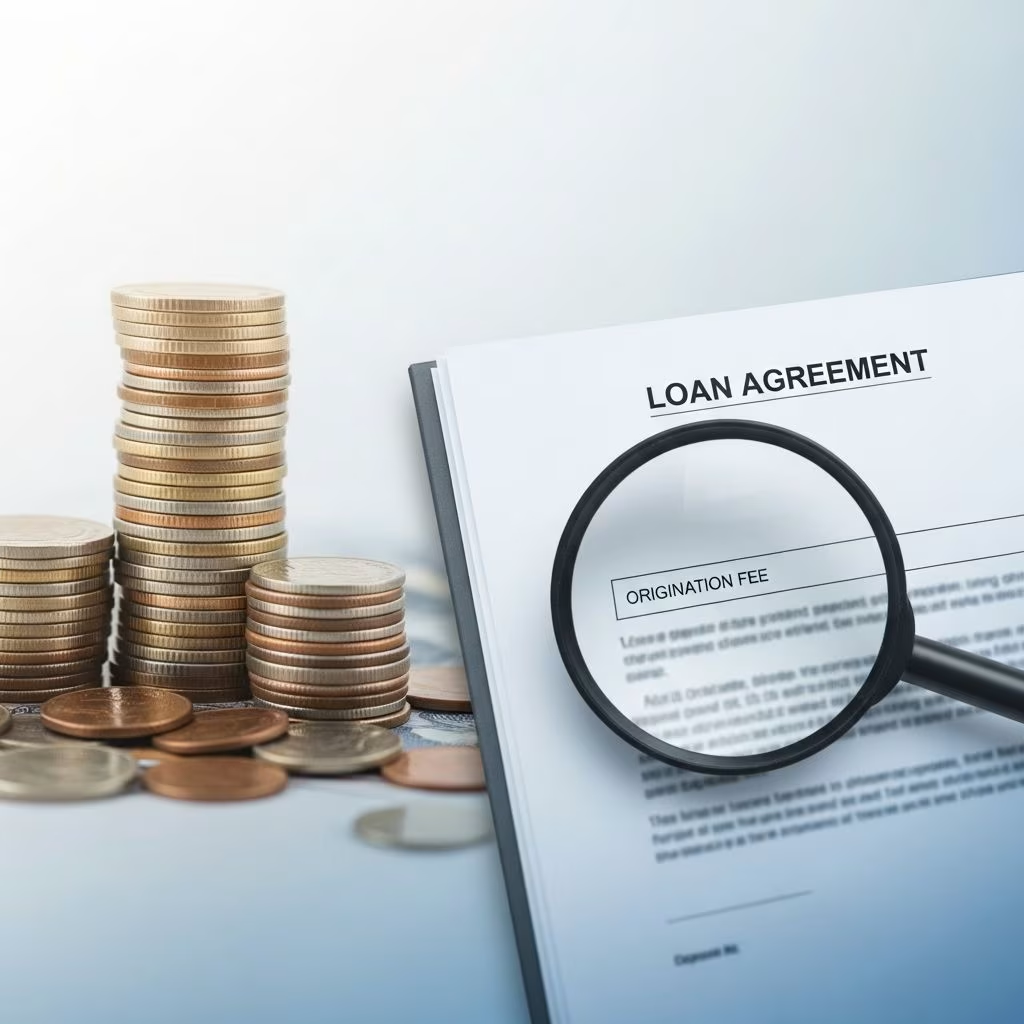
Understanding Personal Loan Origination Fees
When you apply for a personal loan, you’re likely to encounter more than just an interest rate. Many lenders charge an origination fee, also known as a processing fee or administrative fee, which is a one-time upfront charge for processing your loan application and underwriting the loan. While not all lenders impose this fee, it’s become increasingly common, particularly among online lenders and when borrowing with fair or poor credit. Understanding how origination fees work is crucial to making informed borrowing decisions and accurately comparing loan options.
What Exactly Is a Loan Origination Fee?
An origination fee is a charge that lenders assess to cover the costs associated with processing and issuing your loan. These costs typically include administrative expenses, credit checks, verification of financial information, and other operational expenses related to underwriting your application. The fee is calculated as a percentage of your total loan amount and is one of the primary ways lenders generate revenue from lending activities.
Unlike some other fees you might encounter when borrowing money, origination fees are standardized across the lending industry and transparently disclosed before you sign loan documents. This transparency allows borrowers to factor the fee into their decision-making process when evaluating whether to accept a particular loan offer.
How Much Do Origination Fees Typically Cost?
Origination fees generally range from 1 to 10 percent of your total loan amount, though the exact percentage varies based on multiple factors including your creditworthiness, the lender you choose, the loan amount, and the loan term. For borrowers with excellent credit, fees might be as low as 0.99 percent or even lower. Conversely, borrowers with poor or fair credit might face fees approaching 10 to 12 percent from specialized bad-credit lenders.
To illustrate with a concrete example, consider a $10,000 personal loan:
- With a 1 percent fee: You’d pay $100 in origination costs
- With a 5 percent fee: You’d pay $500 in origination costs
- With a 10 percent fee: You’d pay $1,000 in origination costs
These seemingly modest percentages can quickly accumulate into substantial amounts, especially for larger loan amounts.
How Origination Fees Affect Your Loan Proceeds
One critical aspect of origination fees that many borrowers overlook is how they’re deducted from your loan. In the vast majority of cases, lenders deduct the origination fee directly from your loan proceeds before disbursing funds to you. This means you don’t pay the fee out-of-pocket, but you receive less money than you borrowed.
Here’s how this works in practice: Suppose you’re approved for a $10,000 personal loan with a 5 percent origination fee ($500). Rather than receiving the full $10,000, you’ll actually receive only $9,500 because the lender subtracts the $500 fee from your loan proceeds. However, you’re still obligated to repay the entire $10,000 plus interest.
This creates an important consideration: if you need $10,000 for a specific purpose, you’ll actually need to borrow more than $10,000 to account for the origination fee. In this example, you’d need to request approximately $10,527 to end up with $10,000 after the fee is deducted.
The True Cost: Interest on the Full Loan Amount
An often-misunderstood aspect of origination fees is that you pay interest on the entire loan amount, not just the money you actually receive. Using our earlier example, even though you receive only $9,500 after the origination fee is deducted, you’ll pay interest on the full $10,000 (or $10,527 if you borrowed that amount to net $10,000).
This compounds the actual cost of the origination fee. The fee itself is a direct cost, but it also increases the principal amount on which interest is calculated, resulting in additional interest charges over the life of the loan. This is why comparing the annual percentage rate (APR) across lenders is so important—the APR reflects both the interest rate and the impact of origination fees on your total borrowing cost.
What Factors Influence Your Origination Fee?
Lenders don’t charge all borrowers the same origination fee. Instead, they use your financial profile and credit risk assessment to determine your specific fee. Several key factors influence this determination:
- Credit Score: Your credit score is perhaps the most significant factor. Borrowers with excellent credit (typically 750+) qualify for lower fees, while those with poor credit (below 620) face higher fees.
- Income and Debt-to-Income Ratio: Lenders assess your ability to repay by examining your income and comparing it to your existing debt obligations. Lower debt-to-income ratios result in lower fees.
- Employment History: Stable employment history suggests reliability and reduces risk in the lender’s eyes, potentially lowering your fee.
- Loan Amount: While the fee is a percentage, the absolute dollar amount increases with larger loans, affecting the lender’s risk assessment.
- Loan Term: Longer loan terms may result in higher fees due to increased risk exposure over time.
- Lender Type: Online lenders, traditional banks, and credit unions may charge different fees based on their business models and risk tolerance.
Origination Fees by Lender: A Comparison
Different lenders take varying approaches to origination fees. Some well-known lenders and their typical fee ranges include:
| Lender | Origination Fee Range |
|---|---|
| Achieve | 1.99% to 8.99% |
| Alliant Credit Union | None |
| American Express | None |
| Best Egg | 0.99% to 9.99% |
| Citibank | None |
| Discover Personal Loans | None |
As you can see, several major lenders offer personal loans with no origination fees whatsoever. This doesn’t necessarily mean these loans are cheaper overall—lenders without origination fees may compensate by charging higher interest rates.
Are Origination Fees Always Worth It?
The answer to this question isn’t straightforward. While origination fees do increase your upfront and overall borrowing costs, a loan with an origination fee isn’t automatically worse than one without. Here’s why: some lenders who charge origination fees offer significantly lower interest rates to offset the upfront cost. Conversely, lenders advertising “no origination fees” often charge higher interest rates to maintain profitability.
Consider this comparison: Imagine two $10,000 loans with identical interest rates but different fee structures:
| Loan Characteristic | Loan A | Loan B |
|---|---|---|
| Origination Fee | 3% ($300) | 5% ($500) |
| APR | 12.1% | 14.1% |
| Total Loan Cost | $13,377 | $13,992 |
Despite having the same base interest rate, Loan B costs approximately $615 more over its lifetime due to the higher origination fee and interest rate combination. This demonstrates why total cost comparison is essential, not just looking at advertised rates.
How to Calculate the True Cost of Origination Fees
To accurately assess whether an origination fee is reasonable, you need to calculate the true total cost of borrowing. Rather than comparing interest rates alone, focus on the annual percentage rate (APR), which incorporates both the interest rate and the origination fee. The APR provides a more accurate representation of your actual borrowing cost.
When evaluating multiple loan offers, use these steps:
- Determine how much you actually need to borrow to account for the origination fee deduction
- Calculate the total interest you’ll pay over the loan term
- Add the origination fee to the total interest
- Compare this total cost across lenders offering similar loan terms
- Use the APR as your primary comparison metric
Online personal loan calculators can significantly streamline this process, allowing you to input different lender options and quickly see which offers the lowest total cost.
When You Should Avoid Loans with Origination Fees
While origination fees don’t automatically make a loan a bad deal, you should be cautious about certain situations:
- Upfront Payment Requests: If a lender asks you to pay an origination fee before funding your loan, this is a major red flag indicating a potential scam. Legitimate lenders always deduct fees from your loan proceeds or add them to your balance.
- Predatory Lending: Some lenders targeting those with poor credit charge excessively high origination fees (10-12 percent) combined with triple-digit interest rates, making repayment nearly impossible.
- Small Loan Amounts: For small loans, origination fees can represent a disproportionately high cost. A 5 percent fee on a $2,000 loan ($100) is relatively insignificant, but a 5 percent fee on a $500 emergency loan ($25) might not be worth it if a no-fee alternative exists.
Strategies to Minimize Origination Fee Impact
If you’re concerned about origination fees, several strategies can help minimize their impact:
- Improve Your Credit Score: A higher credit score qualifies you for lower fees. Even improving your score by 50-100 points could reduce your origination fee by 1-2 percent.
- Seek Out No-Fee Lenders: Several lenders genuinely offer no origination fees. Compare their interest rates carefully to ensure you’re not paying more in interest what you save in fees.
- Compare APRs Across Multiple Lenders: Don’t settle for the first offer. Shopping around can reveal significant differences in total cost.
- Consider Borrow Less: If possible, borrow a smaller amount. A 5 percent fee on $5,000 ($250) is less than the same percentage on $10,000 ($500).
- Negotiate with Your Bank: If you have an established relationship with a bank, ask whether they can waive or reduce the origination fee, particularly if you maintain significant balances with them.
Frequently Asked Questions
Q: Can origination fees be negotiated?
A: With some lenders, particularly traditional banks, there may be room to negotiate origination fees if you have an established relationship or strong credit profile. Online lenders typically have fixed fee structures that aren’t negotiable.
Q: Is there a difference between origination fees and other loan fees?
A: Yes. Origination fees are specifically for loan processing and underwriting. Other fees might include prepayment penalties (charged if you pay off the loan early), late fees (charged if you miss payments), or returned payment fees (if a payment bounces).
Q: What’s the average origination fee for personal loans?
A: Most personal loans charge origination fees between 1 and 10 percent. The specific amount depends heavily on your credit score and the lender’s policies. Borrowers with excellent credit typically pay fees on the lower end (1-3 percent), while those with fair or poor credit may pay 6-10 percent.
Q: How does an origination fee affect my monthly payment?
A: While the origination fee isn’t a separate monthly charge, it effectively increases your loan principal, which raises your monthly payment. For example, a 5 percent fee increases the amount you need to repay, directly increasing what you owe each month plus interest.
Q: Are federal student loans required to disclose origination fees?
A: Yes. Federal student loans are required to clearly disclose origination fees as a percentage of the loan amount. This transparency requirement doesn’t apply universally to all personal loans, though most lenders do disclose them.
Q: Should I always choose the loan with the lowest origination fee?
A: Not necessarily. A loan with a slightly higher origination fee but significantly lower interest rate might cost less overall. Always compare total costs using the APR, not individual fees alone.
References
- Personal Loan Origination Fees: What To Know — Bankrate. 2025. https://www.bankrate.com/loans/personal-loans/personal-loan-origination-fees/
- What Is a Personal Loan Origination Fee? — Discover. 2025. https://www.discover.com/personal-loans/resources/learn-about-personal-loans/interest-rates-and-origination-fees/
- What is a loan origination fee? — Federal Student Aid, U.S. Department of Education. https://studentaid.gov/help-center/answers/article/what-is-origination-fee
- Advantages & Drawbacks of Personal Loans — MoneyRates. https://www.moneyrates.com/personal-loans/pros-and-cons-of-personal-loans.htm
- Best Personal Loan Rates of 2026 Compared — MoneyRates. https://www.moneyrates.com/personal-loan-rates.htm
This article is general information, not personal financial advice. Consider your own situation, or speak with a licensed adviser, before acting on it.