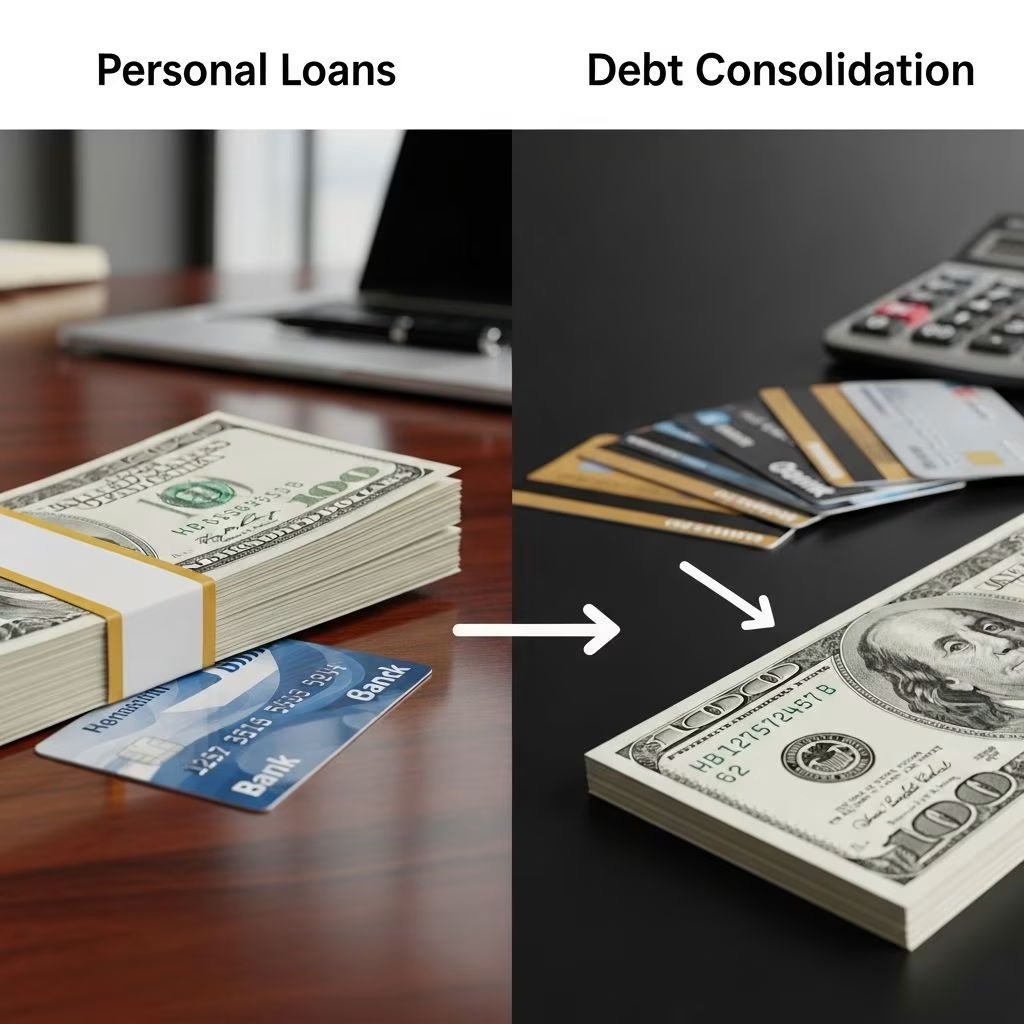
When navigating the landscape of personal borrowing, many individuals encounter the terms “personal loan” and “debt consolidation loan” used interchangeably, creating confusion about whether these represent distinct financial products or variations of the same offering. The reality is more nuanced than a simple yes or no answer. Understanding the fundamental relationship between these two borrowing mechanisms is essential for making informed decisions about your financial future.
The Core Relationship Between These Two Loan Types
At their foundation, a debt consolidation loan functions as a specialized application of a personal loan rather than a completely separate financial product. When you obtain a personal loan and deliberately use those funds to pay off existing debts, you have effectively transformed that personal loan into a debt consolidation loan. This distinction is crucial: the loan itself doesn’t change in nature, but rather your intended use of the borrowed funds determines its classification.
Financial institutions recognize this relationship, which is why you’ll frequently encounter personal loans marketed as debt consolidation solutions. Lenders understand that many borrowers seek to streamline their financial obligations, and they highlight how their personal loan products can serve this purpose. However, the underlying loan mechanics remain identical to a standard personal loan—fixed repayment terms, predetermined interest rates, and defined loan amounts.
Defining Personal Loans in Modern Finance
A personal loan represents an unsecured borrowing instrument that provides you with a lump sum of capital to address various financial needs. Unlike secured loans that require collateral (such as a home or vehicle), personal loans don’t obligate you to pledge specific assets as security. Lenders approve personal loans primarily based on your creditworthiness, income stability, and overall financial profile.
These loans typically feature several consistent characteristics that make them accessible to many borrowers. Most personal loans carry fixed interest rates, meaning your rate remains constant throughout the loan term, allowing for predictable monthly payments. The repayment period typically ranges from two to seven years, though specific terms vary among lenders and individual circumstances.
The versatility of personal loans distinguishes them significantly in the lending marketplace. You can allocate these funds toward virtually any purpose, including:
- Home renovation and improvement projects
- Medical expenses and healthcare-related costs
- Vehicle repairs and maintenance
- Educational expenses and training programs
- Vacation and travel planning
- Wedding expenses and celebrations
- Emergency financial needs
- Small business ventures and entrepreneurial pursuits
Most lenders impose minimal restrictions on how you utilize personal loan proceeds, providing substantial flexibility for borrowers facing diverse financial situations.
Understanding Debt Consolidation as a Strategic Application
Debt consolidation represents a deliberate financial strategy wherein you take out a new loan specifically to eliminate multiple existing debts. Consider a practical scenario: you’re managing three separate credit card accounts with balances totaling $15,000 across different interest rates, each requiring individual monthly payments with varying due dates. A debt consolidation approach would involve securing a $15,000 loan and using those proceeds to settle all three credit card balances simultaneously, resulting in a single monthly payment obligation instead of three.
This strategy appeals to borrowers for several compelling reasons. The consolidation process simplifies financial management by reducing payment tracking complexity. Rather than monitoring multiple due dates, interest rates, and minimum payments, you focus on one straightforward monthly obligation. This organizational simplification alone reduces the likelihood of missed payments and associated penalties.
Beyond convenience, debt consolidation frequently delivers financial benefits through interest rate reduction. Credit card accounts commonly carry higher annual percentage rates (APRs) compared to personal loans, sometimes exceeding 20 percent or more depending on creditworthiness and market conditions. By consolidating these higher-rate debts into a personal loan with a substantially lower rate, you can accumulate significant interest savings over the loan’s duration.
Comparative Analysis: Key Differentiators
| Feature | Personal Loan | Debt Consolidation Application |
|---|---|---|
| Primary Purpose | Flexible funding for various needs | Specific debt repayment and simplification |
| Number of Debts Addressed | Not applicable (funds available for any use) | Combines multiple existing debts |
| Interest Rate Structure | Fixed rate throughout term | Fixed rate, typically lower than original debts |
| Monthly Payment Simplification | Single payment (for the personal loan) | Single payment consolidating multiple obligations |
| Unsecured Status | Yes, no collateral required | Yes, no collateral required |
| Approval Requirements | Based on creditworthiness and income | Based on creditworthiness and income |
Advantages of Pursuing Consolidation Through Personal Loans
When you choose to use a personal loan for debt consolidation purposes, you unlock several meaningful financial and practical benefits that can significantly improve your overall financial position.
Interest Rate Optimization: The most substantial advantage involves reducing your effective interest rate. If you’re consolidating credit card debt with APRs between 18 and 25 percent into a personal loan carrying a rate of 8 to 12 percent, you immediately reduce your borrowing costs. This difference compounds substantially over the loan term, potentially saving thousands of dollars in interest payments.
Payment Streamlining: Managing multiple creditors with different payment schedules creates mental and administrative burden. Consolidation transforms this fragmented approach into a single, predictable monthly payment. This simplification reduces the cognitive load of debt management and decreases the probability of missed payments that would trigger late fees and credit score damage.
Credit Utilization Improvement: When you pay off credit cards through consolidation, you reduce your credit utilization ratio—the percentage of available credit you’re currently using. Credit bureaus view lower utilization ratios favorably, as they suggest responsible credit management. This improvement can positively influence your credit score over time, potentially leading to better borrowing terms for future financial needs.
Predictable Payment Structure: Personal loans feature fixed interest rates and predetermined amortization schedules. Unlike credit card minimum payments that can fluctuate based on balance changes, your personal loan payment remains constant throughout the term. This predictability facilitates budgeting and financial planning, allowing you to accurately forecast future cash flow.
Determining Your Optimal Borrowing Strategy
Selecting between a personal loan and a debt consolidation approach requires honest assessment of your financial objectives. The fundamental question guiding your decision should focus on your intended use of borrowed funds: “What specific financial goal am I trying to accomplish?”
Choose a Traditional Personal Loan When: You require flexible funding for diverse purposes unrelated to existing debt elimination. This includes emergency medical expenses, home improvement projects, vehicle repairs, educational pursuits, or planned major purchases. Personal loans excel when your borrowing need doesn’t involve consolidating existing obligations but rather addressing a new financial requirement.
Choose a Debt Consolidation Strategy When: Your primary objective involves streamlining multiple existing debt obligations into a single manageable payment. If you’re struggling to track multiple due dates, paying higher-than-necessary interest rates across various creditors, or feeling overwhelmed by fragmented debt management, consolidation through a personal loan becomes strategically advantageous. This approach particularly benefits those with credit card debt, medical bills, or other high-interest obligations.
Frequently Asked Questions
Are debt consolidation loans and personal loans literally the same product?
Technically, a debt consolidation loan is a personal loan used for a specific purpose. The underlying loan product hasn’t changed; rather, your intended use determines its classification. Many lenders market identical personal loan products under both names depending on the borrower’s stated purpose.
Can I use a personal loan for something other than debt consolidation?
Absolutely. Personal loans offer flexibility regarding fund allocation. You can use personal loan proceeds for virtually any legal purpose—home renovations, vacation travel, emergency expenses, business ventures—without lenders restricting your choices significantly.
Will consolidating my debt through a personal loan improve my credit score?
Potentially, yes. Consolidation can improve your credit score through several mechanisms: reducing credit utilization on paid-off credit cards, establishing a positive payment history on the new loan, and diversifying your credit mix. However, short-term score impacts from the new loan application and hard inquiry may temporarily decrease your score before improvements materialize.
What interest rate should I expect from a debt consolidation personal loan?
Interest rates vary based on multiple factors including your credit score, income stability, debt-to-income ratio, loan amount, and term length. Generally, rates range from 6 to 36 percent, with better-qualified borrowers securing rates in the lower range. Rates for consolidation loans are typically lower than credit card APRs but may be higher than secured loan options like home equity lines of credit.
How long does the debt consolidation process typically take?
Timeline varies by lender but typically ranges from a few days to two weeks. Some online lenders offer rapid approval and funding within 24 hours, while traditional banks may require longer. Once funds are disbursed, you can pay off your existing debts immediately.
Making Your Final Decision
The distinction between personal loans and debt consolidation approaches ultimately hinges on your financial circumstances and objectives. If you’re simply seeking capital for a specific need unrelated to existing debt, a personal loan serves your purpose perfectly. If you’re burdened by multiple debt obligations and seeking to simplify your financial life while reducing interest expenses, applying a personal loan toward debt consolidation represents a strategic financial move.
Understanding that these aren’t fundamentally different products empowers you to evaluate lending options more intelligently. Focus on identifying a lender offering favorable terms—competitive interest rates, manageable payment schedules, and transparent fee structures—regardless of how the product is marketed. Your financial well-being depends less on terminology and more on securing borrowing terms that genuinely improve your overall financial position.
References
- How Are Debt Consolidation Loans and Personal Loans Different? — Experian. 2024. https://www.experian.com/blogs/ask-experian/is-a-personal-loan-the-same-as-a-consolidation-loan/
- Personal Loans vs. Debt Consolidation: What’s The Difference? — Community Choice Credit Union. 2024. https://www.communitychoicecu.com/financial-education/personal-loans-vs-debt-consolidation-whats-the-difference/
- Personal Loan vs Debt Consolidation Loan — BHG Financial. 2024. https://bhgfinancial.com/personal-loans/personal-loan-vs-debt-consolidation-loan
- Debt Consolidation Loans vs. Personal Loans — Citi Personal Loans. 2024. https://www.citi.com/personal-loans/learning-center/debt-consolidation/debt-consolidation-loans-vs-personal-loans
- Personal Loans vs. Debt Consolidation — Profed Credit Union. 2024. https://profedcu.org/learn/blog/personal-loans-vs-debt-consolidation
This article is general information, not personal financial advice. Consider your own situation, or speak with a licensed adviser, before acting on it.