

Prairie Crossing, Illinois: An Eco-Conscious Community Redefining Suburban Living
Nestled approximately 40 miles north of Chicago in the town of Grayslake, Illinois, Prairie Crossing stands as a remarkable example of how modern suburban development can harmoniously blend environmental stewardship with residential comfort. This bustling conservation community, which has earned recognition as one of Money magazine’s 50 best places to live in 2024, occupies more than 650 acres dominated by restored native prairies, wetlands, and a working organic farm. Unlike the typical cookie-cutter suburban subdivisions that characterize much of the American landscape, Prairie Crossing represents a paradigm shift in how communities can be planned and developed to enhance the environment while supporting a better quality of life for residents.
The Vision Behind Prairie Crossing
Prairie Crossing emerged from a bold vision developed in the mid-1990s by developers who sought to create a blueprint for ecologically-focused suburban living. The community was conceived as a response to unchecked sprawl that threatened the region’s natural landscapes. Developers Vicky and George Ranney Jr. partnered with other investors, including the Donnelley family, who had a long-standing commitment to conservation. Their collaborative effort resulted in the purchase of 677 acres of land that developers had previously planned to transform into approximately 3,000 homes. Instead, the Ranneys and their partners adopted a radically different approach: clustering homes on smaller lots while preserving 60 percent of the community’s acreage in a permanent land conservation easement.
The development of Prairie Crossing was guided by ten carefully crafted “guiding principles” that established both concrete environmental goals and broader community aspirations. These principles encompassed environmental protection, efficient transportation, economic viability, lifelong learning, healthy lifestyles, a sense of place, and economic and racial diversity. This thoughtful planning process reflected the developers’ commitment to creating not just a residential subdivision, but a genuine community dedicated to conservation and sustainable living practices.
Environmental Features and Conservation Efforts
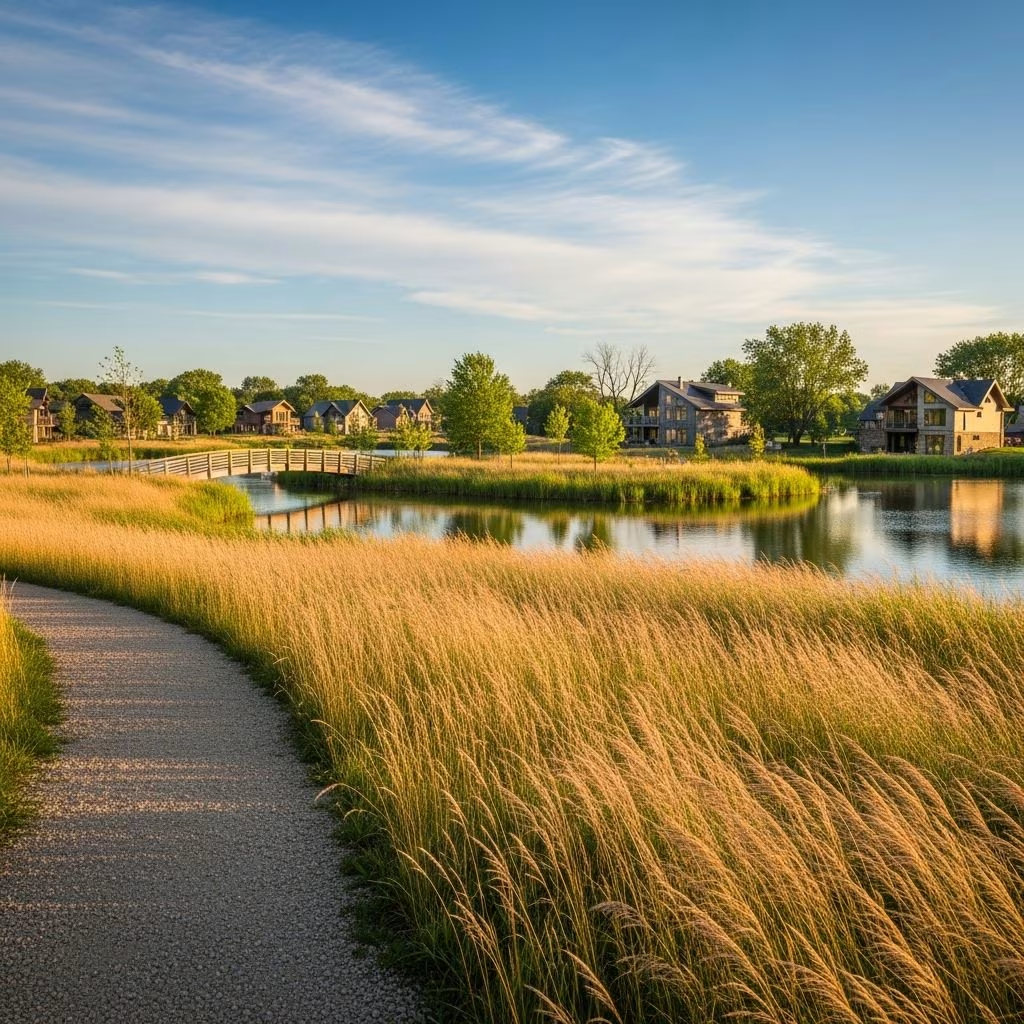
One of the most distinctive characteristics of Prairie Crossing is its remarkable environmental footprint. The community is dominated by restored open prairies and wetlands that showcase native plants and pollinators. Rather than replacing native vegetation with manicured lawns, residents’ yards feature waist-high native prairie grasses that undulate across the landscape. This approach not only preserves the ecological integrity of the region but also creates a visually distinctive aesthetic that sets Prairie Crossing apart from conventional suburban developments.
The conservation commitment extends beyond the immediate 677-acre community. Prairie Crossing is connected to the larger Liberty Prairie Reserve, a 3,200-acre conglomeration of public and private land that is legally protected from future development. This broader preservation effort, which was initiated in 1995, ensures that the natural heritage of the region remains intact for future generations. The reserve represents a collaborative approach to land preservation that demonstrates how private development can serve as a catalyst for larger-scale environmental protection.
Green Architecture and Sustainable Building Practices
Each home in Prairie Crossing was constructed using green building techniques approved by the U.S. Department of Energy, ensuring that environmental considerations were integrated into every residential structure. The approximately 400 homes in the community showcase diverse architectural styles while maintaining consistent standards for energy efficiency and sustainable materials. This commitment to green construction helped establish Prairie Crossing as a proving ground for residential building practices that could significantly reduce environmental impact without compromising quality of life or aesthetic appeal.
The architectural diversity within Prairie Crossing was intentional, reflecting the developers’ desire to avoid the monotonous uniformity that characterizes many suburban developments. By requiring green construction standards while allowing architectural variety, Prairie Crossing created a visually interesting community that appeals to a broad range of residents while maintaining strong environmental principles.
The Sandhill Organics Farm: A Model for Peri-Urban Agriculture
At the heart of Prairie Crossing lies Sandhill Organics, a 100-acre organic, production farmland operation that has become one of the community’s most distinctive features. This large-scale, intensive, integrated produce and livestock farm represents a significant departure from typical suburban green spaces, which historically have been limited to small community gardens or decorative landscaping. Sandhill Organics produces a diverse array of crops and raises livestock, including pigs and chickens, creating a genuine working farm within the community.
Matt and Peg Sheaffer, who came to Prairie Crossing early as the original farmers for Sandhill Organics, have transformed the operation into a thriving business. Leasing 45 acres of certified organic farmland from the Ranneys, the Sheaffers have built a sustainable agricultural enterprise through Community Supported Agriculture (CSA) memberships and sales at Chicago farmers markets. Their operation generates approximately $20,000 per acre—a figure dramatically higher than the roughly $800 per acre earned by mono-crop farmers who dominate the rest of Illinois. This economic success demonstrates that sustainable, diversified farming can be not only environmentally responsible but also financially viable.
Beyond Sandhill Organics, Prairie Crossing also features four “incubator farms” in the property’s back section, where young farmers have the opportunity to develop viable, profitable farm businesses before establishing their own independent operations. These incubator farms function as part of the Farm Business Development Center, providing essential support and resources for the next generation of sustainable agriculture entrepreneurs.
Transportation and Connectivity
Prairie Crossing’s commitment to reducing environmental impact extends to transportation infrastructure and planning. The community boasts two commuter rail stations that provide direct connections to Chicago, with trains departing every 40 minutes. This exceptional transit access allows residents to maintain professional careers in the Chicago metropolitan area while enjoying the environmental and lifestyle benefits of Prairie Crossing’s conservation-focused community.
The design of Prairie Crossing reflects a transportation philosophy that prioritizes walking and biking over automobile dependence. Residents walk from their homes to the Metra stations for their commutes to the Loop, and children ride their bikes to the Prairie Crossing Charter School and throughout the community. Winding trails take the place of conventional sidewalks, creating a more natural and aesthetically pleasing pedestrian infrastructure while encouraging active transportation.
Education and Community Programming
Prairie Crossing features its own top-rated charter school, the Prairie Crossing Charter School, which serves students throughout the county. The school’s curriculum is grounded in place-based education that ensures all students develop a solid academic understanding of the natural world. This educational approach reinforces the community’s commitment to environmental stewardship and sustainability, while providing residents with access to high-quality schooling without requiring private school fees or long commutes.
Beyond formal education, the community maintains an active events calendar packed with activities focused on sustainable land restoration and traditional celebrations. From educational workshops on prairie restoration to a July Fourth bike parade that celebrates the community’s commitment to active transportation, Prairie Crossing fosters a strong sense of community engagement and shared values among residents.
Market Reception and Economic Success
When Prairie Crossing was first conceived, skeptics questioned whether the development model could succeed. Municipal officials and developers across the country wondered whether buyers would pay premium prices for homes on smaller lots, accept narrow roads without conventional sidewalks, embrace primarily communal open space, and participate in land stewardship activities. The first 40 sales proved particularly challenging as prospective buyers struggled to trust the developers’ intentions and envision the completed community.
Despite initial hesitation, Prairie Crossing ultimately achieved remarkable commercial success. All approximately 400 homes sold, and at a rate 34 percent above the market price for similarly sized developments and homes in the surrounding area. This pricing premium demonstrates that homebuyers recognize and value the community’s distinctive environmental features, sustainable practices, and enhanced quality of life. The market success of Prairie Crossing has effectively validated the underlying thesis that environmentally conscious suburban development can be both commercially viable and economically rewarding.
The first residents to purchase homes in Prairie Crossing included empty-nesters, young professionals, and families with children—a diverse demographic that reflected the community’s appeal to multiple lifestyle preferences and life stages. The diversity of the resident population has contributed to a vibrant, inclusive community atmosphere that honors the developers’ principle of promoting economic and racial diversity.
Commercial Development and Local Amenities
The evolution of Prairie Crossing has included carefully planned commercial development that complements the residential community without compromising its environmental character. Ground-floor retailers and service businesses have been integrated into the community’s commercial district, including a coffee shop, an international fair-trade gift store, and a children’s bookstore operated by a Prairie Crossing homeowner. These local businesses contribute to the community’s viability and self-sufficiency while providing residents with convenient access to essential services and shopping.
The commercial development at Prairie Crossing reflects a thoughtful approach to retail and service sector integration within the broader conservation community framework. Rather than the sprawling commercial strips that characterize many suburban developments, Prairie Crossing’s commercial areas are compact, walkable, and designed to minimize environmental impact.
Recognition and National Impact
Prairie Crossing has achieved significant national recognition for its pioneering approach to conservation-focused community development. The community’s inclusion in Money magazine’s 50 best places to live in 2024 reflects its status as a national model for sustainable suburban development. The community stands as the only Illinois representation on this prestigious list, underscoring its unique position within the real estate and lifestyle landscape.
Beyond media recognition, Prairie Crossing has influenced municipal planning and development practices across the country. The community demonstrates that conservation and development need not be opposing forces; rather, they can be thoughtfully integrated to create more resilient, environmentally responsible, and livable communities. Developers and municipal officials continue to study Prairie Crossing as a case study in sustainable development practices.
Frequently Asked Questions
Q: What makes Prairie Crossing different from other suburban developments?
A: Prairie Crossing is distinguished by its integration of conservation principles into every aspect of community design, including restored prairies covering 60 percent of the development, green-certified homes, an operational organic farm, two commuter rail stations, and a charter school with place-based environmental education.
Q: How close is Prairie Crossing to Chicago?
A: Prairie Crossing is located approximately 40 miles north of downtown Chicago in Grayslake, Illinois. Two Metra commuter rail stations provide convenient access to the city, with trains departing every 40 minutes.
Q: What is the size of the Prairie Crossing community?
A: The Prairie Crossing residential development encompasses 677 acres, with 60 percent permanently protected in a conservation easement. The community also connects to the larger Liberty Prairie Reserve, which preserves an additional 3,200 acres of public and private land.
Q: Are homes in Prairie Crossing more expensive than comparable suburban properties?
A: Prairie Crossing homes sold at approximately 34 percent above market rates for similarly sized homes in comparable suburban developments, reflecting the premium buyers place on the community’s environmental features and quality of life benefits.
Q: What educational opportunities are available in Prairie Crossing?
A: Prairie Crossing features a top-rated charter school open to students throughout the county, with a curriculum grounded in place-based environmental education and sustainable land management principles.
Q: How does Sandhill Organics contribute to the Prairie Crossing community?
A: Sandhill Organics operates 100 acres of certified organic farmland, producing vegetables, fruits, and livestock for CSA members and Chicago farmers market sales. The farm also features incubator farms where young farmers can develop sustainable agricultural businesses.
References
- Prairie Crossing | A conservation community in Grayslake, Illinois — Prairie Crossing Official Website. 2024. https://prairiecrossing.com
- Prairie Crossing, Illinois is one of the best places to live in 2024 — Money Magazine. 2024. https://money.com/best-places-to-live/prairie-crossing-illinois/
- Prairie Lights — The University of Chicago Magazine. 2006. https://magazine.uchicago.edu/0612/features/prairie.shtml
- Prairie Crossing in Illinois: The ‘urban’ farm of the future? — Grist. 2024. https://grist.org/article/food-prairie-crossing-in-illinois/
- Curriculum — Prairie Crossing Charter School. 2024. https://prairiecrossingcharterschool.org/curriculum/
- Prairie Crossing, Illinois in Money magazine 50 Best Places to Live — PJ Star. 2024. https://www.pjstar.com/story/news/state/2024/09/25/prairie-crossing-illinois-money-magazine-50-best-places-to-live-in-us/75365710007/
This article is general information, not personal financial advice. Consider your own situation, or speak with a licensed adviser, before acting on it.


