

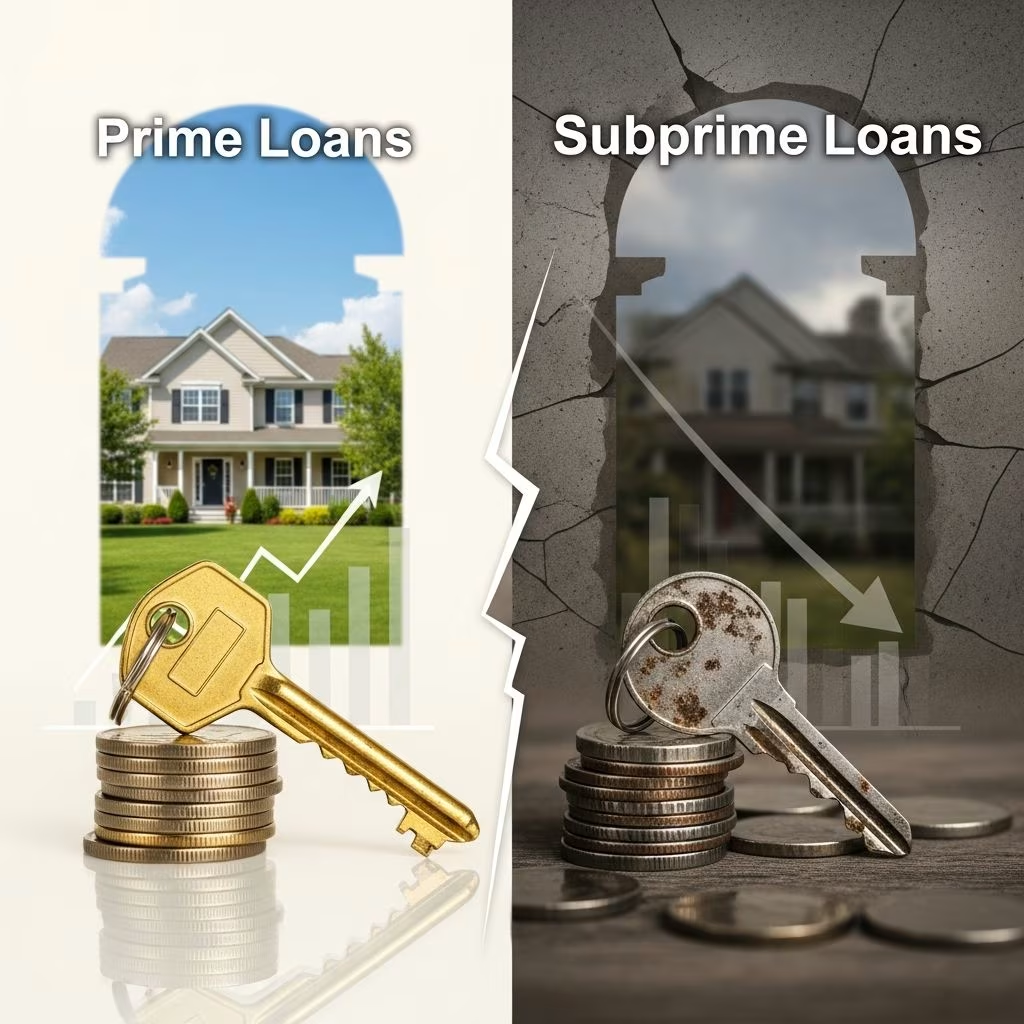
Prime loans provide favorable terms to borrowers with excellent credit profiles, whereas subprime loans accommodate those with weaker credit histories at a higher cost to lenders.
Understanding Borrower Classifications in Lending
Lenders categorize applicants based on creditworthiness to determine loan suitability. Prime borrowers demonstrate low default risk through consistent payment histories and high credit scores, often starting at 670 on the FICO scale. Super-prime individuals, with scores above 740, access the most advantageous conditions.
Subprime borrowers, conversely, face higher risk perceptions due to past delinquencies, limited credit files, or scores below 620. Deep subprime categories, under 580, encounter the steepest challenges. These classifications guide everything from approval odds to pricing structures.
Core Features of Prime Loans
Prime loans align closely with the benchmark prime rate set by central banks, serving as the foundation for optimal borrowing costs. Borrowers enjoy fixed low interest rates, minimal fees, and flexible amounts suited for major purchases like homes or vehicles.
- Low interest rates: Typically fixed, ensuring predictable payments.
- Small down payments: As low as 3% for mortgages.
- Large loan sizes: Higher limits reflect lender confidence.
- Shorter terms available: Options like 36 months for autos reduce total interest.
Qualification demands strong debt-to-income ratios and verified income, but rewards include substantial savings over the loan life.
Characteristics of Subprime Loans
Subprime products target applicants outside prime tiers, compensating for elevated default probabilities with protective measures. They enable access to financing despite credit setbacks, though at greater expense.
- Elevated interest rates: Often adjustable, potentially tripling prime equivalents; auto loans can surpass 29% APR.
- Larger down payments: Up to 25% or more to mitigate lender exposure.
- Restricted amounts: Smaller sums limit potential losses.
- Extended repayment: Longer periods like 60 months increase overall costs despite lower monthly outlays.
- Higher fees: Origination and penalty charges exceed prime counterparts.
These terms reflect lender strategies to balance risk, as outlined in analyses of mortgage and auto markets.
Comparative Analysis: Prime vs. Subprime
The table below summarizes primary distinctions, highlighting how credit tier influences borrowing economics.
| Aspect | Prime Loans | Subprime Loans |
|---|---|---|
| Interest Rates | Low, often fixed (near prime rate) | High, frequently adjustable (> prime + several points) |
| Down Payments | Minimal (e.g., 3-5%) | Substantial (20-25%+) |
| Loan Amounts | Larger, flexible | Smaller, conservative |
| Repayment Terms | Varied, shorter options | Longer durations |
| Fees | Low or none | Elevated origination and penalties |
| Credit Score Range (FICO) | 670+ (740+ super-prime) | Below 620 (580-619 typical) |
Prime options minimize long-term expenses, while subprime structures prioritize lender protection.
Risks and Benefits Across Loan Types
Prime loans benefit borrowers with stability and affordability but require maintaining elite credit status. Missing payments can shift future eligibility downward.
Subprime loans offer entry points for credit rebuilding yet pose dangers: soaring payments from rate adjustments, debt spirals from high costs, and default cycles. Historical data shows subprime mortgages comprised 15% of the market pre-2008, amplifying systemic risks when defaults rose.
Benefits for subprime users include building payment history toward prime status, provided disciplined repayment occurs.
Qualification Pathways for Better Rates
Aspiring prime borrowers should prioritize score improvement: pay debts on time, reduce utilization below 30%, and limit new inquiries. Secured cards or credit-builder loans aid subprime transitions.
Lenders assess beyond scores, factoring income stability and assets. Shopping multiple offers reveals variances, as criteria differ. Government-backed options like FHA loans ease entry for near-prime profiles with lower down payments.
Real-World Impacts on Major Purchases
For autos, a $30,000 prime loan at 4% over 36 months costs about $4,200 in interest; subprime at 18% over 60 months exceeds $16,000. Mortgages amplify this: a subprime 30-year $200,000 loan at 8% versus prime 4% adds over $250,000 in total payments.
These disparities underscore proactive credit management, potentially saving tens of thousands.
Navigating Current Market Dynamics
As of 2026, persistent inflation and rate fluctuations heighten subprime premiums, per recent CFPB trends. Prime access remains tied to FICO tiers, with super-prime shrinking amid economic pressures.
Frequently Asked Questions
What credit score qualifies for a prime loan?
Generally 670+, with 740+ unlocking super-prime perks.
Are subprime loans always more expensive?
Yes, due to risk-adjusted rates and fees, though they provide essential access.
Can subprime borrowers improve to prime status?
Absolutely, through consistent payments and score-building habits.
How do adjustable rates affect subprime loans?
They can raise payments post-initial fixed period, increasing default risk.
What role does down payment play?
Larger amounts in subprime reduce lender risk, improving approval odds.
References
- What Is the Difference Between a Prime and Subprime Loan? — Experian. 2023. https://www.experian.com/blogs/ask-experian/what-is-the-difference-between-a-prime-loan-and-a-subprime-loan/
- Prime vs. Subprime Loan: What’s the Difference? — AceableAgent. 2023. https://www.aceableagent.com/blog/prime-vs-subprime-loan-whats-difference/
- Understanding Prime vs. Subprime Loans — GetMeRenewed. 2024-08-04. https://www.getmerenewed.com/blog/2024/08/04/understanding-prime-vs-subprime-loans/
- Prime vs. Subprime Loans: How Are They Different? — myFICO. 2023. https://www.myfico.com/credit-education/blog/prime-vs-subprime-loans
- Prime Versus Sub-Prime Lenders — ATM. 2023. https://www.at-m.co.uk/research-tools/prime-versus-sub-prime-lenders/
- Comparing the Prime and Subprime Mortgage Markets — Federal Reserve Bank of Chicago. 2007-08. https://www.chicagofed.org/publications/chicago-fed-letter/2007/august-241
- Borrower Risk Profiles — Consumer Financial Protection Bureau. 2023. https://www.consumerfinance.gov/data-research/consumer-credit-trends/student-loans/borrower-risk-profiles/
This article is general information, not personal financial advice. Consider your own situation, or speak with a licensed adviser, before acting on it.


