

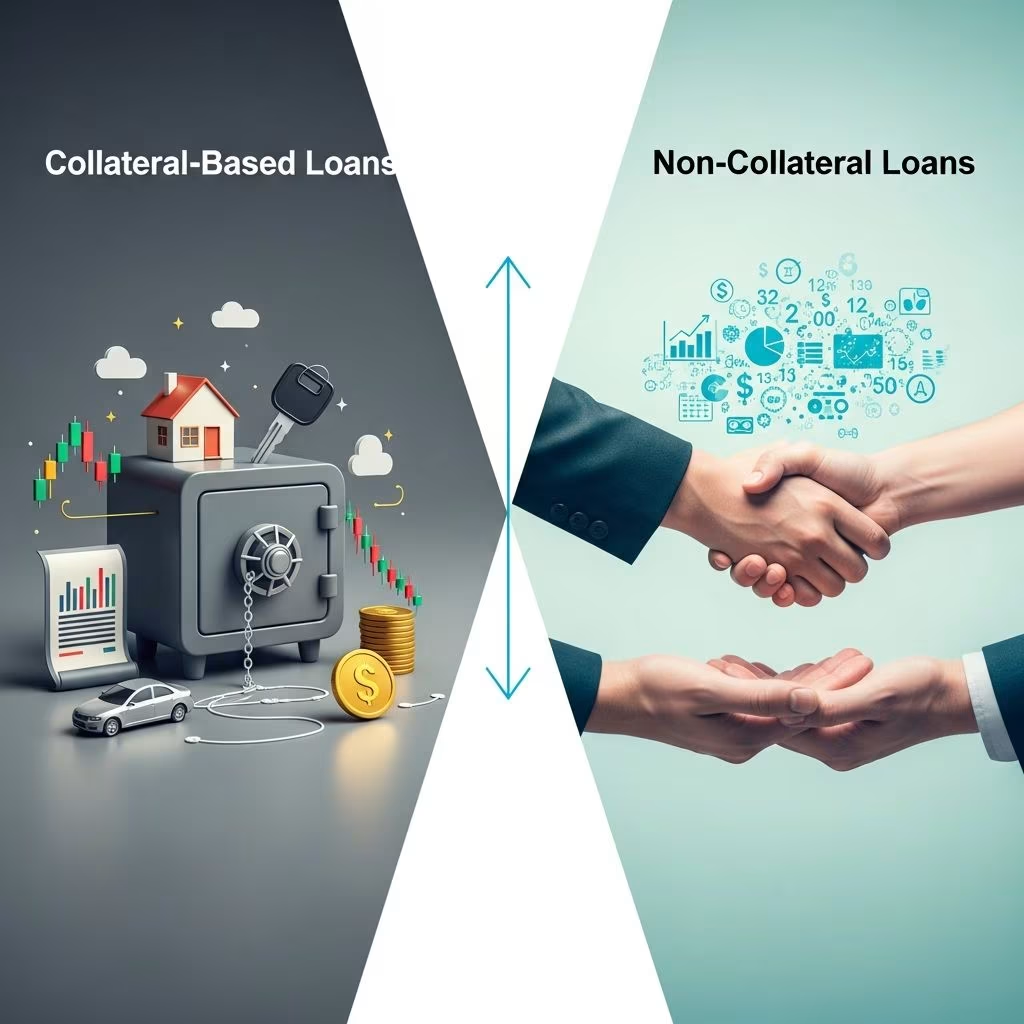
When you need to borrow money, lenders typically offer you two fundamental options that differ based on whether you pledge an asset to back the loan. These distinctions significantly affect your interest rates, approval chances, and the amount you can borrow. Understanding these differences helps you make informed decisions about your borrowing strategy and choose the option that aligns with your financial goals and circumstances.
The Foundation: How Collateral Changes the Lending Equation
The primary distinction between these two loan categories centers on whether you offer something of value to the lender as security. When you provide collateral, you’re essentially telling the lender: “If I cannot repay this loan, you have the right to take this asset to recover your money.” This arrangement fundamentally changes how lenders view risk and, consequently, how they structure your loan terms.
Lenders perceive collateral-backed borrowing as less risky because borrowers have a tangible incentive to repay—the threat of losing a valued possession. This reduced risk allows financial institutions to offer more favorable terms, including lower interest rates and higher borrowing amounts. Conversely, when you borrow without collateral, lenders must rely entirely on your creditworthiness and financial track record to determine whether you’ll repay. This increased uncertainty typically results in stricter approval requirements and higher interest rates.
Collateral-Backed Borrowing: Benefits and Considerations
What Qualifies as Collateral?
Various assets can serve as collateral for loans. Common examples include savings accounts, certificates of deposit (CDs), vehicles, investment portfolios, and real estate. The value of your collateral often determines your borrowing limit—typically, you can borrow up to a certain percentage of the asset’s appraised value.
Key Advantages of Asset-Secured Borrowing
- More Accessible Approval: Since lenders face reduced financial risk, they’re often willing to approve borrowers with lower credit scores or limited credit history. This makes collateral-backed loans particularly valuable for individuals rebuilding their credit or those with minimal borrowing history.
- Significantly Lower Interest Rates: The reduced risk translates to meaningful savings. Research shows that some lenders charge interest rates approximately 20 percent lower on collateral-backed loans compared to unsecured options. Even borrowers with good credit benefit from this rate advantage.
- Access to Larger Loan Amounts: Because lenders can recover their investment through asset seizure if necessary, they’re willing to lend more substantial sums. Your borrowing ceiling is primarily limited by your collateral’s value rather than your income or credit score alone.
- Flexible Fund Usage: Some collateral-backed loans allow you to use borrowed funds for various purposes, though certain lenders may have specific restrictions depending on the collateral type.
Important Drawbacks to Consider
- Asset Seizure Risk: The most significant downside is that failing to make payments could result in losing the asset you pledged. This risk makes collateral-backed borrowing a serious financial commitment.
- Longer Processing Times: Lenders typically require appraisals or asset verification, which can extend approval timelines compared to unsecured options.
- Potential Usage Restrictions: Depending on what serves as collateral, lenders may impose limitations on how you can use the borrowed funds.
Non-Collateral Borrowing: Flexibility Without Asset Risk
How Non-Collateral Loans Work
Unsecured personal loans operate on an entirely different principle. Rather than pledging an asset, you’re essentially asking a lender to trust that you’ll repay based on your financial reputation. Lenders evaluate your credit score, payment history, income level, and debt-to-income ratio to determine whether to approve your application and what interest rate to offer.
Advantages of Unsecured Borrowing
- Your Assets Remain Protected: The most compelling advantage is that no asset is at risk. Your home, car, savings account, or investments remain entirely yours regardless of loan repayment challenges. This protection provides significant psychological and financial security.
- Potentially Faster Approvals: Without the need for asset appraisals or verification processes, lenders can move more quickly through approval. Some applications receive funding within a single business day.
- Broad Availability: Unsecured personal loans are widely available from banks, credit unions, and online lenders, giving you numerous options to compare.
- Minimal Usage Restrictions: Most unsecured lenders allow you to use borrowed funds flexibly for debt consolidation, home improvements, unexpected expenses, or other purposes.
Significant Limitations
- Higher Interest Rates: Without collateral to mitigate risk, lenders compensate by charging higher interest rates. Current average rates on unsecured personal loans exceed 12 percent annually.
- Stricter Qualification Standards: You typically need a minimum credit score of 580 to qualify and 700 to secure favorable rates. Lenders also scrutinize your income and existing debt more carefully.
- Lower Borrowing Limits: Unsecured loans typically cap out around $100,000, whereas collateral-backed options may allow substantially larger amounts depending on your asset values.
- Potential Additional Fees: Beyond higher interest rates, unsecured loans sometimes carry additional fees that increase the overall borrowing cost.
Comparative Analysis: Side-by-Side Evaluation
| Characteristic | Collateral-Backed Loans | Unsecured Loans |
|---|---|---|
| Collateral Requirement | Yes—an asset of value must be pledged | No—based on creditworthiness alone |
| Interest Rates | Typically lower; varies but often substantially below unsecured rates | Higher; currently averaging above 12% annually |
| Loan Amounts Available | Determined by collateral value; potentially very large | Generally capped around $100,000; based on income and credit |
| Credit Score Requirements | May have minimal requirements; some have no minimum score | Minimum 580 to qualify; 700+ for competitive rates |
| Approval Speed | Slower; requires asset appraisal and verification | Faster; minimal documentation needed |
| Primary Risk to Borrower | Loss of pledged asset upon default | Credit damage, collection actions, and fees |
| Fund Usage Restrictions | May have specific limitations depending on loan type | Generally flexible; few restrictions |
| Lender Risk Profile | Lower risk due to collateral protection | Higher risk; relies on borrower reputation |
Evaluating Your Creditworthiness Impact
Your credit history and current score play different roles depending on which loan type you pursue. For collateral-backed borrowing, your credit score matters less significantly because the asset itself protects the lender’s investment. However, a very poor credit history might still result in higher interest rates even with collateral.
For unsecured borrowing, your credit score becomes the central factor in both approval decisions and rate determination. Scores below 580 typically result in rejection or extremely unfavorable terms. Even moderate credit scores of 600-669 may qualify you for unsecured loans, but at considerably higher rates than borrowers with scores of 700 or above.
Determining Your Optimal Borrowing Strategy
Consider Collateral-Backed Borrowing When:
- You have valuable assets you’re comfortable pledging and confident you can repay the loan
- You have limited credit history or are rebuilding credit after past difficulties
- You need to borrow a substantial amount beyond typical unsecured limits
- You want to minimize your interest rate and overall borrowing costs
- Your credit score is below 670, making unsecured approval difficult or expensive
Consider Unsecured Borrowing When:
- You want to protect your valuable assets from potential seizure
- You have good to excellent credit and qualify for competitive rates
- You need fast funding and cannot accommodate longer approval timelines
- The loan amount falls within typical limits (under $100,000)
- You prefer the psychological security of knowing your possessions aren’t at risk
Frequently Asked Questions
Can I get approved for a collateral-backed loan with bad credit?
Yes, in many cases. Collateral significantly reduces lender risk, so some financial institutions will approve borrowers with poor credit scores. However, you may still face higher interest rates than borrowers with better credit, and the collateral must have sufficient value.
What happens if I default on a collateral-backed loan?
If you fail to make payments, the lender can legally seize and sell your pledged asset to recover the loan balance. Beyond losing the asset, you’ll also face credit damage, potential collection actions, and additional fees, similar to unsecured loan defaults.
Are unsecured loans always more expensive?
Not necessarily for every borrower. Someone with excellent credit and a strong income might qualify for unsecured rates that are competitive with collateral-backed options. However, on average, unsecured rates do exceed secured rates.
How long does it take to get approved for each type?
Unsecured loans typically process faster, sometimes within one business day. Collateral-backed loans require asset verification or appraisal, potentially adding several days to the timeline.
Can I use a credit card as collateral for a secured loan?
No. Traditional collateral includes tangible or liquid assets like vehicles, savings accounts, CDs, stock portfolios, or real estate. Credit cards represent borrowing capacity rather than owned assets.
Making Your Decision: Key Takeaways
The choice between collateral-backed and unsecured borrowing fundamentally depends on your specific circumstances. If you have valuable assets you can safely pledge, strong repayment confidence, and a desire to minimize interest costs, a collateral-backed loan offers substantial advantages. Conversely, if protecting your assets matters most, you have good credit, and you need quick funding, an unsecured loan provides the flexibility and security you’re seeking.
Regardless of which path you choose, compare offers from multiple lenders—banks, credit unions, and online platforms all provide both loan types. Evaluate not just interest rates but also fees, repayment terms, and customer service quality. Your borrowing decision today establishes patterns that will affect your financial health for years to come.
References
- Secured vs. Unsecured Personal Loans: Key Differences — Bankrate. 2024. https://www.bankrate.com/loans/personal-loans/secured-vs-unsecured-personal-loans/
- Secured vs. Unsecured Personal Loans: What’s the Difference? — Experian. 2024. https://www.experian.com/blogs/ask-experian/secured-vs-unsecured-loans-what-you-should-know/
- Secured vs. Unsecured Lending — Nebraska Bank. 2024. https://www.ne.bank/secured-vs-unsecured-lending
- Secured vs. Unsecured Loans: It’s All About Collateral — Truist. 2024. https://www.truist.com/money-mindset/principles/outsmarting-debt/secured-vs-unsecured-loans
- Differentiating between Secured and Unsecured Loans — Consumer Financial Protection Bureau. 2024. https://files.consumerfinance.gov/f/documents/cfpb_building_block_activities_differentiating-secured-unsecured-loans_guide.pdf
- Unsecured vs Secured Loans: What’s the Difference? — TD Bank. 2024. https://www.td.com/us/en/personal-banking/learning/unsecured-vs-secured-loan
- Secured vs Unsecured Debt — U.S. Bank. 2024. https://www.usbank.com/financialiq/manage-your-household/manage-debt/secured-vs-unsecured-debt.html
This article is general information, not personal financial advice. Consider your own situation, or speak with a licensed adviser, before acting on it.


