

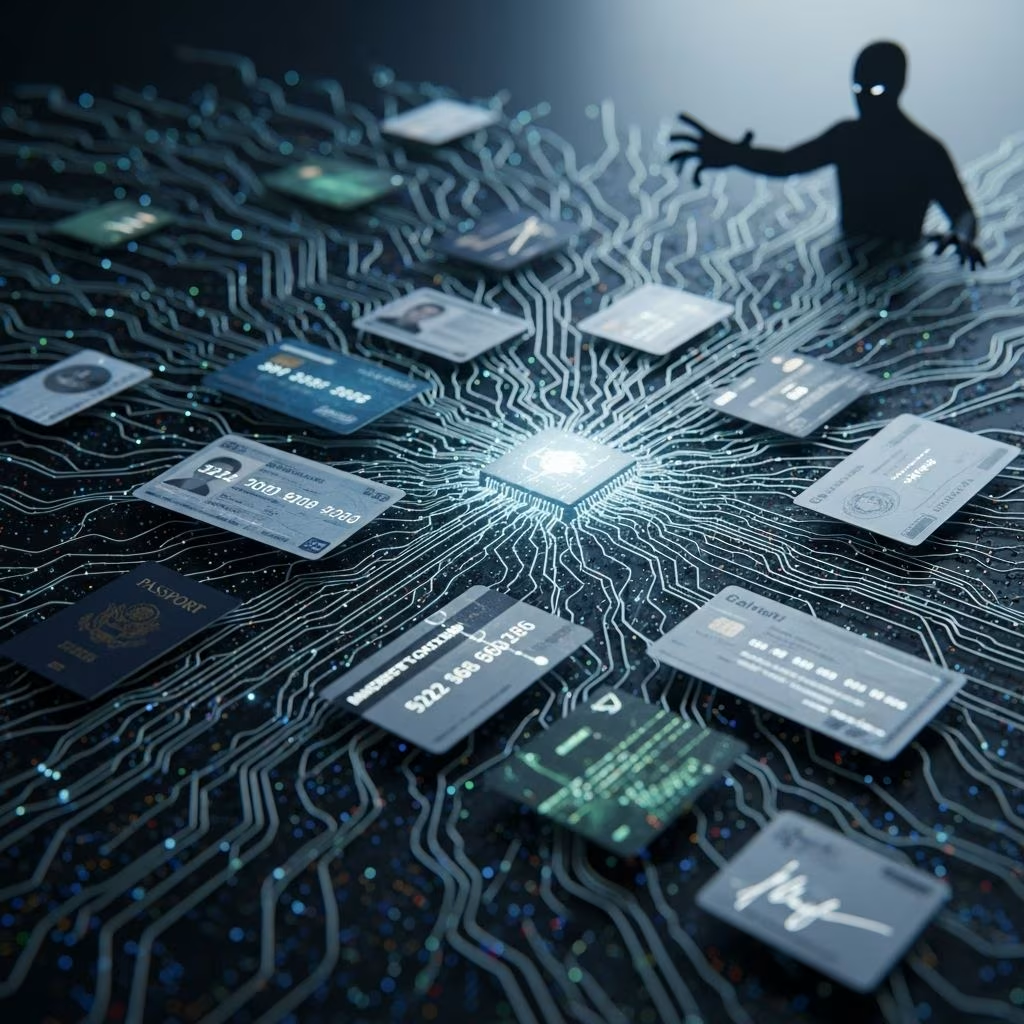
The creation of entirely fictional personas using combinations of real and fabricated personal information represents one of the fastest-growing financial crimes globally. Unlike traditional identity theft where criminals exploit an existing person’s credentials, this sophisticated fraud method assembles new identities from disparate data sources. Losses from this crime category are projected to reach $23 billion by 2030, with over 80% of all new account fraud attributed to these schemes.
Distinguishing Synthetic Identity Fraud from Traditional Identity Theft
While both crimes involve misuse of personal information, synthetic identity fraud operates through fundamentally different mechanics. Traditional identity theft targets a specific individual whose credentials are stolen and used without authorization. The victim typically discovers the fraud when reviewing their credit report or receiving bills for accounts they did not open.
Synthetic identity fraud, conversely, creates a phantom person who has no actual existence. This fabricated entity comprises fragments assembled from multiple sources—some real, some entirely invented. The resulting identity exists only within financial systems and databases, making detection considerably more challenging. Because no real victim exists to report unauthorized account activity, institutions absorb losses across dispersed transactions rather than through a single compromised account.
The Assembly Process: How Fraudsters Build Fictitious Identities
Creating a synthetic identity requires several sequential phases, each building upon the previous step to establish credibility within financial ecosystems.
Data Collection and Information Sourcing
The initial phase involves gathering legitimate and publicly available information. Fraudsters acquire real personal identifiers through multiple channels:
- Public data breaches exposing social security numbers, email addresses, and date of birth information
- Dark web marketplaces where stolen credentials are bought and sold
- Web scraping of social media profiles, professional networking sites, and public records
- Marketing databases and consumer information brokers who sell demographic data
- Identity information from vulnerable populations including children, elderly individuals, and homeless persons
These data sources provide the foundation upon which fraudsters construct plausible identities. The selection of target information is often deliberate—criminals frequently target children or deceased individuals whose SSNs are less likely to generate immediate alerts.
Credential Fusion and Identity Compilation
Once fraudsters obtain legitimate identifiers, they combine them with invented details through a process called identity compilation. A typical synthetic identity might consist of:
- A real social security number paired with a fabricated name and birth date
- Invented address and phone number under the fraudster’s control
- Email account created specifically to manage the synthetic identity
- Fictional employment history with fake employers and job titles
This fusion process requires careful attention to plausibility. Fraudsters use demographic databases to ensure that invented details align with geographical and statistical patterns. A fabricated name must be reasonably common in the region associated with the address; employment history must reflect realistic job progressions; and all interconnected details must form a coherent narrative.
Establishing False Credentials and Reputation Building
After assembling basic identity components, fraudsters establish digital footprints that create the appearance of a real person. This credibility-building phase includes:
- Creating social media profiles with consistent activity patterns and historical posts
- Establishing email accounts with documented communication history
- Registering utility accounts and phone service under the synthetic identity
- Setting up professional profiles on employment sites
- Obtaining credit reports showing established credit history
These artifacts serve a critical function: they seed the synthetic identity throughout multiple databases and commercial ecosystems. When financial institutions conduct background verification, they encounter digital evidence of a established person with apparent history and legitimacy.
Two Primary Categories of Synthetic Identity Schemes
Fraudsters employ two distinct methodologies when creating synthetic identities, each with different detection characteristics.
Manipulated Identity Schemes
This approach involves modifying legitimate information from a real person. A fraudster might alter one or more details from an actual individual’s identity—changing an address, adding a middle initial, or slightly modifying a name. While technically simpler to execute, this method is also more easily identified during verification processes because the altered information can be detected through cross-reference checks.
Manufactured Identity Schemes
The more sophisticated approach combines entirely genuine data components with fabricated elements to create a wholly new person. Sometimes called “Frankenstein Fraud,” this methodology represents the fastest-growing variant globally. Manufactured identities are substantially more difficult to detect because they involve legitimate information that cannot be flagged as incorrect—it simply belongs to different actual people or incomplete data sets.
The Fraud Execution Lifecycle: From Application to Cash-Out
Successful synthetic identity fraud operates through an extended timeline, often spanning months or years as fraudsters patiently establish credibility before executing their primary schemes.
Initial Account Applications and Credit Building
Fraudsters begin by applying for credit using their fabricated identities. Initial applications frequently receive denials due to insufficient credit history. However, these denied applications paradoxically benefit the fraudster by establishing a credit file for the synthetic identity. Each application generates a thin credit file, and credit bureaus begin tracking the synthetic person.
Over time, fraudsters apply for small-limit credit products—secured credit cards, retail store cards, or small personal loans. As these accounts are opened and payments made (often using stolen funds or manipulated transactions), the synthetic identity’s credit profile strengthens. The credit score improves, opening access to larger credit lines and more attractive financial products.
Credential Piggybacking and Layering
Fraudsters employ sophisticated techniques to accelerate credibility building. One method involves adding the synthetic identity as an authorized user to legitimate accounts in good standing. This “piggybacking” transfers the positive payment history to the synthetic identity, dramatically improving credit scores without actual credit activity.
Additionally, fraudsters create interconnected networks of synthetic identities that cross-endorse each other. Multiple fake personas might appear as references on employment applications, family members in household credit applications, or business partners in commercial accounts. These layered relationships create complex webs of fabricated validation.
The Monetization Phase and Account Takeover
Once the synthetic identity has accumulated sufficient credit availability, fraudsters execute their primary scheme. They simultaneously maximize all available credit lines, applying for additional accounts and withdrawing available funds. This coordinated “bust-out” or “blow-up” phase extracts maximum value before disappearing entirely.
The monetization extends beyond traditional credit cards. Fraudsters exploit:
- Credit card cash advances and balance transfers
- Personal loans and home equity lines of credit
- Buy-now-pay-later services with established credibility
- Refund fraud through staged returns on legitimate platforms
- Mule orchestration networks that move funds across jurisdictions
Cross-Border Value Extraction
To prevent fund recovery, fraudsters employ international movement strategies. Extracted funds are converted into cryptocurrency, loaded onto prepaid cards, or transferred to accounts in foreign jurisdictions. These cross-border cash-outs effectively launder proceeds while placing them beyond recovery jurisdiction.
Detection Challenges and System Vulnerabilities
Synthetic identity fraud presents detection difficulties that traditional fraud monitoring systems struggle to address. The absence of a complaining victim eliminates the primary alert mechanism for account fraud—the rightful account holder reporting unauthorized activity. Losses distribute across multiple financial institutions rather than concentrating on a single account, making pattern recognition difficult.
Probabilistic risk models designed to identify anomalies in spending patterns may not trigger alerts because synthetic identities often demonstrate consistent, controlled activity. Credit utilization remains within normal parameters, payment histories appear clean, and transaction patterns seem reasonable until the monetization phase.
Vulnerable Populations and Targeting Patterns
Certain demographic groups face heightened risk from synthetic identity fraudsters. Children represent particularly attractive targets because their SSNs are unlikely to be actively monitored by credit bureaus. The fraud may persist for years before discovery when the victim applies for credit as an adult.
Elderly individuals and homeless populations similarly face elevated risk. These groups may have limited credit activity monitoring, less frequent credit report reviews, and reduced likelihood of immediately noticing fraudulent accounts opened in their name.
Advanced Techniques and Technological Escalation
Fraudsters increasingly leverage artificial intelligence and automation to scale synthetic identity operations. Sophisticated actors employ:
- Automated systems that generate thousands of candidate identities and test them against institutional validation systems
- AI-powered document generation creating high-fidelity forgeries of identification documents
- Deepfake technology producing synthetic images and video used to defeat facial recognition and liveness verification
- Machine learning algorithms optimizing monetization decisions based on institutional risk tolerance signals
These technological capabilities enable criminals to operate at industrial scale, creating and managing hundreds or thousands of synthetic identities simultaneously.
Multi-Purpose Exploitation Beyond Financial Crime
While financial fraud represents the primary application, synthetic identities enable various secondary frauds:
- Regulatory Evasion: Criminals use synthetic identities to obscure beneficial ownership and evade sanctions screening
- Healthcare Fraud: False qualifications and medical records enable fraudulent disability claims and insurance exploitation
- Influence Operations: Synthetic personas coordinate inauthentic engagement in social media platforms to manipulate public opinion
- Employment Fraud: Fabricated credentials and employment histories enable unauthorized hiring or contractor engagement
These applications demonstrate that synthetic identity fraud extends far beyond traditional credit card schemes into systemic institutional and regulatory risks.
Institutional Response Strategies and Prevention Measures
Financial institutions implement multi-layered approaches to combat synthetic identity fraud. Effective strategies include:
- Enhanced identity verification protocols requiring documentation cross-verification with government databases
- Behavioral analysis monitoring account activity for inconsistencies with established patterns
- Social network analysis detecting interconnected synthetic identities and suspicious relationship patterns
- Velocity checks identifying abnormal application rates and credit inquiries from single sources
- Third-party data validation confirming identity details against authoritative sources
Regulatory coordination between financial institutions and law enforcement agencies increasingly focuses on shared intelligence about synthetic identity networks and fraud-as-a-service operations.
Frequently Asked Questions
What makes synthetic identity fraud different from credit card fraud?
Synthetic identity fraud creates entirely new identities rather than compromising existing accounts. This fundamental difference means no real victim exists to report the fraud, losses disperse across institutions, and detection requires different analytical approaches than traditional account monitoring.
How long does it typically take to fully develop a synthetic identity?
Development timelines vary widely but commonly span months to years. Fraudsters patiently build credibility, gradually increasing credit limits and accessing better products. The extended timeline reduces detection risk by avoiding sudden activity changes that might trigger fraud alerts.
Why are children particularly vulnerable to synthetic identity fraud?
Children possess unused social security numbers that are less likely to appear in active credit monitoring systems. Fraudsters can exploit these numbers for years without detection, as children rarely monitor credit or actively use financial services.
Can synthetic identities be completely prevented?
Complete prevention is unlikely given the sophistication of modern fraud techniques and the availability of personal information. However, multi-layered detection systems combining identity verification, behavioral analysis, and institutional cooperation can significantly reduce successful fraud attempts.
References
- Synthetic Identity Fraud (SIF): Hybrid and Cyber Risks — Synthetic Identity Fraud Database. https://www.synthetic-identity-fraud.com
- What Is Synthetic Identity Fraud: How to Detect & Prevent Against It? — Feedzai. https://www.feedzai.com/blog/synthetic-id-fraud/
- Synthetic Identity Fraud: What Is It and How to Avoid It? — Regula Forensics. https://regulaforensics.com/blog/synthetic-identity-fraud/
- Synthetic Identity Theft: What Is It? — Equifax. https://www.equifax.com/personal/education/identity-theft/articles/-/learn/synthetic-identity-theft/
- Understanding Synthetic Identity Theft and Fraud Risks — Mastercard. https://www.mastercard.com/us/en/news-and-trends/Insights/2024/what-is-synthetic-identity-fraud-and-how-does-synthetic-identity-theft-work.html
- Synthetic Identity Fraud & Its Importance in Today’s Digital Landscape — Moody’s Analytics. https://www.moodys.com/web/en/us/kyc/resources/insights/synthetic-identities-and-why-they-are-important-in-todays-digital-landscape.html
- Synthetic Identity Fraud: What is it and How to Combat it — Thomson Reuters Legal. https://legal.thomsonreuters.com/blog/synthetic-identity-fraud-what-is-it-and-how-to-combat-it/
This article is general information, not personal financial advice. Consider your own situation, or speak with a licensed adviser, before acting on it.


