

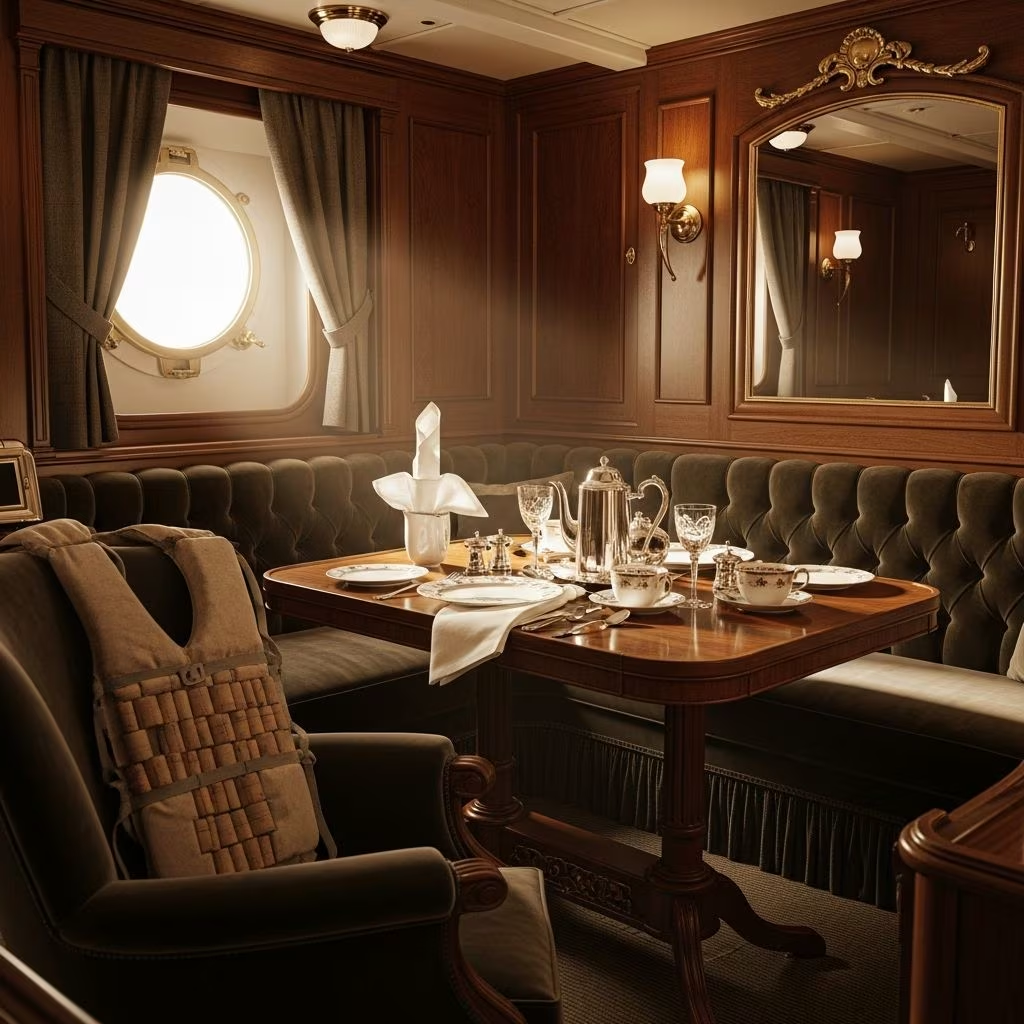
The Titanic’s Most Expensive Ticket: A Window into Unmatched Maritime Luxury
More than a century after the RMS Titanic sank into the Atlantic Ocean, the ship remains synonymous with both opulence and tragedy. Built in 1912 at a cost of $7.5 million—equivalent to approximately $180 million in today’s currency—the Titanic was engineered to be the epitome of luxury travel. However, the most fascinating aspect of this legendary vessel lies not merely in its construction, but in the stark contrasts it embodied: between wealth and poverty, comfort and desperation, and ultimately, survival and loss. Understanding what the Titanic’s most expensive ticket actually purchased provides crucial insight into the class divisions that defined both the ship and the era.
Charlotte Drake Cardeza: The Woman Who Purchased Luxury
Charlotte Drake Cardeza, a 58-year-old Philadelphia resident, holds the distinction of purchasing what historians believe to be the most expensive ticket aboard the Titanic. Priced at $2,560 in 1912 dollars—equivalent to more than $61,000 in contemporary currency—this ticket represented far more than mere passage across the Atlantic. Cardeza came from substantial means; her family fortune originated from her father’s ownership of a wealthy textile mill, positioning her comfortably within the upper echelons of American society.
Though not quite at the social level of other Titanic millionaires such as John Jacob Astor IV or Benjamin Guggenheim, Cardeza was nonetheless a woman of considerable accomplishment and refinement. She was an accomplished yachtswoman, a big-game hunter of notable reputation, and an active patron of the arts. When she boarded the Titanic in Cherbourg, France, she traveled with her 36-year-old son Thomas, her personal maid, his valet, fourteen trunks, four suitcases, and three additional crates of belongings—a testament to both the scale of her travel and her expectations regarding accommodations.
The Millionaire’s Suite: A Floating Ranch House
The Cardezas’ accommodations aboard the Titanic were nothing short of extraordinary. They occupied one of the ship’s two most luxurious spaces: a three-room suite featuring two bedrooms, a sitting room, two wardrobe rooms, and a private bathroom. When combined, these spaces occupied approximately the same square footage as a small ranch house—an impressive feat on a ship, regardless of the Titanic’s massive dimensions.
What truly set this suite apart, however, was its most distinctive amenity: a private, 50-foot-long promenade deck. This exclusive outdoor space meant that the Cardezas could take their leisure without encountering passengers from lower classes, or even other first-class passengers with whom they might not wish to associate. The suite’s isolation represented the ultimate expression of wealth-based privacy on the vessel—a floating sanctuary designed to insulate the ultra-wealthy from the broader passenger experience.
The Cardezas’ suite was one of two identical parlor suites, often referred to as “The Millionaire’s Suites,” each costing approximately $4,350 in 1912 currency (over $140,000 today). The second suite, which served as the mirror-image counterpart to the Cardezas’ accommodations, was intended for J.P. Morgan, the powerful financier who controlled the company owning the Titanic. Morgan’s absence from the voyage—he cancelled his passage before departure—meant this second suite was occupied by J. Bruce Ismay, the White Star Line’s managing director, though historical records suggest this arrangement may have varied.
The Dining Experience: A Gastronomic Display of Wealth
For passengers of the Cardezas’ status, mealtimes presented multiple options that starkly illustrated their elevated position. First-class diners could choose between two venues: the main first-class dining room or the à la carte restaurant, which charged additional fees for dining privileges. Few menus from the Titanic survive, but historical records of the final dinner service reveal the extraordinary nature of first-class dining.
That final meal on April 14, 1912, consisted of an astonishing ten courses. The progression began with oysters and proceeded through salmon, chicken, lamb, duckling, and squab. Perhaps most tellingly, the menu featured multiple beef preparations: filet mignon Lili graced the fourth course, while sirloin of beef appeared in the fifth course. Such abundance and variety would have been virtually unimaginable to the vast majority of the global population in 1912, yet it was standard fare for Titanic’s first-class passengers. The menu itself served as a declaration of status—a visible reminder of where diners ranked within the strict hierarchy that governed life aboard the ship.
Amenities and Exclusive Access
Beyond dining, first-class passengers enjoyed amenities that were revolutionary for the era. The Titanic featured a heated swimming pool—a remarkable luxury for 1912. First-class passengers could purchase tickets to use this facility for just 25 cents, while access to the squash court and services of a professional player cost an additional 50 cents. A fully equipped gymnasium, Turkish bath, and various other recreational facilities rounded out the first-class experience.
However, access to these amenities was carefully controlled. Men, women, and children had designated times to use certain facilities, maintaining the Victorian sensibilities regarding gender separation even within recreational spaces. The psychological effect of these restrictions was significant: they reinforced the social hierarchy while creating an illusion of abundant luxury through carefully scheduled exclusivity.
Contrast and Inequality: First Class Versus Other Accommodations
To fully appreciate what the Cardezas’ $2,560 ticket purchased, one must understand the stark contrast it represented compared to other passenger classes. A third-class ticket aboard the Titanic cost just $40 in 1912 dollars, approximately $1,200 in contemporary currency. Third-class passengers were housed in cramped quarters where up to ten people might share a single room. These accommodations were divided by gender, frequently separating family members during their passage.
Even second-class accommodations, while described as superior to comparable spaces on other ships of the era, paled in comparison to first-class luxury. This disparity extended beyond mere physical space to encompass every aspect of the voyage experience—dining quality, amenity access, crew attention, and ultimately, as the tragedy would reveal, proximity to lifeboats and thus to survival itself.
The Night of the Disaster: Survival and Loss
On the evening of April 14-15, 1912, the Titanic struck an iceberg in the North Atlantic, beginning its descent into history as one of humanity’s greatest maritime disasters. In the chaos that followed, approximately 1,500 people perished, either trapped within the sinking vessel or succumbing to hypothermia in waters measuring 28 degrees Fahrenheit.
The Cardezas, however, were among the fortunate survivors. Charlotte, Thomas, and their servants all secured places in lifeboats during the ship’s final hours. Whether their wealth directly facilitated their rescue or whether they simply possessed the fortune of proximity to lifeboat stations remains historically ambiguous. Nonetheless, they escaped a fate that claimed 1,123 first-class passengers who perished, 528 third-class passengers, and 679 crew members. First-class passengers had a 62% survival rate, dramatically higher than the 42% survival rate for second-class passengers and the mere 26% survival rate for third-class passengers.
The Cost of Luxury: Charlotte’s Claim Against the Titanic’s Owners
Though the Cardezas survived the disaster, they were forced to leave behind the extensive luggage that had accompanied them: 14 trunks, four suitcases, and three crates. These belongings contained far more than mere clothing. Months after the disaster, when Charlotte Cardeza filed a claim against the Titanic’s owners for compensation of lost possessions, her itemized list ran to sixteen single-spaced typed pages—a testament to both her extraordinary shopping habits and the remarkable quality of her memory under duress.
The list included $5,500 in 1912 currency (equivalent to $132,000 today) in cash, jewelry, furs, and numerous dresses of the finest materials and craftsmanship. However, these items represented mere fractions of her total claim. Cardeza valued her lost possessions at more than $177,000 in 1912 dollars—approximately $4.2 million when adjusted to 2016 currency values. For context, this amount exceeded the entire annual income of the vast majority of American households during that era.
Life After the Titanic: Continuing Prosperity
Unlike many less affluent passengers and crew members who struggled with the financial and psychological aftermath of the disaster, the Cardezas recovered with remarkable ease. Both Charlotte and Thomas continued to live in the style to which they had become accustomed. Charlotte maintained her position in Philadelphia society until her death in 1939, while Thomas lived until 1952. The disaster, catastrophic as it was for so many, represented merely a temporary inconvenience for the wealthy—a powerful and sobering commentary on the relationship between class and consequence in early twentieth-century society.
Frequently Asked Questions About Titanic’s Most Expensive Ticket
Q: What was the total cost of building and furnishing the Titanic?
A: The Titanic cost $7.5 million in 1912 dollars to build and furnish, equivalent to approximately $180 million in today’s currency, making it one of the most expensive ships ever constructed at that time.
Q: How many rooms did the Cardezas’ suite contain?
A: The Cardezas occupied a three-room suite consisting of two bedrooms, a sitting room, two wardrobe rooms, and a private bathroom, plus exclusive access to a private 50-foot promenade deck.
Q: How many courses were served in the Titanic’s final first-class dinner?
A: The final first-class dinner consisted of ten courses, featuring oysters, salmon, chicken, lamb, duckling, squab, and multiple beef preparations including filet mignon and sirloin.
Q: What percentage of first-class passengers survived the Titanic disaster?
A: Approximately 62% of first-class passengers survived the Titanic disaster, significantly higher than the survival rates for second-class (42%) and third-class passengers (26%).
Q: How much did Charlotte Cardeza claim in lost possessions after the disaster?
A: Charlotte Cardeza filed a claim valued at more than $177,000 in 1912 dollars (approximately $4.2 million in 2016 values) for lost dresses, furs, jewelry, and other possessions, itemized across sixteen single-spaced pages.
References
- What the Most Expensive Ticket on the Titanic Bought You — Money Magazine. Accessed November 2025. https://money.com/titanic-most-expensive-ticket/
- Titanic Facts: Surprising and Essential Info — RMS Titanic Inc. Accessed November 2025. https://rmstitanicinc.com/titanic-facts/
- The Official Titanic Inquiry Report — United States Senate Committee on Commerce. 1912. Available through the National Archives digital collections documenting historical maritime records and passenger claims.
This article is general information, not personal financial advice. Consider your own situation, or speak with a licensed adviser, before acting on it.


