

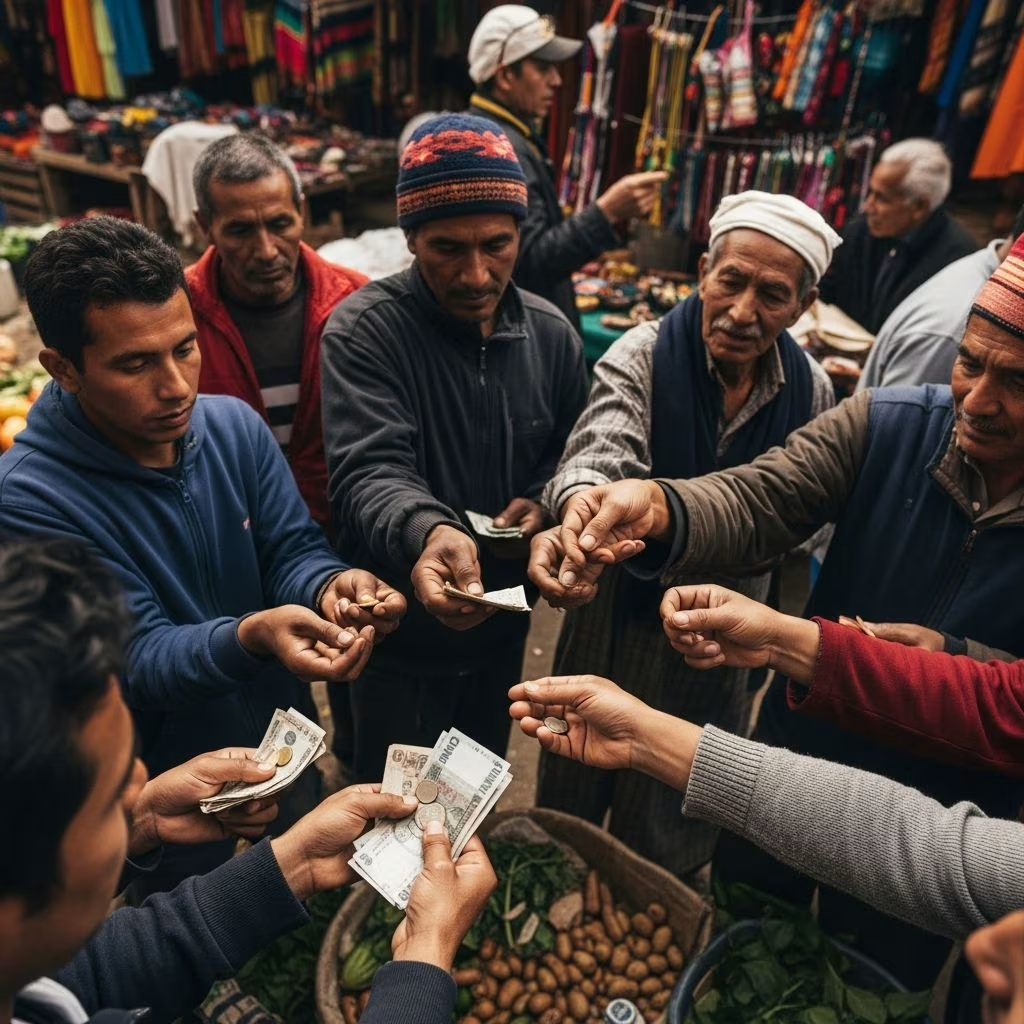
The term “unbanked” describes individuals or households without access to traditional banking services like checking or savings accounts at banks or credit unions. This situation affects millions in the United States, limiting their ability to safely store money, make payments, or build credit. Recent data from official sources reveals a nuanced picture, distinguishing between those who want accounts but cannot obtain them and those uninterested in banking altogether.
Defining Key Terms in Financial Access
To grasp the unbanked phenomenon, it’s essential to differentiate related concepts. The **unbanked** are households where no one has a bank or credit union account. In contrast, the **underbanked** have accounts but rely heavily on alternative financial services (AFS) such as payday loans, check-cashing outlets, or prepaid cards for daily needs.
A refined Federal Reserve definition further splits the unbanked into two groups: the “true unbanked”—those interested in accounts but unable to get one—and the “out of banking population,” who have no desire for traditional accounts. This distinction is policy-critical, as the former faces barriers like credit issues, while the latter often distrust banks.
- Banking Population: Households with accounts or interest in having one (96.8% in 2021).
- Out of Banking: No account and no interest (3.2% of banking-age population in 2021).
- Underbanked: Account holders using AFS (14.2% of U.S. households in 2023).
Current Statistics on Unbanked Households
According to the 2023 FDIC National Survey of Unbanked and Underbanked Households, 4.2% of U.S. households—about 5.6 million—were unbanked, the lowest rate since tracking began in 2009. This marks progress, with the fully banked rate reaching 96%.
Earlier FDIC data from 2021 pegged the unbanked rate at 4.5%, while the Federal Reserve’s refined measure lowered it to 1.3% within the banking population by excluding the uninterested group. The banking participation rate has climbed steadily from 94.6% in 2009 to 96.8% in 2021.
| Year | FDIC Unbanked Rate | Fed Refined Unbanked Rate | Fully Banked Rate |
|---|---|---|---|
| 2009 | ~7% | N/A | 94.6% |
| 2021 | 4.5% | 1.3% | 96.8% |
| 2023 | 4.2% | N/A | 96% |
Globally, the World Bank notes 2.5 billion people remain unbanked, relying on risky cash-based systems, though U.S. rates are far lower.
Demographic Breakdown: Who Lacks Bank Accounts?
Unbanked rates vary sharply by demographics. Lower-income groups face the highest hurdles: 23% of adults earning under $25,000 are unbanked, dropping to 1% for those over $100,000.
Racial and ethnic disparities persist. In 2024 FDIC data, 10.6% of Black households and 9.5% of Hispanic households were unbanked, compared to lower rates among white households. Younger adults (18-29) show 11% unbanked rates, versus 2% for those 60+.
- Income < $25K: 23% unbanked
- Black households: 10.6% unbanked
- Hispanic households: 9.5% unbanked
- Ages 18-29: 11% unbanked
Urban areas like Cleveland (45.9% Black population) and Houston (44.2% Hispanic) highlight localized challenges.
Primary Barriers Preventing Account Ownership
Reasons for remaining unbanked differ by subgroup. Among the “true unbanked,” common barriers include past banking or credit problems (cited by nearly 20%), lack of trust, and inability to meet minimum balance requirements.
The out-of-banking group increasingly reports distrust in banks as the main reason, a trend rising over time. About 20% of unbanked had accounts recently, but many closed them due to fees or overdrafts; the majority of out-of-bankers have never banked.
Other factors: high fees, privacy concerns, and preference for cash. Prepaid cards serve 1.8% of unbanked households as a bridge.
Alternatives Used by the Unbanked and Underbanked
Without traditional accounts, many turn to AFS:
- Check-cashing services: High fees for basic transactions.
- Payday loans: Short-term, high-interest debt cycles.
- Prepaid debit cards: Used by 2.4 million unbanked households in 2021.
- Money orders and cash: Risky for storage and transfers.
Underbanked households (19 million in 2023) blend bank accounts with AFS, with 48.3% using mobile banking primarily. Fintech innovations like digital wallets are gaining traction but don’t fully replace accounts.
Benefits of Joining the Traditional Banking System
Maintaining a bank account unlocks key advantages:
- Safety: FDIC-insured deposits up to $250,000 protect against loss.
- Convenience: Direct deposit, online bill pay, and ATM access.
- Credit building: Accounts feed positive history to credit bureaus.
- Lower costs: Avoid AFS fees averaging 2-5% per check cashed.
- Financial tools: Savings accounts, loans, and investment options.
Banked households report higher financial stability and participation in the economy.
Practical Steps to Become Banked
Overcoming barriers is achievable:
| Barrier | Solution |
|---|---|
| Poor credit history | Seek second-chance checking accounts or credit unions. |
| No ID or address | Use ITIN, obtain state ID, or choose online-only banks. |
| Minimum balance fees | Opt for free checking with direct deposit. |
| Distrust | Start with low-risk neobanks or community banks. |
Programs like Bank On offer certified accounts with predictable fees. Government benefits via Direct Express cards can transition users.
Role of Technology and Policy in Inclusion
Mobile banking adoption (48.3% primary method) aids access, especially post-pandemic. Policymakers advocate refined unbanked definitions to target aid effectively—focusing on the 1.3% interested but excluded.
Initiatives include fee caps on AFS and expanded ID options. The rise from 94.6% to 96.8% banking participation shows policy impact.
Frequently Asked Questions (FAQs)
What percentage of Americans are unbanked?
About 4.2% of households in 2023, or 5.6 million, per FDIC data.
Who is most likely to be unbanked?
Low-income earners under $25K (23%), Black (10.6%) and Hispanic (9.5%) households, and young adults (11%).
What’s the difference between unbanked and underbanked?
Unbanked have no account; underbanked have accounts but use AFS (14.2% of households).
Can unbanked people build credit?
Yes, via secured cards or becoming banked to report positive activity.
Are there free bank accounts for unbanked?
Yes, many offer no-fee options with direct deposit; check Bank On standards.
References
- Refining the Definition of the Unbanked — Federal Reserve. 2025-03-03. https://www.federalreserve.gov/econres/feds/files/2025033pap.pdf
- Refining the Definition of the Unbanked (Federal Reserve Paper) — Direct Express Info. 2025-12-12. https://directexpress.info/2025/12/12/refining-the-definition-of-the-unbanked-federal-reserve-paper/
- Who is unbanked in the US? — USAFacts. N/A. https://usafacts.org/articles/who-is-unbanked-in-the-us/
- Unbanked & Underbanked – Fintech: Financial Technology — Library of Congress. N/A. https://guides.loc.gov/fintech/21st-century/unbanked-underbanked
- Who are the Unbanked? — World Bank. 2012-04-19. https://www.worldbank.org/en/news/infographic/2012/04/19/who-are-the-unbanked
- Consumer Research Perspectives – A Closer Look At The Unbanked — FDIC. 2024-08. https://www.fdic.gov/system/files/2024-08/cash-only.pdf
- The Accounts of the Unbanked and Underbanked — Cleveland Fed. 2026. https://www.clevelandfed.org/publications/economic-commentary/2026/ec-202602-accounts-of-the-unbanked-and-underbanked
This article is general information, not personal financial advice. Consider your own situation, or speak with a licensed adviser, before acting on it.


