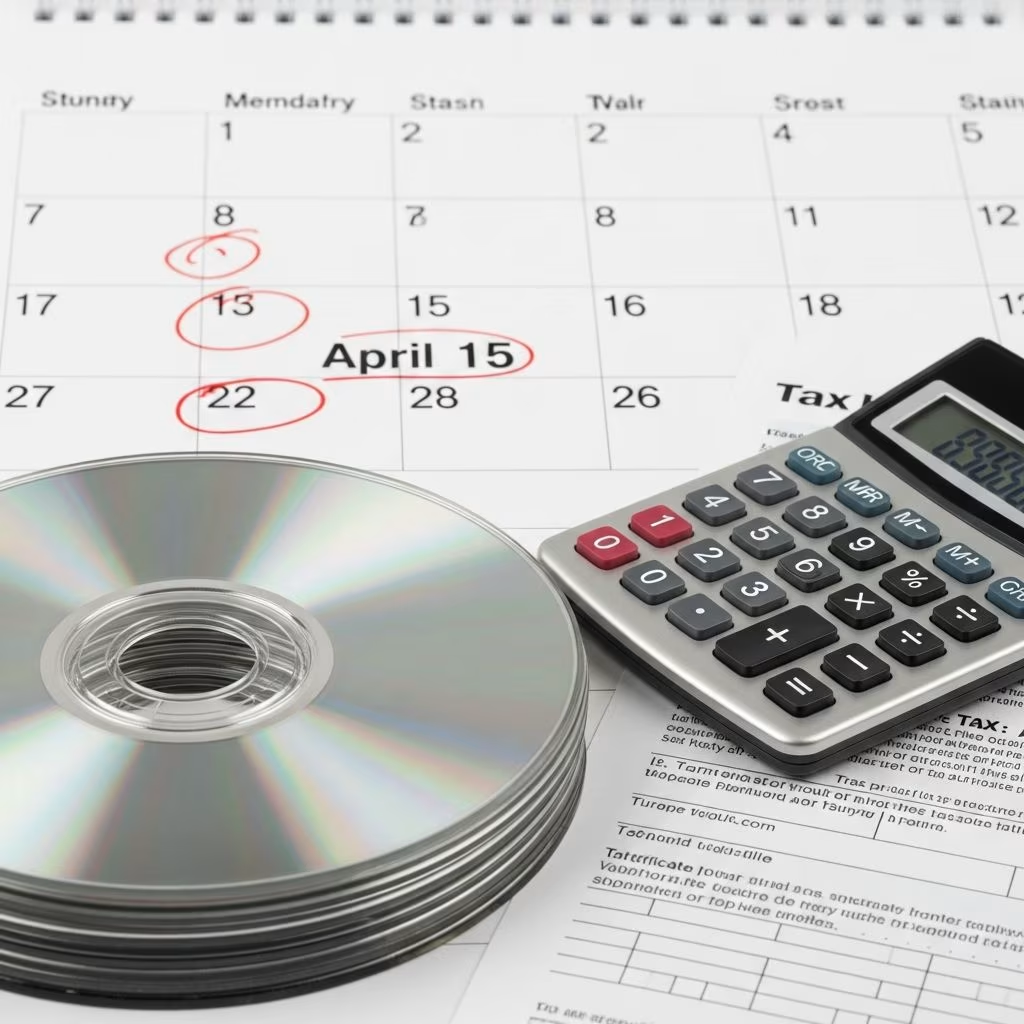
Certificates of deposit (CDs) can be a safe way to grow your savings, but the interest you earn rarely escapes the reach of taxes. Understanding when CD interest becomes taxable, how it is reported, and what you might do to manage the tax impact helps you avoid surprises at filing time.
This guide explains when tax is due on a CD, how the IRS treats interest income, the difference between CDs in taxable and tax-advantaged accounts, and common questions savers have about cashing in CDs and paying tax on their earnings.
Are CDs Taxable?
From the IRS’s perspective, most of the money you earn on a CD is treated as taxable interest income, not as capital gains. This means it is generally taxed at your ordinary income tax rate, just like wages or salary.
Key points about CD taxability include:
- Interest is taxable: The interest credited to your CD is taxable in the year it becomes available to you.
- Principal is not taxable: The amount you initially deposit is treated as a return of your own money, not income.
- Federal tax always applies in taxable accounts; state and local tax may apply depending on where you live.
- CD interest is not capital gains; it does not benefit from lower long-term capital gains rates.
If your CD is held in a standard, taxable bank account, you should expect to pay tax on your CD interest each year as it is credited.
When Is CD Interest Taxed?
The timing of when tax is due depends on when you are considered to have received the interest. The IRS states that interest is generally taxable in the year it is credited to your account and available to you, even if you leave it in the account.
In practice, that means:
- Short-term CDs (one year or less): Interest is usually taxable in the year it is paid or credited at maturity.
- Longer-term CDs (more than one year): Interest is taxable in each year you are legally entitled to it, even if the CD has not matured.
- Compounding CDs: If interest is posted annually or more frequently and you can withdraw it (possibly with a penalty), it is taxable in the year it posts.
Because of these rules, you can owe tax on a multi-year CD even though you haven’t yet taken the money out.
How Banks Report CD Interest (Form 1099-INT)
Banks and credit unions report your CD interest to you and to the IRS using Form 1099-INT when the total interest for the year is at least $10.
- Threshold: If you earn $10 or more in interest from a financial institution during the year, it must issue a 1099-INT.
- Box 1 – Interest income: Shows the amount of taxable interest paid to you during the calendar year.
- Box 2 – Early withdrawal penalty: Reports any penalty charged for withdrawing from a CD before maturity.
You should receive your 1099-INT at the beginning of the year, covering interest from the previous tax year. Even if you do not receive the form, you are still responsible for reporting taxable interest of $10 or more on your return.
Short-Term vs. Long-Term CDs
The core tax rules are the same for all CDs, but the timing often feels different depending on whether your CD is short-term or long-term.
| CD Type | Typical Term | When Interest Is Taxed | Key Consideration |
|---|---|---|---|
| Short-term CD | One year or less | Interest is taxable in the year it is paid, often at maturity. | All interest may appear on a single year’s 1099-INT. |
| Long-term CD | More than one year | Interest is taxable each year it accrues and is credited, even before maturity. | You may get 1099-INT forms over several tax years for one CD. |
Because long-term CDs often credit interest annually, you will usually report and pay taxes on that interest each year rather than all at maturity.
How CD Interest Is Taxed
Once interest is credited and reported, it is taxed as ordinary income based on your marginal tax bracket.
- Ordinary income treatment: CD interest is taxed at the same rate as wages or salary.
- Combined tax effects: High earners may see a meaningful portion of their nominal CD return reduced by taxes and inflation combined.
- State and local taxes: Many states also tax CD interest, adding to the overall tax cost.
For example, if you are in the 24% federal tax bracket and earn $1,000 in CD interest in a year, you may owe $240 in federal income tax on that interest, plus any applicable state and local taxes.
Taxable Accounts vs. Tax-Advantaged Accounts
Where you hold your CD can significantly change when you owe tax, even though the underlying behavior of the CD is similar.
- Regular taxable accounts: You report and pay tax on CD interest each year as it is credited.
- Traditional IRA or 401(k): CD interest generally grows tax-deferred; you pay income tax only when you withdraw money from the account.
- Roth IRA: Qualified withdrawals are tax-free, so CD interest may avoid taxation entirely if you follow Roth rules.
Tax-advantaged accounts do not change how the CD itself earns interest, but they can defer or eliminate income tax on that interest.
How to Report CD Interest on Your Tax Return
Reporting CD interest follows the general rules for interest income set by the IRS.
In most cases, you will:
- Gather Forms 1099-INT from each bank or credit union where you earned interest.
- Total your interest income from all forms, including CD interest and other bank interest.
- Enter taxable interest on the appropriate line of Form 1040 and on Schedule B if required.
- Report any tax-exempt interest separately if applicable (though CD interest is normally taxable).
Even if you receive no 1099-INT because you earned less than $10 at a particular institution, you are still required to report all taxable interest.
Early Withdrawal Penalties and Deductions
If you withdraw from a CD before it matures, your bank may charge an early withdrawal penalty. While penalties reduce your return, they can provide a small tax benefit.
- Penalty reporting: The early withdrawal penalty is shown in Box 2 of Form 1099-INT.
- Tax treatment: The penalty amount is generally deductible as an adjustment to income on your federal return, reducing your taxable income.
- Net effect: You still lose money overall, but the deduction may slightly lower the tax cost of the interest you earned.
Because the rules can change and deductions may interact with other areas of your return, many taxpayers consult a tax professional when dealing with substantial penalties.
Strategies to Manage or Reduce Tax on CD Interest
You cannot avoid reporting legitimate interest income, but you can plan how and where you hold CDs to better manage the tax impact.
- Use tax-advantaged accounts: Holding CDs in IRAs or 401(k)s can defer or eliminate tax on interest, depending on the account type.
- Consider your tax bracket: If you expect to be in a lower bracket in a future year, deferred taxation inside retirement accounts may be advantageous.
- Mind state taxes: Some investors compare CDs with Treasury securities, which are generally exempt from state and local income taxes, while CD interest is usually fully taxable.
- Coordinate maturity dates: Staggering CD maturities may help spread interest income across multiple years rather than concentrating it in one year.
Although CDs are straightforward products, treating them as part of a broader tax and savings plan can improve your after-tax return.
Common Scenarios for When Tax Is Due
Because the rules can sound abstract, it is helpful to look at typical situations and when tax is due in each one.
Scenario 1: One-Year CD in a Taxable Account
- You open a 12-month CD in a regular taxable account with a fixed rate.
- All interest is paid at maturity and credited to your account.
- The bank issues a 1099-INT showing the total interest for the year.
- You report that interest on your tax return for the year in which the CD matured.
Scenario 2: Three-Year CD with Annual Interest Credits
- You open a three-year CD that credits interest annually, which is added to the CD balance.
- Each year, the bank credits interest and reports the amount on Form 1099-INT.
- You owe tax on the interest each year, not just when the CD matures.
Scenario 3: CD Inside a Traditional IRA
- You buy a CD within a traditional IRA.
- Interest accrues and stays in the IRA; no Form 1099-INT is issued to you for annual interest.
- You do not report the CD interest yearly on your individual return; instead, you pay tax when you withdraw funds from the IRA, generally at ordinary income rates.
Scenario 4: Early Withdrawal and Penalty
- You break a CD before maturity and pay a penalty.
- Your 1099-INT shows both interest earned (Box 1) and the early withdrawal penalty (Box 2).
- You report the interest as income and may deduct the penalty, reducing your taxable income by that penalty amount.
Frequently Asked Questions (FAQs)
Q: Does cashing in a CD count as income?
Cashing in a CD itself is not income; it is simply converting your deposit back to cash. The interest portion of the payout is what counts as taxable income. The bank reports that interest on Form 1099-INT, and you must include it on your tax return for the year it was paid, even if you reinvest the funds.
Q: When do I pay tax on interest from a long-term CD?
For long-term CDs, you usually owe tax on the interest in each year you are legally entitled to it, which is typically when it is credited to your account, not only when the CD matures. If the bank credits interest annually and you could withdraw it (even with a penalty), that annual interest is taxable for that year.
Q: How do I report CD interest on my tax return?
You use Form 1099-INT from your bank to see how much interest you earned during the year. Taxable interest is reported on Form 1040 in the section for interest income, and on Schedule B if your total interest is above certain thresholds or you have specific reporting requirements. Even if you don’t receive a 1099-INT, you must still report all taxable interest.
Q: Can I avoid tax on CD interest?
You generally cannot avoid tax on interest earned in a regular taxable account, but you can defer or potentially eliminate tax by holding CDs in tax-advantaged accounts. CDs in traditional IRAs or 401(k)s grow tax-deferred; CDs in Roth IRAs can generate interest that may ultimately be withdrawn tax-free if you follow Roth distribution rules.
Q: Is CD interest taxed at capital gains rates?
No. CD interest is treated as ordinary income, not capital gains. It does not qualify for lower long-term capital gains tax rates, regardless of how long you hold the CD.
References
- Are Certificates of Deposit (CDs) Taxable? — SoFi. 2024-02-09. https://www.sofi.com/learn/content/are-certificates-of-deposit-taxable/
- How are CDs Taxed? Learn More About the Process — Annuity.org. 2023-10-12. https://www.annuity.org/personal-finance/banking/certificate-of-deposit/taxation/
- Paying tax on CD interest — Bankrate. 2024-05-03. https://www.bankrate.com/banking/cds/paying-tax-on-cd-interest/
- How Are CDs Taxed? Learn the Tax Implications — BMO. 2023-07-18. https://www.bmo.com/en-us/main/personal/bank-accounts/savings-and-cds/certificates-of-deposit/how-are-cds-taxed/
- Understanding Tax Implications of Certificates of Deposit — Seattle Bank. 2023-06-01. https://www.seattlebank.com/about/updates/updates-detail.html?title=understanding-tax-implications-of-certificates-of-deposit
- Topic No. 403, Interest Received — Internal Revenue Service. 2023-03-22. https://www.irs.gov/taxtopics/tc403
- How Are CDs Taxed? — Experian. 2023-09-07. https://www.experian.com/blogs/ask-experian/how-are-cds-taxed/
- CD or Treasury? Five Factors to Consider — Charles Schwab. 2024-01-10. https://www.schwab.com/learn/story/cd-or-treasury-five-factors-to-consider
This article is general information, not personal financial advice. Consider your own situation, or speak with a licensed adviser, before acting on it.