

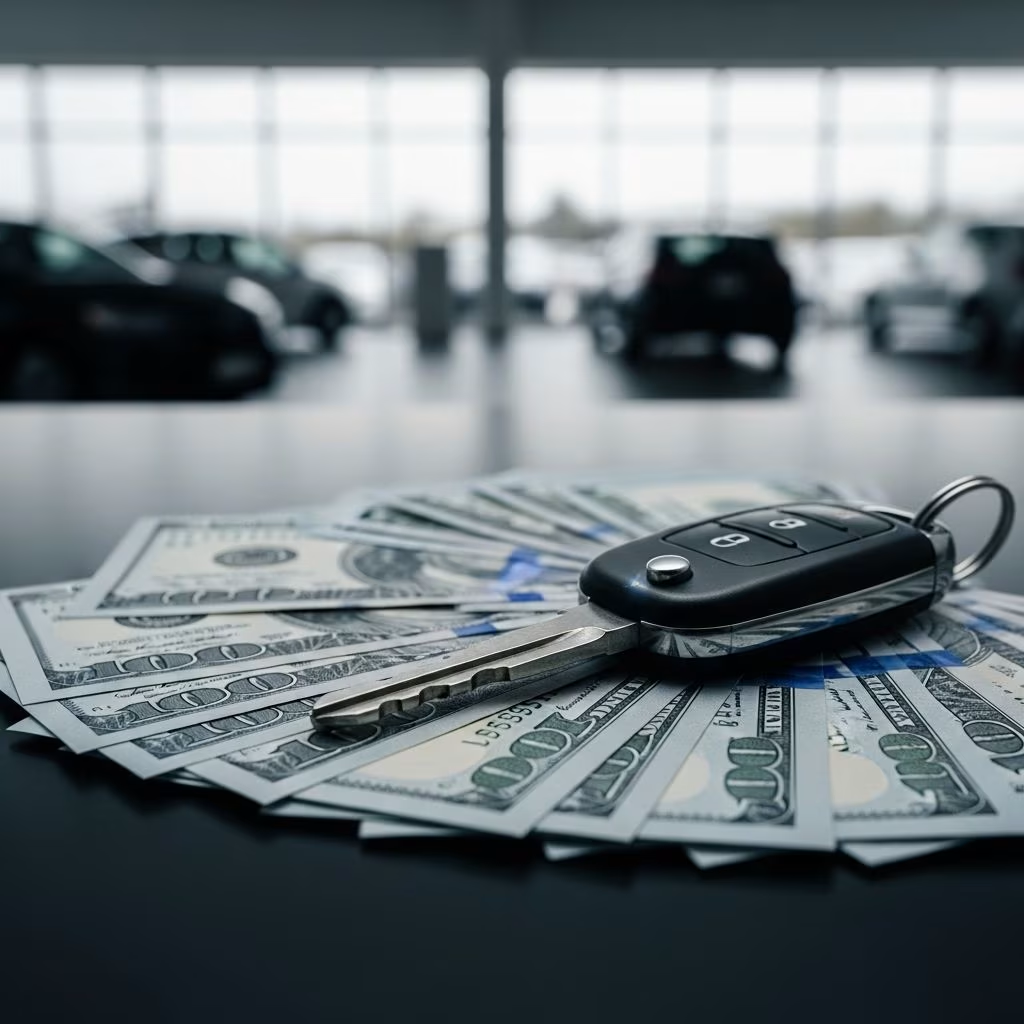
Acquiring a vehicle without an initial cash outlay is possible through specific financing arrangements, but it typically results in elevated borrowing costs and potential long-term financial strain. Lenders view zero-down loans as riskier, often imposing higher interest rates that can inflate the total purchase price significantly.
Understanding Zero Down Financing Basics
Zero down financing allows buyers to finance 100% of the vehicle’s cost, covering the full negotiated price plus taxes, fees, and any add-ons like extended warranties. This approach appeals to those short on savings, yet it demands strong creditworthiness. Borrowers with excellent credit profiles—typically scores above 700—stand the best chance of approval, as lenders mitigate risk through premium rates.
Common zero-down options include manufacturer incentives, particularly 0% APR promotions on select models. In March 2026, numerous automakers offer these deals, enabling interest-free borrowing for extended periods on popular SUVs, trucks, and EVs. For instance, buyers can secure 0% APR for up to 72 months on vehicles like the 2025 Kia EV6 or 2026 Kia EV9, potentially saving thousands in interest compared to standard 6-8% rates.
Current 0% APR Promotions Revolutionizing Deals
Manufacturer-backed 0% APR financing represents a prime avenue for zero-down purchases without excessive costs. These limited-time offers, valid through late March 2026, apply to dozens of models across brands. Hyundai leads with extensive options, followed by Kia, Nissan, and Dodge. Such promotions often pair with cash rebates or deferred payments, enhancing affordability.
| Brand | Model | 0% APR Terms | Expires |
|---|---|---|---|
| Hyundai | 2026 IONIQ 5 | 72 months + $5,000 bonus | 3/31/2026 |
| Kia | 2025 EV6 | 72 months | 3/2/2026 |
| Kia | 2026 EV9 | 60 months + $3,500 cash back | 3/31/2026 |
| Nissan | 2026 Rogue | 60 months (all trims) | 3/31/2026 |
| Dodge | 2026 Durango | 60 months | 3/2/2026 |
| Toyota | 2026 bZ | 72 months | 3/2/2026 |
These deals, drawn from manufacturer programs, underscore a buyer’s market with 49 active 0% offers. Opting for 0% over standard financing avoids interest accrual, but terms vary by trim and region—always verify eligibility at dealerships.
Eligibility Requirements for No-Money-Down Loans
Securing zero-down approval hinges on several factors. Lenders scrutinize credit scores via FICO models, favoring scores in the 720+ range for the lowest rates. Income stability, debt-to-income ratios under 36%, and employment history also play pivotal roles. Subprime borrowers (scores below 600) rarely qualify without co-signers or substantial trade-ins.
- Credit Score Thresholds: Prime (661-780): Possible with 0-10% down; Super Prime (781+): Often 0% down viable.
- Debt-to-Income (DTI): Below 45% ideal; higher ratios trigger denials.
- Proof of Income: Recent pay stubs, tax returns mandatory.
- Vehicle Limits: Newer models under $50,000 more likely approved.
Dealerships may roll negative equity from prior leases into new loans, but this escalates total debt. Pre-approval from banks or credit unions beforehand strengthens negotiating power.
Financial Pros and Cons of Skipping the Down Payment
While convenient, zero-down strategies carry trade-offs. On the positive side, they preserve liquidity for emergencies or other investments. Paired with 0% APR, they minimize costs—e.g., a $40,000 Kia Sorento at 0% for 48 months means equal monthly payments without interest creep.
Drawbacks loom larger: higher loan principals lead to steeper monthly payments and extended terms, increasing lifetime costs if rates exceed 5%. Lenders often mandate gap insurance or higher premiums, adding hundreds annually. Moreover, zero equity at purchase heightens negative equity risk if the car depreciates rapidly.
| Aspect | Zero Down | 10-20% Down |
|---|---|---|
| Average Interest Rate | 5-8% APR | 3-5% APR |
| Monthly Payment ($30k car, 60 mo) | $580-610 | $480-520 |
| Total Interest Paid | $5,000+ | $3,000-$4,000 |
| Equity Build | Slow | Immediate |
Data reflects typical 2026 market rates; 0% deals mitigate interest but remain time-sensitive.
Hidden Costs That Inflate Zero-Down Deals
Beyond the sticker price, zero-down buyers face add-ons like taxes (6-10% of value), title fees ($100-300), and documentation charges ($500+). Dealer-installed options, such as protection packages, often bundle in, pushing loans over MSRP. Sales tax on the full financed amount compounds expenses—e.g., 8% tax on $35,000 equals $2,800 added to principal.
Insurance escalates too; full coverage on a new $45,000 EV might run $2,500 yearly, versus $1,800 for used models. Fuel efficiency matters—hybrids like the 2026 Hyundai Tucson (38 mpg) cut ongoing costs. Always request itemized breakdowns to avoid surprises.
Strategies to Minimize Risks in No-Down Purchases
Shop during promotional windows like March 2026 for 0% APR stacking with rebates. Compare lender quotes via online tools, targeting credit unions for rates 1-2% below dealer financing. Negotiate aggressively on price first, using invoice data for leverage.
- Boost credit score pre-purchase by paying down debts.
- Trade in old vehicles to offset down payment needs.
- Select shorter loan terms (36-48 months) to build equity faster.
- Defer non-essential add-ons until post-purchase.
Leasing offers another zero-down path with lower monthly outlays, though mileage caps apply. For ownership, certified pre-owned (CPO) vehicles balance affordability and warranties.
Impact on Credit Scores and Long-Term Finances
Initiating a zero-down auto loan triggers hard inquiries, dinging scores by 5-10 points temporarily. High loan-to-value ratios signal risk, potentially raising future borrowing costs. Positive payment history can rebound scores within months, but missed payments devastate profiles.
Long-term, larger loans strain budgets—aim for payments under 15% of take-home pay. Building an emergency fund post-purchase cushions depreciation hits, where new cars lose 20% value in year one.
Alternatives to Traditional Zero-Down Financing
Credit unions and banks often undercut dealer rates for qualified buyers. Ride-sharing or public transit delays major purchases, allowing savings accumulation. Used car markets yield 20-30% discounts, enabling genuine down payments.
EV incentives, like federal tax credits up to $7,500, effectively reduce upfront costs when financing qualifies. Balloons payments—larger final sums—shorten terms but demand planning.
Frequently Asked Questions
Can anyone buy a car with no money down?
No, approval requires strong credit (700+ FICO), stable income, and low DTI. Subprime buyers typically need co-signers or trade-ins.
Are 0% APR deals truly free of interest?
Yes, for the term specified, but they demand excellent credit and may exclude rebates. Verify terms end dates, like March 31, 2026.
Does zero down affect insurance rates?
Yes, higher vehicle values and loan requirements often mandate comprehensive coverage, raising premiums 20-30%.
Is leasing better than zero-down buying?
Leasing suits low-mileage drivers with zero down, lower payments, but no ownership equity.
How much can I save with 0% vs. standard financing?
On a $40,000 loan over 60 months, 0% saves ~$6,000 versus 6% APR.
Final Considerations for Smart Buyers
Zero-down car buys suit those with stellar credit eyeing 0% deals, but weigh total ownership costs. Prioritize price negotiation, promotion timing, and financial readiness to avoid pitfalls. Consult multiple lenders and run affordability calculators before signing.
References
- Every Zero Percent Financing Offer For March 2026 — CarEdge. 2026-03. https://caredge.com/guides/zero-percent-financing-car-deals-march-2026
- Every New Car Offering 0 Financing in February 2026 — Cars.com. 2026-02. https://www.cars.com/articles/every-new-car-offering-0-financing-in-february-2026-521663/
- Best 0% APR Car Deals: March 2026 — CarsDirect. 2026-03. https://www.carsdirect.com/deals-articles/best-zero-percent-financing-deals
- 10 Best 0% APR Deals in March 2026 — Kelley Blue Book. 2026-03. https://www.kbb.com/best-cars/best-0-apr-financing-deals/
- Every 0% APR Car Deal in March 2026 — Carfax. 2026-03. https://www.carfax.com/deals/0-apr-car-deals
- Car Deals with 0% APR in March 2026 — CarGurus. 2026-03. https://www.cargurus.com/Cars/articles/0-apr-car-deals
- Best New Car Finance Deals for March 2026 — Car and Driver. 2026-03. https://www.caranddriver.com/shopping-advice/a69287293/best-new-car-finance-deals-this-month/
This article is general information, not personal financial advice. Consider your own situation, or speak with a licensed adviser, before acting on it.


