

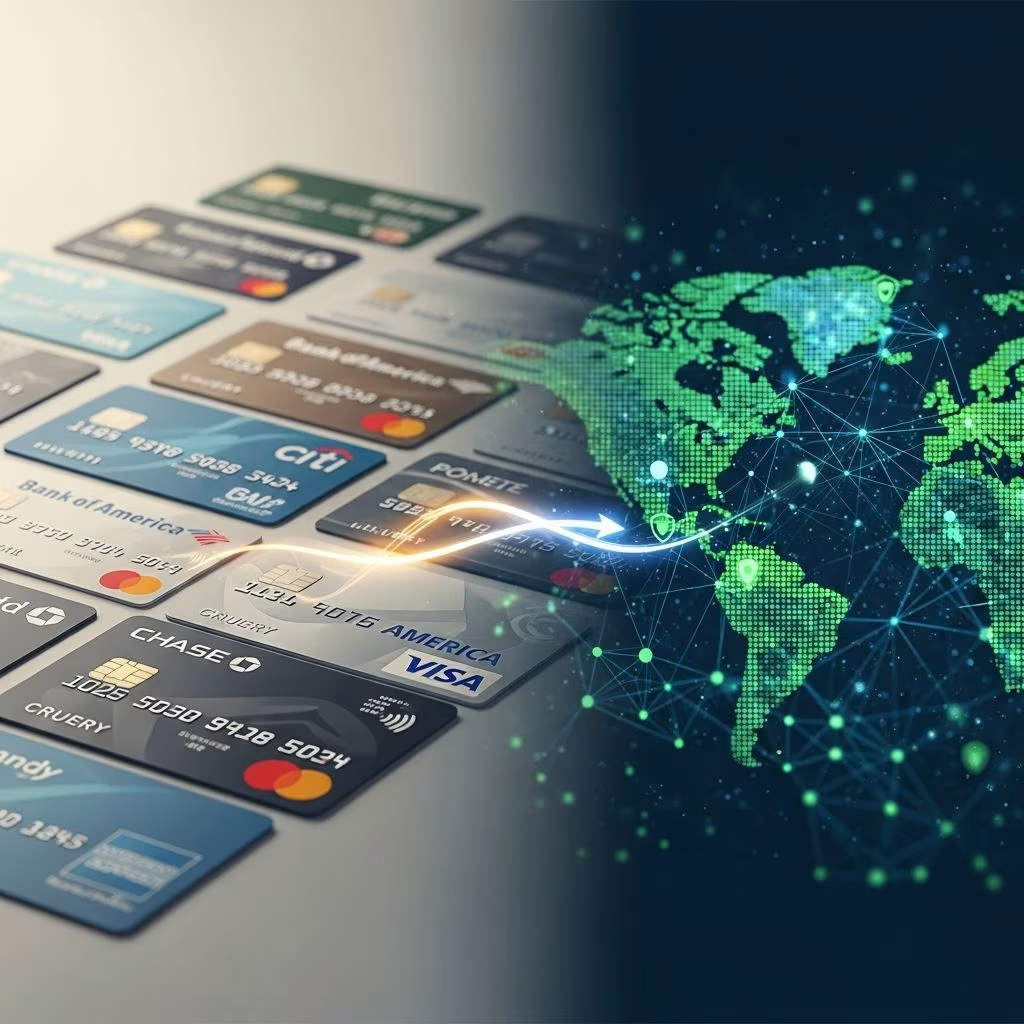
In the world of personal finance, credit cards serve as essential tools for everyday spending, travel rewards, and building credit history. However, few users fully grasp the dual-logo system on their cards—one representing the issuer and the other the network. This partnership is fundamental to every swipe, tap, or online checkout. Issuers provide the credit line and customer service, while networks handle the secure data flow across millions of merchants worldwide.
Understanding this distinction empowers better decisions on card selection, dispute resolution, and reward optimization. This comprehensive guide breaks down their roles, differences, transaction mechanics, major players, and practical advice, drawing from industry standards and operational realities.
Defining the Core Players in Credit Card Transactions
Every credit card transaction involves multiple entities working seamlessly behind the scenes. At the heart are credit card issuers and credit card networks, each with specialized functions that complement one another.
What Does a Credit Card Issuer Do?
Credit card issuers are typically banks or financial institutions that directly lend money to cardholders. They perform critical consumer-facing tasks:
- Evaluate and approve credit applications based on credit scores, income, and history.
- Assign personalized credit limits, interest rates (APRs), and fees like annual charges.
- Design rewards programs, such as cash back, travel points, or airline miles.
- Manage billing, payments, and customer support, including fraud claims and limit increases.
- Pay merchants upfront for purchases, then collect from cardholders over time.
Examples include Chase, Capital One, Bank of America, and Citi. These entities bear the financial risk of lending and thus set terms to mitigate defaults.
The Role of Credit Card Networks
Networks operate as the digital highways for payment data. They do not lend money or issue cards but ensure transactions route securely between buyers, sellers, and banks globally. Key responsibilities include:
- Building and maintaining processing infrastructure for authorization, clearing, and settlement.
- Setting security standards like EMV chip technology and tokenization for mobile payments.
- Determining merchant acceptance rules and interchange fees (the cut paid to issuers).
- Handling cross-border transactions and dispute protocols at scale.
Prominent networks are Visa, Mastercard, American Express, and Discover. They generate revenue through assessment fees on every transaction volume.
Key Differences: Issuers vs. Networks at a Glance
To clarify distinctions, consider this comparison table highlighting operational divides:
| Aspect | Credit Card Issuer | Credit Card Network |
|---|---|---|
| Primary Function | Lends credit and manages accounts | Processes and routes transactions |
| Customer Interaction | Direct: applications, billing, rewards | Indirect: infrastructure only |
| Revenue Sources | Interest, fees, interchange share | Assessment and processing fees |
| Decision on Approvals | Final say on credit availability | Routes requests, no lending |
| Risk Exposure | High: defaults and fraud losses | Low: tech and compliance focus |
This table underscores how issuers focus on relationship-building while networks prioritize scalability and security.
Inside a Credit Card Transaction: Step-by-Step Flow
A typical purchase reveals their synergy. Imagine buying coffee with a Visa card issued by Chase:
- Swipe or Tap: Merchant terminal captures card data.
- Acquirer Request: Merchant’s bank (acquirer) sends authorization via the Visa network.
- Network Routing: Visa forwards details to Chase for verification.
- Issuer Check: Chase reviews balance, fraud flags, and approves/denies.
- Response Loop: Approval zips back through Visa to merchant terminal.
- Settlement: Later, funds clear: issuer pays acquirer minus fees.
This four-party model (cardholder, issuer, network, merchant/acquirer) processes trillions annually with sub-second speeds.
Major Credit Card Networks: Profiles and Strengths
Four networks dominate 95%+ of U.S. volume, each with unique traits.
Visa: The Global Leader
Visa processes over 200 billion transactions yearly, excelling in international acceptance (accepted at 100M+ merchants). Strengths: robust fraud tools like Visa Secure and Visa Token Service.
Mastercard: Innovation Powerhouse
Similar scale to Visa, Mastercard emphasizes contactless (Mastercard Tap on Phone) and priceless experiences via partnerships. Wide acceptance rivals Visa.
American Express: Premium Closed Network
Amex issues its own cards, targeting high-spenders with superior rewards (e.g., Membership Rewards). Higher merchant fees (2.5-3.5%) limit some acceptance, but perks like purchase protection shine.
Discover: Value-Driven Option
Also closed-loop, Discover offers cashback and no foreign fees. Growing acceptance (now 99% of Visa/MC) with strong U.S. focus.
Open vs. Closed Networks: Visa/Mastercard (open) partner with thousands of issuers for ubiquity. Amex/Discover (closed) control issuance for tighter integration but narrower reach historically.
Revenue Mechanics: Fees That Fuel the System
Transactions generate fees split among parties:
- Interchange (1.5-3.5%): Merchant pays issuer primarily; networks take a sliver.
- Assessment (0.1-0.15%): Network’s direct cut.
- Processing: Acquirers handle markup.
Issuers reinvest in rewards (e.g., 2% cashback offsets ~1.5% interchange). Networks fund tech upgrades. Recent regulations cap fees in some regions, spurring efficiency.
Consumer Impacts: Rewards, Security, and Disputes
Rewards and Perks
Issuers craft bonuses tied to spending categories; networks enable global redemption (e.g., Visa Signature perks). Co-branded cards blend both, like Chase Sapphire with United Airlines.
Fraud Protection and Security
Networks enforce standards (PCI DSS compliance); issuers offer zero-liability policies. Tools like 3D Secure add layers.
Handling Disputes and Issues
Contact issuer for chargebacks or errors—they mediate. Networks assist on acceptance refusals. Response times vary: issuers 1-2 days, networks systemic fixes.
Choosing the Right Combination for Your Needs
Match issuer-network pairs to lifestyle:
- Travelers: Chase Visa or Amex for lounges/airport perks.
- Cashback Fans: Citi Mastercard or Discover.
- Everyday: Bank of America Visa for no-fee basics.
Check acceptance maps; compare APRs (issuer-driven) vs. global reach (network-driven). Tools like annual fee calculators help.
Future Trends: Evolution of Issuers and Networks
Digital shifts loom: buy-now-pay-later integration, central bank digital currencies, and AI fraud detection. Networks push tokenization for Apple Pay/Google Wallet; issuers expand embedded finance in apps. Expect tighter collaboration amid regulatory scrutiny on fees.
Frequently Asked Questions (FAQs)
Who should I call for a disputed charge?
Your card issuer handles disputes and chargebacks directly.
Can I use any Visa issuer at any Visa merchant?
Yes—networks standardize acceptance regardless of issuer.
Why do some cards have higher rewards?
Issuers fund them from interchange; premium networks like Amex add value.
What’s the difference between open and closed networks?
Open (Visa/MC) partner with banks; closed (Amex/Discover) issue directly for control.
Do networks set my interest rate?
No, issuers determine APRs and limits exclusively.
References
- Credit Card Network vs Issuer: What Is the Difference? — Wallester. 2023-10-15. https://wallester.com/blog/business-insights/credit-card-network-vs-issuer-what-is-the-difference
- Credit Card Network vs Issuer: What Is the Difference? — SoFi. 2024-05-20. https://www.sofi.com/learn/content/credit-card-network-vs-issuer/
- Credit card networks explained — Stripe. 2024-08-12. https://stripe.com/resources/more/how-do-credit-card-networks-work
- What is a credit card network? — CLOWD9. 2023-11-08. https://www.clowd9.com/blog/what-is-a-card-network
- What’s the difference between a credit card network and issuer? — The Points Guy. 2024-02-14. https://thepointsguy.com/credit-cards/whats-the-difference-between-a-credit-card-network-and-issuer/
- Credit card issuers vs networks: What’s the difference? — Chase. 2024-06-01. https://www.chase.com/personal/credit-cards/education/basics/credit-card-issuer-vs-network
This article is general information, not personal financial advice. Consider your own situation, or speak with a licensed adviser, before acting on it.


