

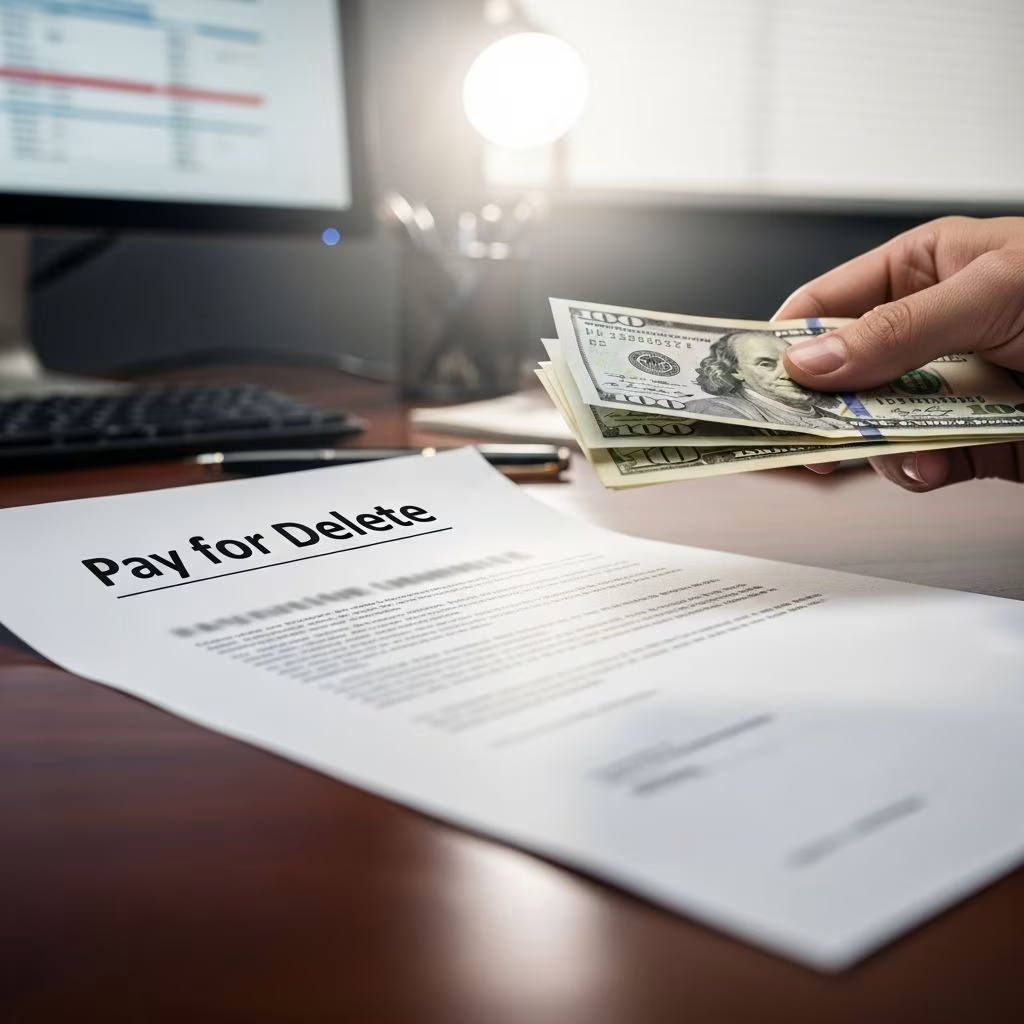
A **pay for delete letter** is a powerful negotiation tool designed to remove negative collection accounts from your credit report in exchange for full or partial payment of the debt. This strategy targets collection agencies or original creditors holding delinquent accounts, offering them immediate payment if they agree to delete the tradeline entirely from reports filed with Equifax, Experian, and TransUnion.
While not guaranteed, pay for delete agreements have helped many consumers improve their credit scores by eliminating derogatory marks that can linger for up to seven years. Success often hinges on crafting a clear, professional letter with specific terms, understanding collection agency motivations, and following up persistently. This comprehensive guide covers everything from mechanics and templates to legality, risks, and alternatives.
What Is a Pay for Delete Letter?
A pay for delete letter is a formal written agreement proposal sent to a creditor or collection agency. In it, you offer to pay the outstanding balance (or a negotiated settlement amount) on a collection account **in exchange for complete removal** of all related negative information from your credit reports.
Unlike standard debt payments—which typically result in the account being marked as ‘paid collection’ or ‘settled,’ still visible to lenders—this arrangement requests total deletion, as if the account never existed. Collection agencies may accept because they often purchase debts for pennies on the dollar and prioritize quick cash recovery over long-term reporting.
Key elements typically include:
- Account details (number, original creditor, balance).
- Your payment offer and method.
- Explicit deletion terms for all three major credit bureaus.
- Request for written confirmation on company letterhead before payment.
- A response deadline (e.g., 10-15 days).
This approach works best for legitimate but aged collections where the agency has little incentive to litigate and values immediate funds.
How Does a Pay for Delete Letter Work?
Pay for delete leverages the business model of debt collectors. Many agencies buy delinquent accounts at 4-10% of face value from original creditors. For a $1,000 debt bought for $50-100, your full payment represents pure profit if they delete rather than report.
Step-by-Step Process:
- Verify the Account: Pull free credit reports from AnnualCreditReport.com to confirm details. Dispute inaccuracies first via FCRA procedures.
- Research the Collector: Contact them to gauge willingness. Note if they’re a first-party (original creditor) or third-party buyer.
- Draft and Send the Letter: Use certified mail for proof. Include all specifics.
- Negotiate Terms: They may counter with partial deletion or ‘paid’ status—hold firm for full removal.
- Get Written Agreement: Only pay after receiving signed confirmation.
- Make Payment: Use trackable methods like cashier’s check or wire.
- Monitor Reports: Check bureaus 30-45 days later. Follow up if not deleted.
Success rates vary (20-50% per consumer reports), higher with smaller agencies lacking strict bureau contracts. Newer FICO 9 and VantageScore 3.0 ignore paid collections, reducing urgency for some, but older models used by many lenders still penalize them heavily.
Pay for Delete Letter Template
Use this customizable **pay for delete letter template**. Replace bolded sections with your details. Print on professional letterhead if possible, and send via certified mail with return receipt.
[Your Full Name]
[Your Address]
[City, State, ZIP Code]
[Date][Collection Agency Name]
[Agency Address]
[City, State, ZIP Code]Re: Account Number: [XXXXXXXXXXX]
Original Creditor: [Original Creditor Name]
Amount Owed: $XXX.XXDear Sir or Madam,
I am writing to negotiate a one-time settlement for the above-referenced account. I propose paying $XXX.XX in full via [cashier’s check/money order/wire transfer] in exchange for the following:
- Complete removal of all references to this account from my credit files at Equifax, Experian, and TransUnion.
- No reporting as ‘paid collection,’ ‘settled,’ or any negative status.
- Confirmation that this payment satisfies the debt in full.
This offer is contingent upon receiving your signed agreement on company letterhead from an authorized representative within 15 days. Upon receipt, I will remit payment immediately.
If no response is received by [specific date], this offer is withdrawn. This letter does not acknowledge the debt or waive validation rights under FDCPA.
Sincerely,
[Your Full Name]
[Phone Number]
[Email]
Pro Tip: For partial settlements, adjust the amount (e.g., 50-70% of balance) but emphasize deletion. Always retain copies.
Is a Pay for Delete Letter Legal?
Yes, pay for delete letters are **fully legal** under the Fair Debt Collection Practices Act (FDCPA) and Fair Credit Reporting Act (FCRA). They constitute legitimate negotiation, and no law prohibits creditors from deleting accurate information voluntarily.
However:
- No Obligation: Creditors aren’t required to accept or respond.
- Bureau Policies: Equifax, Experian, and TransUnion discourage deleting accurate data via contracts with furnishers, making large creditors less receptive.
- Accuracy Matters: You can’t demand deletion of verifiable debts; focus on negotiation, not disputes for valid items.
The Consumer Financial Protection Bureau (CFPB) oversees practices, ensuring no abusive tactics. Smaller agencies often comply to secure payment.
Pros and Cons of Pay for Delete Letters
| Pros | Cons |
|---|---|
|
|
Ideal for consumers with 1-2 collections impacting loans/mortgages.
When Should You Use a Pay for Delete Letter?
Best scenarios:
- Third-party collections under $2,000.
- Accounts 1-3 years old (agencies eager to close).
- You’re financially stable to pay immediately.
- Near major credit events (homebuying, job requiring checks).
Avoid if disputable (use FCRA disputes instead), tax debts, or student loans (different rules). Consult professionals for complex cases.
Alternatives to Pay for Delete
- Dispute Inaccuracies: Free via bureaus if unverified.
- Goodwill Letters: Request deletion from original creditor post-payment.
- Debt Validation: Challenge collectors under FDCPA.
- Credit Counseling: Nonprofit help for settlements.
- Bankruptcy: Last resort for multiples.
Frequently Asked Questions (FAQs)
What is the success rate of pay for delete letters?
Success varies from 20-50%, higher with small agencies buying debts cheaply. No guarantees, but low effort to try.
Will pay for delete work on original creditors?
Less likely; they prioritize accuracy contracts. Better for third-party collectors.
What if they don’t delete after payment?
Have proof of agreement. Dispute with bureaus citing the contract; sue for breach if needed.
Does paying a collection hurt my score?
Payment itself doesn’t; it stays as ‘paid.’ Deletion is key for max improvement.
Can I use this for settled accounts?
Yes, negotiate retroactive deletion if recently settled.
References
- Pay for delete letter template + sample for credit repair — Lexington Law. 2023-10-15. https://www.lexingtonlaw.com/blog/finance/pay-for-delete-letter.html
- What Is A Pay-For-Delete Letter And How Do You Write One? — Bankrate. 2024-05-22. https://www.bankrate.com/personal-finance/credit/what-is-a-pay-for-delete-letter/
- Are Pay for Delete Letters Effective? — Upsolve. 2024-08-10. https://upsolve.org/learn/are-pay-for-delete-letters-effective/
- Do ‘pay for delete’ letters work to clean up your credit report? — Boston 25 News (Clark Howard). 2023-11-05. https://www.boston25news.com/consumer/clark-howard/clark-your-life/do-pay-for-delete-letters-work-to-clean-up-your-credit-report/955954044/
- Sample Pay for Delete Letter for Collection Accounts — HSH.com. 2022-07-18. https://www.hsh.com/homebuyer/collection-pay-for-delete-letter.html
This article is general information, not personal financial advice. Consider your own situation, or speak with a licensed adviser, before acting on it.


